
News Details
EKA Mobility's Software-First EV Strategy to Scale-Up Growth
Summary
Forget just selling trucks. EKA is exporting a whole platform architecture. Software at the top, hardware follows. Inside their plan to take 'Bharat Ki EKA' global.
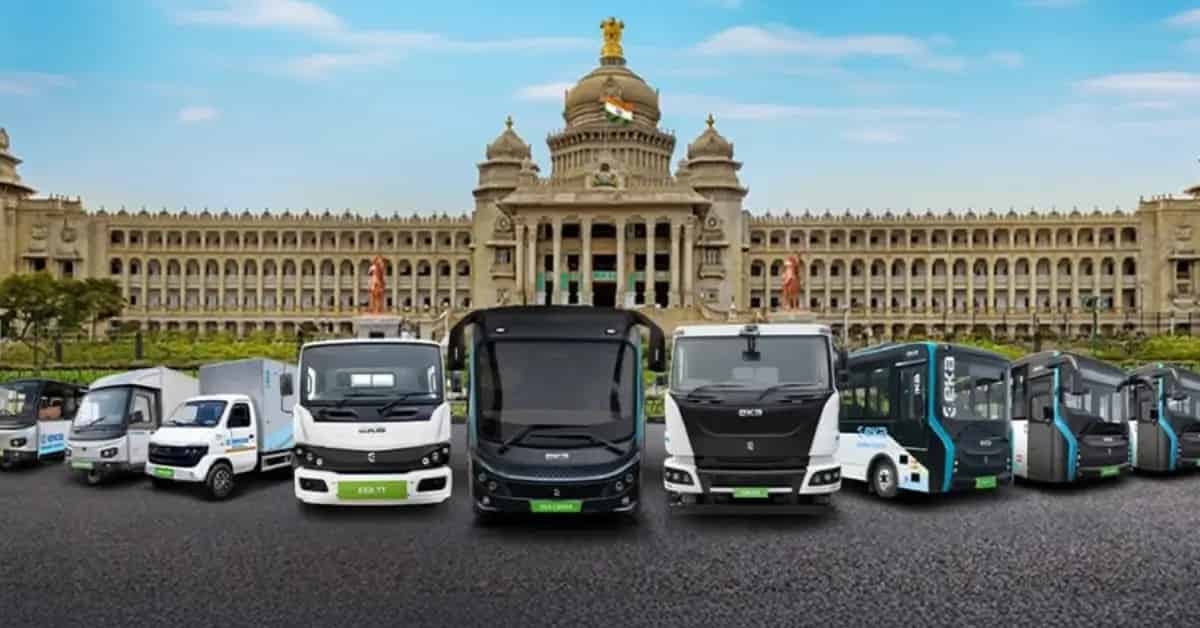


EKA Mobility is betting big on software-defined vehicles to drive its next growth phase. The Pune-based electric commercial vehicle company is building a modular EV operating system designed to scale across geographies and use cases.
Software Sits at the Top Layer of EKA's Architecture
"We are fundamentally building software-defined vehicles," the Chief Product Officer, Zoeb Karampurwala said. "Our top layer is software: EKA Intellify, EKA Connect, and the EKA platform working together as a full ecosystem. The hardware and manufacturing simply follow that intelligence." Every deployed vehicle becomes a data-generating node, supported by an ecosystem ensuring predictive reliability and uptime.
3R Philosophy Guides Hardware Design
At the heart of EKA's product strategy lies the 3R philosophy: reusability, repairability, and reliability. Vehicles are engineered so components can be optimized across multiple platforms, serviced quickly in real-world conditions, and trusted over long operating cycles. This framework challenges the throwaway mindset often associated with new technologies.
Global Expansion Through Distributed Manufacturing
EKA is focusing on physical global presence beyond traditional exporting. The company entered the African market through a partnership with Ethiopian business group Kerchanshe Trading PLC to distribute, assemble, and service electric buses across East Africa. "We want to take the 'Bharat Ki EKA' philosophy to the world," Karampurwala stated. "This isn't just about shipping vehicles; it is about exporting a complete platform architecture."
CKD Kits Enable Regional Economic Participation
Platforms are engineered with left-hand-drive flexibility built in from inception. Completely knocked-down kits are shipped overseas, with final assembly creating regional economic participation in partner countries. Core design and manufacturing intelligence remain anchored in India. This blueprint allows Indian engineering to become the global backbone while keeping the business asset-light and scalable.
Flexible Manufacturing Footprint Across Three Plants
EKA operates two Pune facilities at Koregaon Bhima and Chakan as tightly integrated hubs. The Chakan plant has current capacity of 24,000 units, stretchable to nearly 30,000 without significant fresh investment. An upcoming plant at Pithampur in Madhya Pradesh will focus on buses with 10,000-unit capacity. Combined manufacturing footprint will reach around 38,000 units. Plants are extremely flexible, with the same line capable of producing different vehicle lengths and configurations.
Three-Wheelers Electrifying Fastest, Heavy Trucks Next
Karampurwala sees demand tied closely to use case. Three-wheelers are already over 40% electric in new sales and will electrify fastest. Small commercial vehicles are now taking off. Buses will continue to be driven by government tenders for the next three to four years. He noted rapid readiness of heavier segments, with EKA's truck platform already ready. Government push for corridor electrification like the Mumbai–Delhi route will accelerate 55-tonne truck and tipper adoption faster than many anticipate.
Also Read : Indian CV Sales Jump to 27% in January to 99,544 Units on GST Cut
Building Beyond Subsidies for Sustainable Economics
Karampurwala insisted on self-reliance rather than subsidy dependence. "Subsidies should accelerate adoption, not sustain business models," he emphasized. He described EV evolution in three phases: Phase-1 was electrification as differentiation; Phase-2 is localisation and volume ramp-up; Phase-3 is deep optimisation, cost efficiency, and vertical integration. "EKA started preparing for Phase-3 five years ago," he said. "If a product cannot stand on its own economics today, it is not ready for the future."
Safety and Hydrogen Readiness Built In
On battery safety, the approach is uncompromising. EKA uses only A-grade cells and applies multiple proactive safety layers, integrating the BMS with an additional layer through the VCU. Platforms are adaptable and hydrogen-ready. While commercial viability depends on hydrogen cost, a fuel-cell vehicle still relies on an EV powertrain architecture, which aligns perfectly with EKA's core strength.
Also Read : Gas Powered Commercial Vehicle Market to Hit $151.91 Billion by 2035