Atut Sangam High Power Battery E-Rickshaw vs Kaptech Auto E-Rickshaw vs Kaptech Battery E-Rickshaw vs Kaptech Battery E-Rickshaw 4 Seater/Electric vs Kaptech Eco Friendly vs Kaptech Passenger E-Rickshaw: Price & Specs Comparison
By TruckOnWheels Editorial Team · Last updated 30 Jan 2026
Atut Sangam High Power Battery E-Rickshaw and Kaptech Auto E-Rickshaw and Kaptech Battery E-Rickshaw and Kaptech Battery E-Rickshaw 4 Seater/Electric and Kaptech Eco Friendly and Kaptech Passenger E-Rickshaw are compared here on price, engine, mileage, and specifications to help you pick the right truck for your business.
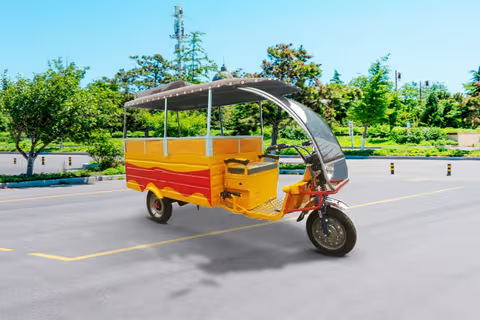 Atut Sangam High Power Battery E-Rickshaw ₹92.00 K | 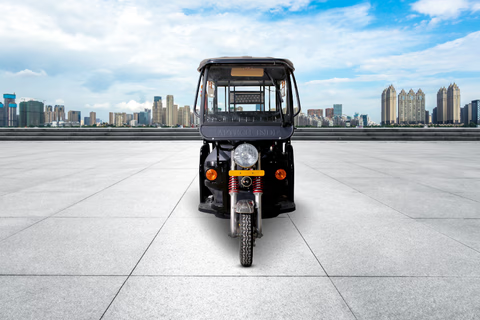 Kaptech Auto E-Rickshaw ₹90.00 K | 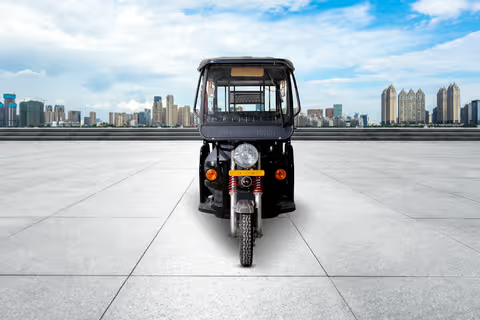 Kaptech Battery E-Rickshaw ₹90.00 K | 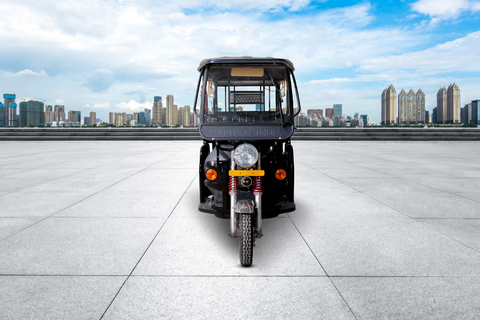 Kaptech Battery E-Rickshaw 4 Seater/Electric ₹90.00 K | 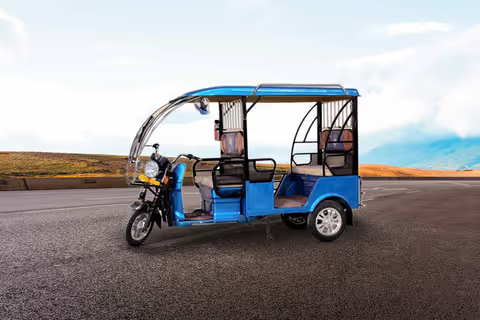 Kaptech Eco Friendly ₹90.00 K | 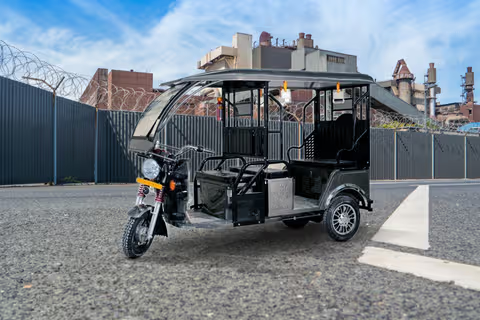 Kaptech Passenger E-Rickshaw ₹90.00 K | |
|---|---|---|---|---|---|---|
| Price | ₹92.00 K | ₹90.00 K | ₹90.00 K | ₹90.00 K | ₹90.00 K | ₹90.00 K |
| Body Type | E Rickshaw | E Rickshaw | E Rickshaw | E Rickshaw | E Rickshaw | E Rickshaw |
| Engine | NA | NA | NA | NA | NA | NA |
| Power | 1 hp | 1 hp | 1 hp | 1 hp | 1 hp | 1 hp |
| Max Torque | NA Nm | NA Nm | NA Nm | NA Nm | 22 Nm Nm | NA Nm |
| Mileage | 80 km | 70-80 KM/Full Charge | 70-80 KM/Full Charge | 70-80 KM/Full Charge | 80 -100 KM/Full Charge | 70-80 KM/Full Charge |
| Gross Vehicle Weight | 750 kg | 772 kg | 500 kg | 500 kg | 700 kg | 772 kg |
| Payload | NA | NA | NA | NA | NA | NA |
| No. of Tyres | 3 | 3 | 3 | 3 | 3 | 3 |
| Fuel Type | Electric | Electric | Electric | Electric | Electric | Electric |
| Gear Box | 1 Forward + 1 Reverse | 1 Forward + 1 Reverse | 1 Forward + 1 Reverse | 1 Forward + 1 Reverse | 1 Forward + 1 Reverse | 1 Forward + 1 Reverse |
| Chassis Type | Chassis with Cabin | Chassis with Cabin | Chassis with Cabin | Chassis with Cabin | Chassis with Cabin | Chassis with Cabin |
You can compare up to 6 trucks at a time.
Review
Pros & Cons
Atut Sangam High Power Battery E-Rickshaw
Pros
- The phrase Atut Sangam suggests robustness and reliability, appealing to a customer's need for a durable vehicle.
- High Power Battery directly communicates superior performance, longer range, and potentially better load carrying capacity.
- The name clearly identifies it as an electric vehicle, highlighting its environmental friendliness and lower running costs.
Cons
- The name is excessively long and complex, making it difficult to remember, pronounce, or use in marketing campaigns.
- Atut Sangam may not be easily understood or remembered by non Hindi speaking audiences, potentially limiting broader appeal.
- High Power Battery could imply a higher initial purchase price compared to standard battery models, potentially deterring budget conscious buyers.
Kaptech Auto E-Rickshaw
Pros
- The Kaptech Auto E Rickshaw stands out with its class-leading fuel efficiency, offering an impressive 35 km/kg for its CNG variant and a robust 32 km/l for the Diesel model, significantly reducing operational costs for Indian businesses.
- With multiple fuel options (Diesel, Petrol, CNG) and a practical payload capacity ranging from 600 kg to 750 kg, the Kaptech Auto E Rickshaw provides excellent versatility for diverse last-mile delivery and intra-city cargo needs.
- Its compact dimensions and small turning radius make the Kaptech Auto E Rickshaw exceptionally agile and easy to navigate through congested Indian city streets and narrow lanes, ensuring quick deliveries and efficient operations.
Cons
- While excellent for city duties, the Kaptech Auto E Rickshaw's smaller engine (e.g., 16 HP Diesel, 23 HP CNG/Petrol) and top speed can feel underpowered on highways, restricting its suitability for longer inter-city hauls.
- The interior is primarily functional, offering very basic amenities and limited cabin space which might lead to driver fatigue on extended shifts and lacks modern convenience features expected in some competing models.
- The relatively smaller wheel size, while aiding maneuverability, can sometimes compromise ride comfort and stability when traversing rough patches or uneven road surfaces common across India.
Kaptech Battery E-Rickshaw
Pros
- The name immediately informs customers that it is an electric rickshaw powered by a battery.
- Kaptech suggests a focus on technology and modern engineering.
- Clearly communicates the environmental benefits and potentially lower running costs.
Cons
- The overall name is quite long and can be challenging to recall or pronounce easily.
- It sounds more like a generic product specification than a distinct brand identity.
- The Battery E Rickshaw portion is highly descriptive but lacks uniqueness.
Kaptech Battery E-Rickshaw 4 Seater/Electric
Pros
- The Kaptech Battery E Rickshaw 4 Seater Electric range, encompassing its highly efficient Diesel and CNG variants (offering best-in-class mileage of around 32 km/l and 35 km/kg respectively) alongside the cost-effective electric model, promises exceptionally low running costs crucial for maximizing daily profits.
- With a robust chassis adaptable for both passenger movement in its 4-seater electric configuration and compact cargo delivery across its fuel variants, the Kaptech Battery E Rickshaw 4 Seater Electric offers unparalleled versatility for diverse business needs from last-mile connectivity to small-scale logistics.
- Its compact dimensions and nimble turning radius make the Kaptech Battery E Rickshaw 4 Seater Electric an ideal choice for navigating congested city streets and narrow lanes, ensuring quick and efficient operations in urban and semi-urban environments.
Cons
- While efficient for intra-city routes, the relatively limited power output across the Kaptech Battery E Rickshaw 4 Seater Electric family might feel insufficient for longer hauls or routes with steep inclines, especially when fully loaded with either passengers or cargo.
- Designed primarily for utility and economy, the interior comfort and basic amenities of the Kaptech Battery E Rickshaw 4 Seater Electric are quite utilitarian, which might be a consideration for drivers or passengers on extended duty cycles.
- For the electric variant of the Kaptech Battery E Rickshaw 4 Seater Electric, the existing limited public charging infrastructure and potential range anxiety on extended routes remain practical concerns for operators heavily dependent on consistent daily operations.
Kaptech Eco Friendly
Pros
- The name clearly highlights an environmental benefit, appealing to conscious buyers and green policies.
- It projects a modern and technologically advanced image for the brand.
- Specifically targets a growing market segment interested in sustainable transport solutions.
Cons
- The 'Eco Friendly' claim sets high expectations that the truck must consistently deliver upon.
- Might be perceived as more expensive upfront due to advanced environmental technologies.
- Could have a narrower appeal compared to names emphasizing raw power or traditional ruggedness.
Kaptech Passenger E-Rickshaw
Pros
- Zero tailpipe emissions contributing to cleaner urban air
- Lower running costs due to cheaper electricity compared to fossil fuels
- Significantly reduced noise pollution enhancing urban peace
Cons
- Limited driving range on a single battery charge
- Availability of adequate public charging infrastructure can be a challenge
- Longer charging times required compared to refueling conventional vehicles
Which to buy
Which One Fits Your Use Case?
Atut Sangam High Power Battery E-Rickshaw
Best for:
- Intercity transport of goods
Kaptech Auto E-Rickshaw
Best for:
- Transport
Kaptech Battery E-Rickshaw
Best for:
- Transport
Kaptech Battery E-Rickshaw 4 Seater/Electric
Best for:
- Transport
Kaptech Eco Friendly
Best for:
- Transport
Kaptech Passenger E-Rickshaw
Best for:
- Transport
FAQs