
 Electric Vehicle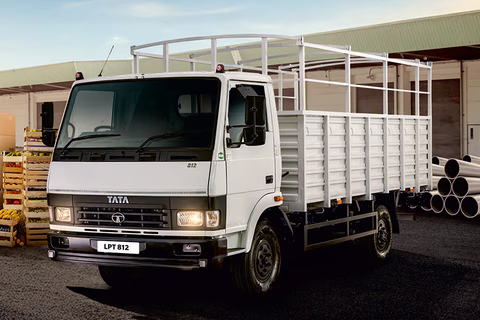
Tata LPT 812
Est. Showroom Price
Price Coming Soon
About
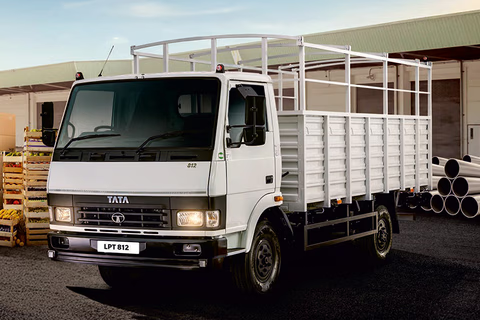
The Tata LPT 812 is built for a specific job. It moves loads between three and five tonnes in cities and on district roads. Think FMCG deliveries, courier parcels, fruits and vegetables, packaged water, construction supplies. That kind of work.
What makes it unusual is simple. It carries a five-tonne rated payload on four tyres, not six. No other truck in this segment does that right now. Fewer tyres means lower replacement costs over time. It also simplifies maintenance. For a first-time truck owner or a small fleet operator, that difference adds up over three years.
Tata launched it in late 2025. It meets BS6 Phase 2 emission norms. Four variants are available. The deck lengths are 14.2 ft and 17.1 ft. Each comes in two body styles. CBC is a flat open deck, suited for construction materials, pipes, and long bundled goods. HSD is a high-side deck, better for cartons, sacks, and courier loads. Most buyers go with the 17.1 ft HSD. It handles mixed loads well.
Pricing has not been officially announced. Segment positioning suggests an ex-showroom range of around Rs 15 to 18 lakh. Add 12 to 18 percent for registration, insurance, and dealer costs to get a realistic on-road figure.
The engine is a 3,300cc diesel unit. It produces 125 PS and 360 Nm of torque. That torque arrives between 1,400 and 2,400 rpm. That is the range where a loaded truck spends most of its working hours. Strong pull without needing high revs means less engine strain and better fuel use. Gradeability is rated at 26.4 percent under load. That is better than most four-tyre alternatives in this class. The gearbox is a five-speed manual.
Tata has not published official mileage numbers. Based on similar engines, expect around 7 to 9 kmpl on highway under full load. City driving loaded will be closer to 6 to 8 kmpl. The fuel tank holds 90 litres. An 18-litre AdBlue tank is also on board.
The load body on the 17.1 ft variant measures 5,218 mm in length and 1,962 mm in width inside. That width fits standard EUR pallets without overhang. Ground clearance is 216 mm. Wheelbase is 3,920 mm. Tyres are 245/90R16 radials on all four wheels.
Inside the cabin, the steering column is tilt-and-telescopic. Seats have decent back support. Air conditioning is available, though buyers should confirm with the dealer if it is standard across all variants. There is no touchscreen or reverse camera. The dashboard is functional but dated in design.
Braking is fully pneumatic with S-Cam air brakes and automatic wear adjusters. There is no ABS. No electronic braking aids are fitted. It is a working truck and the safety kit reflects that.
Tyre cost savings are one of the clearest ownership benefits. A full four-tyre replacement set costs roughly Rs 32,000 to 48,000. A comparable six-tyre truck costs Rs 48,000 to 72,000 for the same job. At fuel costs near Rs 13 per km in city loaded conditions, a truck doing 150 km a day will spend around Rs 50,000 to 60,000 a month on diesel.
The warranty is three years or three lakh km, whichever comes first. Tata backs this with over 3,200 service points across India. That reach matters in Tier 2 and Tier 3 towns more than most specs on a sheet.
Against rivals like the Eicher Pro 2059XP, Mahindra Furio 8, and Tata 710 LPT, the LPT 812 leads on rated payload and engine output. It is the only four-tyre option in the group. On urban and district routes, that combination of payload capacity and lower running costs is its strongest case.
Specifications
Tata LPT 812 Key Specifications
Number of Tyres4
GVW8500 kg
Payload5,000 kg
Power
- 123 hp
Mileage
- 5-6 kmpl
Fuel Tank Capacity90 Ltr
Fuel TypeDiesel
Max Torque360 Nm
Max Speed80 kmph
Gear BoxG400 (5F+1R) Cable shift mechanism
Engine3300 cc
Chassis TypeChassis with Cabin
All Variants
Tata LPT 812 Variants
| Variant Name | Price | Mileage | Fuel Type | Action |
|---|---|---|---|---|
| 3920/17.1 Ft/HSD | Coming Soon | 5-6 kmpl | Diesel | Details |
| 3920/14.2 Ft/CBC | Coming Soon | 5-6 kmpl | Diesel | Details |
| 3920/14.2 Ft/HSD | Coming Soon | 5-6 kmpl | Diesel | Details |
| 3920/17.1 Ft/CBC | Coming Soon | 5-6 kmpl | Diesel | Details |
Series
Explore Tata Series
Applications
Tata LPT 812 Key Use Cases
Use Case 1
Construction material transport
Use Case 2
Logistics
Use Case 3
Intercity transport of goods
Compare
Compare Tata LPT 812 With Similar Trucks
Pros & Cons
Tata LPT 812 Pros & Cons
What We Like
6- Only truck in the segment to offer a five-tonne rated payload on four tyres.
- 26.4 percent gradeability under load is better than most rivals in this class.
- 90-litre fuel tank gives a practical loaded range of up to 810 km per fill.
- Automatic brake wear adjusters reduce maintenance frequency for high-mileage operators.
- Backed by over 3,200 Tata service points, including good coverage in smaller towns.
- Four variants cover both open-load and packaged-goods operations.
What We Don't Like
3- No ABS fitted as standard, which affects emergency braking on wet or loose surfaces.
- No reverse parking camera despite being designed for tight urban delivery routes.
- Official ex-showroom price and mileage haven't been announced, making direct cost comparisons difficult.
Details
Tata LPT 812 Features & Specifications
Performance
13 items
Performance
13 items
Max Power 123 hp
Engine Displacement (cc) 3300 cc
Fuel Tank (Litres) 90 Ltr
Engine 4SP CR 125 PS BS6
Fuel Type Diesel
Emission Norms BS-VI
Max Torque 360 Nm
Gradeability (%) 26.4 %
Engine Cylinders 4
Turning Radius (mm) 12900
Battery Capacity 100 Ah
Carrier Type Goods Carrier
Product Type L5N (High Speed Goods Carrier)
Dimension
5 items
Dimension
5 items
Ground Clearance (mm) 216
Wheelbase (mm) 3920
Loading Length {mm} 5218
Loading Width {mm} 1962
Loading Height {mm} 1811
Transmission & Loading Capacity
5 items
Transmission & Loading Capacity
5 items
Transmission Manual
GVW / GCW (Kgs) 8500 kg
Gear Box G400 (5F+1R) Cable shift mechanism
Clutch 310 mm, Single plate dry friction type Booster assisted
Power SteeringYes
Features
7 items
Features
7 items
Steering Power Steering
A/C Optional
Tiltable Steering Tilt & Telescopic
Seat Type Standard
Driver Information DisplayYes
Seating Capacity D+2
Seat BeltsYes
Brakes & Suspension
6 items
Brakes & Suspension
6 items
Brakes Full S-Cam Air Brake with Automatic Wear Adjuster
Front Axle Heavy Duty Forged I Beam, Reverse Elliot Type
Front Suspension Parabolic Springs at front with Anti Roll Bar
Rear Axle Banjo Type, RAR 4.57
Rear Suspension Semi elliptical at Rear with Parabolic Aux springs
Parking BrakesYes
Body Option & Cabin Type
3 items
Body Option & Cabin Type
3 items
Chassis Type Chassis with Cabin
Body Option Customizable body
Cabin Type Fully Forward Cabin, Day Cabin
Tyres
3 items
Tyres
3 items
Number of Tyre 4
Rear Tyre 245/90R16
Front Tyre 245/90R16
Others
2 items
Others
2 items
ChassisYes
Battery(Volts) 12 V
Alternatives
Tata LPT 812 Alternatives
Truck Options
Explore More Truck Options
News
Truck News

Expert Review
Tata LPT 812 Expert Review
Unleash Your Business Potential with the Tata LPT 812
Looking for a reliable workhorse that delivers performance and efficiency on Indian roads? The Tata LPT 812 is a name synonymous with trust and profitability in the light commercial vehicle (LCV) segment. This versatile truck has consistently been a top choice for businesses across various sectors, known for its robust build and dependable operation.
Tata LPT 812 Price in India: An Investment in Profitability
The Tata LPT 812 price in India typically starts from an ex-showroom range of approximately ₹13.00 Lakh to ₹15.50 Lakh. Please note that prices can vary significantly based on your state, specific variant, chosen body type, and dealer offers. It's always advisable to check with your nearest Tata Motors dealership for the most accurate current pricing.
Exceptional Mileage & Robust Performance
Under the hood, the Tata LPT 812 is powered by a powerful, fuel-efficient engine designed for optimal performance. While specific Tata LPT 812 mileage figures can depend on driving conditions and load, you can expect competitive returns, typically in the range of 6.5-8.5 km/l for diesel variants, helping keep your operational costs low. It boasts a robust engine, delivering impressive power and torque, ensuring smooth hauling of various loads across diverse terrains. This truck is engineered for efficiency, making every trip cost-effective.
Optimal Dimensions & High Capacity
The Tata LPT 812 dimensions are well-suited for both city and highway operations. It comes with multiple wheelbase options, offering cargo bodies that typically range from 14 to 17 feet in length. With a Gross Vehicle Weight (GVW) of 8250 kg (8.25 tons), it offers a substantial payload capacity, often around 4-5 tons, depending on the body type and specific variant. This ample cargo space makes it ideal for carrying a wide range of goods efficiently.
Versatile Use Cases for Every Business Need
The versatility of the Tata LPT 812 makes it a popular choice for numerous applications. It's perfectly suited for intra-city and inter-city logistics, transporting agricultural produce, construction materials like sand and bricks, and general goods distribution. E-commerce logistics, FMCG delivery, and even specialized applications like water tankers or containerized transport find the LPT 812 to be a reliable base. Its maneuverability and load-carrying capability make it indispensable for businesses aiming for efficient last-mile delivery.
Trusted Reliability & Strong Service Support
Owners and drivers consistently praise the Tata LPT 812 for its robust build quality, low maintenance requirements, and excellent service support from Tata Motors' extensive network. Users often highlight its reliability and the easy availability of spare parts across India, which translates to minimal downtime and maximum productivity. This truck is truly built to last, providing peace of mind to its operators.
Variants & Key Competitors
The Tata LPT 812 is available in various body configurations, including fixed-side deck, high-side deck, and chassis cowl options, allowing businesses to customize it as per their specific needs. In the highly competitive 8-ton GVW segment, it faces strong competition from models like the Ashok Leyland Partner, Eicher Pro 2080, and BharatBenz 812. However, the LPT 812 often stands out as a strong contender for the title of best truck in India in its segment due to its proven track record and comprehensive service infrastructure.
Why Choose the Tata LPT 812?
For Indian businesses seeking a powerful, fuel-efficient, and highly reliable light commercial vehicle, the Tata LPT 812 emerges as an outstanding choice. Its competitive Tata LPT 812 price in India, impressive Tata LPT 812 mileage, adaptable Tata LPT 812 dimensions, and unwavering service support make it a smart investment. Choose the LPT 812 to drive your business forward with confidence and profitability.
FAQ
Frequently Asked Questions About Tata LPT 812
Dimensions
Tata LPT 812 Dimensions
What are the overall dimensions of the Tata Lpt 812 truck?
+−
The overall dimensions of the Tata Lpt 812 vary slightly with wheelbase and body type. For instance, with a 3800mm wheelbase, it typically has an overall length of around 6980 mm and a width of 2140 mm.
What is the wheelbase of the Tata Lpt 812?
+−
The Tata Lpt 812 is available with multiple wheelbase options, commonly 3300 mm and 3800 mm, allowing customers to choose based on their cargo volume and maneuverability needs. These different dimensions cater to varied operational requirements.
What is the cargo body length available for the Tata Lpt 812?
+−
The cargo body length for the Tata Lpt 812 varies with the chosen wheelbase; for the 3300mm wheelbase, it's typically 14 feet (4267 mm), and for the 3800mm wheelbase, it's approximately 17 feet (5181 mm). These varying dimensions offer flexibility for different load sizes.
What is the ground clearance of the Tata Lpt 812?
+−
The Tata Lpt 812 offers a good ground clearance of approximately 220 mm, ensuring it can navigate varied Indian road conditions with ease. This generous clearance is a key aspect of its practical dimensions for rural and urban travel.
How wide is the Tata Lpt 812 truck?
+−
The Tata Lpt 812 truck has an overall width of approximately 2140 mm (excluding mirrors), making it suitable for both highways and narrower city lanes. These practical dimensions contribute to its versatility in different operational environments.
What is the turning circle radius of the Tata Lpt 812?
+−
The turning circle radius of the Tata Lpt 812 varies depending on the wheelbase, offering good maneuverability for its segment. For the 3800mm wheelbase, the minimum turning circle diameter is around 14.8 meters, crucial for navigating tight spots and contributing to its effective dimensions.

Brochure
Tata LPT 812 Brochure
Download for detailed specs, features & prices.
Finance