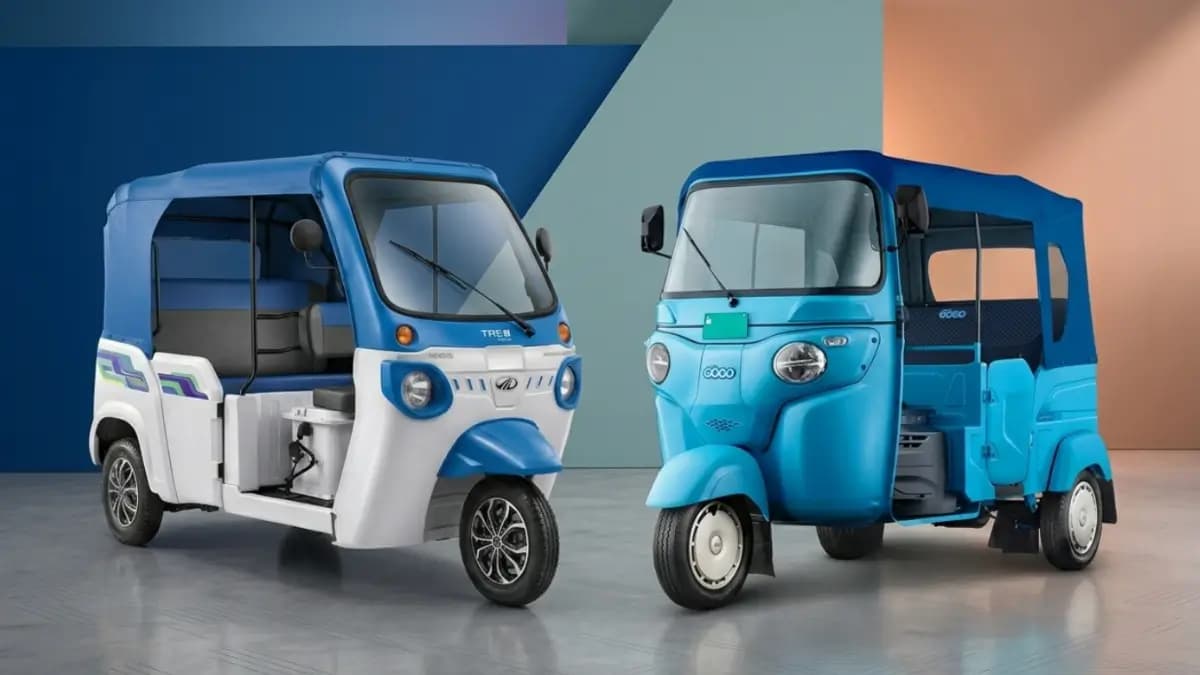

Piaggio and SBI Signed an MoU to Offer Intrest Free Auto Loans in UP
Piaggio and SBI will finance three-wheelers in UP at 0% interest under CM Yuva Yojana. Here's the real math, who qualifies, and how to apply first.

Truck mileage planning
Estimate E-Ashwa E School Van fuel cost and monthly running expense using your route distance and local fuel price.
Claimed Mileage
90-100 km/charge
Fuel Type
Electric
Ex-Showroom Price
₹1.20L
Interactive calculator
Change charging price, battery capacity, range and monthly distance to estimate EV running cost.
Range
90
Fuel
Electric
Enter your charging rate per kWh. Home/depot and public charging rates can be different.
Required for EV cost per charge and cost per km.
Use loaded real-world range for better estimates.
Monthly Cost
—
Estimated charging spend for selected monthly distance.
| Variant | Fuel | Mileage | Monthly Cost |
|---|---|---|---|
| E-Ashwa E School VanTHIS TRUCK | Electric | 90-100 km/charge | — |
| E-Ashwa E School Van Electric Van | Electric | 90-100 km/charge | — |
This page keeps the calculation simple: enter the fuel price in your city and the approximate kilometres your truck runs in a month. The tool then estimates cost per kilometre, daily fuel spend, monthly fuel budget and yearly running cost.
The claimed figure is useful for comparison, but daily mileage depends on route discipline and how the truck is maintained.
Payload & load balance
Overloading, uneven load placement and frequent stop-start operation reduce mileage and increase tyre and clutch wear.
Route & traffic
Flat highway routes usually return better mileage than city routes with congestion, slopes and repeated braking.
Maintenance condition
Clean filters, correct tyre pressure, proper wheel alignment and timely engine service help protect fuel efficiency.
Simple operating habits can make a visible difference in E-Ashwa E School Van running cost, especially for high monthly kilometres.
Avoid long idling and harsh acceleration when the truck is loaded.
Check tyre pressure before long routes and keep wheel alignment in range.
Service air filter, fuel filter and engine oil at recommended intervals.
Plan routes to reduce empty return trips, traffic waiting and unnecessary detours.
Track fuel filled, kilometres driven and load weight to identify mileage drops early.
Compare variant mileage with payload needs before choosing the final configuration.
News
E-Ashwa E School Van has a claimed mileage of 90-100 km/charge. Real-world mileage typically runs 10-15% lower depending on load, route, and driving conditions.
The E Ashwa E School Van mileage offers an impressive range of 120-140 km on a single full charge, depending on driving conditions and load. This makes it highly efficient for daily school routes.
The E Ashwa E School Van battery is designed to last for 120-140 km on a full charge, ensuring reliable transport for typical school schedules. Its 25 kWh LFP battery pack provides consistent performance throughout the day.
The standard AC charging time for the E Ashwa E School Van is approximately 6-8 hours for a full charge. With an optional DC fast charger, the battery can be charged from 0-80% in about 2 hours, maximizing uptime.
A full charge for the E Ashwa E School Van, with its 25 kWh battery, typically costs around ₹200-₹250 in India, based on an average commercial electricity rate of ₹8-₹10 per unit. This translates to significantly lower running costs compared to conventional vans.
The E Ashwa E School Van boasts significantly lower running costs, averaging about ₹1.5-₹2.0 per kilometer, far less than diesel vans which typically incur ₹5-₹7 per kilometer. This substantial saving makes the E Ashwa E School Van a highly economical choice.
Yes, like all electric vehicles, the E Ashwa E School Van mileage can slightly vary with higher loads and aggressive driving, typically ranging between 120-140 km. Maintaining consistent speeds and optimal tire pressure helps maximize its efficiency.
The E Ashwa E School Van comes with an advanced LFP battery, designed for a long lifespan of approximately 8-10 years or 1,50,000 to 2,00,000 kilometers, depending on usage and charging practices. This durable battery ensures long-term reliability for your operations.
Load weight, terrain (hilly vs flat), traffic conditions, driving style, tyre pressure, and how regularly the engine is serviced all affect real-world mileage. Claimed mileage figures are measured under controlled conditions, so actual mileage is usually 10-15% lower depending on how the truck is used.
Running cost per km is calculated by dividing the fuel price by the truck's mileage (km per litre, kg, or unit depending on fuel type). Monthly and yearly costs are then estimated by multiplying this per-km cost by your typical distance driven.
Yes — aggressive acceleration and hard braking can lower mileage by 10% or more on a loaded commercial truck. Maintaining a steady speed, avoiding unnecessary idling, and keeping tyres correctly inflated are the easiest ways to protect fuel efficiency on long hauls.