
Piaggio and SBI Signed an MoU to Offer Intrest Free Auto Loans in UP
Piaggio and SBI will finance three-wheelers in UP at 0% interest under CM Yuva Yojana. Here's the real math, who qualifies, and how to apply first.
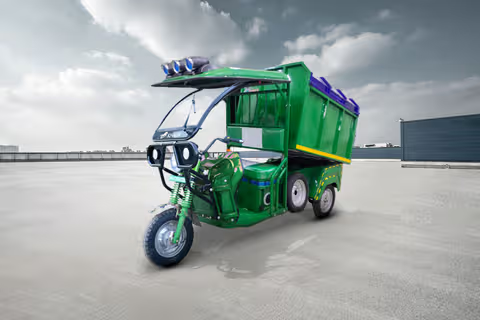
Truck mileage planning
Estimate Khalsa Garbage fuel cost and monthly running expense using your route distance and local fuel price.
Claimed Mileage
110 KM/Full Charge
Fuel Type
Electric
Ex-Showroom Price
₹1.35L
Interactive calculator
Change charging price, battery capacity, range and monthly distance to estimate EV running cost.
Range
110
Fuel
Electric
Enter your charging rate per kWh. Home/depot and public charging rates can be different.
Required for EV cost per charge and cost per km.
Use loaded real-world range for better estimates.
Monthly Cost
—
Estimated charging spend for selected monthly distance.
| Variant | Fuel | Mileage | Monthly Cost |
|---|---|---|---|
| Khalsa GarbageTHIS TRUCK | Electric | 110 KM/Full Charge | — |
| Khalsa Garbage Electric/Cargo | Electric | 110 KM/Full Charge | — |
This page keeps the calculation simple: enter the fuel price in your city and the approximate kilometres your truck runs in a month. The tool then estimates cost per kilometre, daily fuel spend, monthly fuel budget and yearly running cost.
The claimed figure is useful for comparison, but daily mileage depends on route discipline and how the truck is maintained.
Payload & load balance
Overloading, uneven load placement and frequent stop-start operation reduce mileage and increase tyre and clutch wear.
Route & traffic
Flat highway routes usually return better mileage than city routes with congestion, slopes and repeated braking.
Maintenance condition
Clean filters, correct tyre pressure, proper wheel alignment and timely engine service help protect fuel efficiency.
Simple operating habits can make a visible difference in Khalsa Garbage running cost, especially for high monthly kilometres.
Avoid long idling and harsh acceleration when the truck is loaded.
Check tyre pressure before long routes and keep wheel alignment in range.
Service air filter, fuel filter and engine oil at recommended intervals.
Plan routes to reduce empty return trips, traffic waiting and unnecessary detours.
Track fuel filled, kilometres driven and load weight to identify mileage drops early.
Compare variant mileage with payload needs before choosing the final configuration.
News
Khalsa Garbage has a claimed mileage of 110 KM/Full Charge. Real-world mileage typically runs 10-15% lower depending on load, route, and driving conditions.
Truck mileage is mainly affected by engine size, load carried, driving style, and road conditions. Heavier loads and aggressive driving can significantly reduce the mileage of your commercial vehicle. Choosing the right truck based on its intended use is crucial for fuel efficiency.
Small commercial vehicles (SCVs) and light commercial vehicles (LCVs) are designed for urban routes and typically offer better mileage. Their compact size and efficient engines make them cost-effective for last-mile delivery within cities. For example, some sub-1-tonne trucks deliver excellent fuel efficiency.
Maintaining proper tire pressure, regular servicing, and adopting a smooth driving style are key. Avoid overloading your truck beyond its recommended capacity, as this drastically impacts its mileage. Opting for a diesel or CNG variant can also contribute to better fuel economy in the long run.
While heavy-duty trucks are built for power and capacity, their mileage per liter is lower compared to smaller trucks due to their immense size and load. However, their efficiency is measured by tonne-kilometre/liter, where they excel in moving large volumes cost-effectively over long distances. Modern heavy-duty trucks use advanced technologies to optimize fuel consumption.
Small commercial vehicles often deliver impressive mileage, typically ranging from 15 km/l to 25 km/l, depending on the model and driving conditions. This excellent fuel efficiency makes them a popular choice for businesses looking to minimize operational costs. Always check the specific mileage figures for the truck model you are interested in.
Yes, CNG trucks generally offer lower running costs per kilometre compared to diesel, especially with current fuel prices, contributing to better 'effective mileage.' While the literal mileage (km/kg vs km/litre) might differ, CNG variants are often considered more economical for urban operations, reducing your overall fuel expenses.
Overloading a truck severely reduces its mileage and puts undue stress on the engine, tires, and suspension. It leads to higher fuel consumption per trip and can also compromise safety and vehicle lifespan. Always adhere to the recommended payload capacity to ensure optimal mileage and truck performance.
Advertised mileage figures are usually tested under ideal conditions, so real-world mileage can vary. Factors like traffic, terrain, driver habits, and maintenance status significantly influence actual truck mileage. It's best to consider these figures as a guideline and factor in your specific operating environment.
Load weight, terrain (hilly vs flat), traffic conditions, driving style, tyre pressure, and how regularly the engine is serviced all affect real-world mileage. Claimed mileage figures are measured under controlled conditions, so actual mileage is usually 10-15% lower depending on how the truck is used.
Running cost per km is calculated by dividing the fuel price by the truck's mileage (km per litre, kg, or unit depending on fuel type). Monthly and yearly costs are then estimated by multiplying this per-km cost by your typical distance driven.
Yes — aggressive acceleration and hard braking can lower mileage by 10% or more on a loaded commercial truck. Maintaining a steady speed, avoiding unnecessary idling, and keeping tyres correctly inflated are the easiest ways to protect fuel efficiency on long hauls.