News Details
EKA Mobility Launches First 6-Seater Electric Auto at Rs 6.50 Lakh
Summary
The EKA 6S carries double the passengers of a standard electric auto and becomes India's first passenger 3-wheeler to use a steering wheel instead of handlebars.
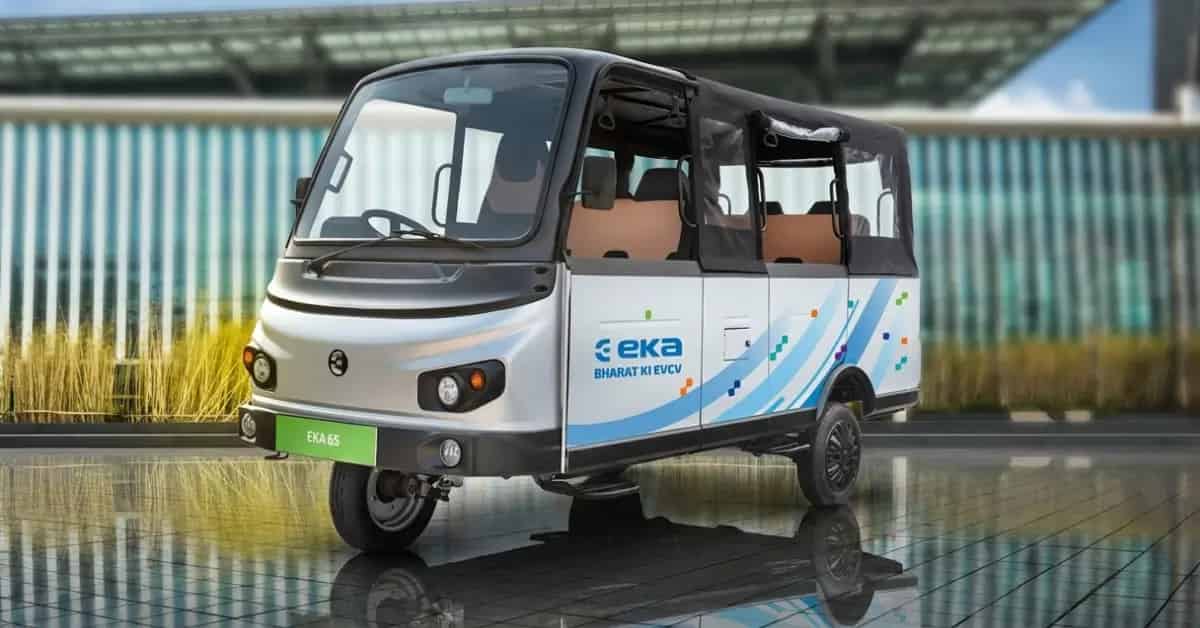


Every electric auto in India seats three passengers. That number has not moved in decades. EKA Mobility just broke it.
The Pune-based company has launched the EKA 6S, a D+6 electric three-wheeler that fits six passengers and a driver. It is also the first passenger 3-wheeler in India to come with a steering wheel. Both of those facts matter, and we will get to why in a moment.
EKA 6S Price, Battery and Range at a Glance
The EKA 6S is priced at Rs 6.50 lakh in New Delhi. Prices vary by state based on local taxes and RTO charges.
It runs on a 15 kWh lithium iron phosphate battery. Claimed range is 140 km on a single charge. Top speed is capped at 50 km/h and peak torque is 65 Nm from a 12 kW motor.
Dimensions are 3545mm long, 1580mm wide, and 1930mm tall, with a 2300mm wheelbase. Turning radius is 4.5 metres and ground clearance sits at 178mm. Gradeability is 21 percent, which means flyovers and steep urban ramps are not a problem.
Why the Steering Wheel on EKA 6S Matters for Commercial Operators
Every three-wheeler auto in India uses handlebars. After 6 to 8 hours of city driving, handlebar fatigue is a real complaint among operators. The EKA 6S drops that entirely and gives the driver a steering wheel.
It is not just a comfort feature. A steering wheel gives the driver more precise control in tight turns. Combined with a 4.5m turning radius, this vehicle can navigate lanes that larger passenger vehicles cannot enter.
For operators running school transport, office shuttle, or tourist circuits, a steering wheel also carries an important perception difference. Passengers associate it with a more structured, safer ride.
EKA 6S Seating Layout and What It Means for Daily Earnings
The interior has three rows. Rows one and three are bench seats. Row two has a central passage so passengers can reach the third row without climbing over each other.
This is where the business case gets sharp. A standard 3-seater electric auto earns on three fares per trip. The EKA 6S earns on six. If your route runs at high occupancy, say a factory shuttle or a station feeder route, the per-trip revenue nearly doubles with no increase in fuel cost.
Running costs on electricity are already a fraction of CNG or petrol. Multiply that advantage across six seats and the daily earnings math changes significantly for a full-time operator.
EKA 6S Charging Time and Battery Warrant
DC fast charging fills the battery in 2 hours. Single-phase AC charging takes 5 hours. For operators running two shifts, the fast charge option is the one that matters since it fits within a break window.
EKA Mobility offers a 3-year warranty on the vehicle with a 1.25 lakh km limit, whichever comes first. The battery warranty is 6 years or 1.65 lakh km. That battery warranty is among the stronger ones in the electric three-wheeler segment and reduces one of the biggest cost uncertainties for buyers.
EKA 6S vs Standard Electric Autos
If you run a point-to-point shared route with predictable passenger load, the 6S makes a strong case. School runs, office feeder routes, railway station last-mile, and hospital transport are all segments where D+6 capacity directly improves revenue per trip.
For drivers doing random street pickup, the picture is less clear. You need consistent occupancy to justify the higher purchase price over a 3-seater. If your average load per trip is two or three passengers, a cheaper 3-seater may still be more practical.
EKA Mobility is a subsidiary of Pune-based Pinnacle Industries, a company with a long history in automotive seating and interiors. That manufacturing background gives the 6S a more structured build quality than most startups entering the 3-wheeler EV space today.
What to Check Before Buying the EKA 6S Electric Auto
Verify the on-road price in your state. At Rs 6.50 lakh ex-showroom Delhi, local taxes can add Rs 30,000 to Rs 70,000 depending on where you register.
Check charging infrastructure on your route. The 2-hour DC fast charge is the practical option for operators running long hours. If your depot or home parking does not have a fast charger, the 5-hour AC option will limit your daily flexibility.
Confirm your permit status. A D+6 vehicle sits in a different commercial permit category from a standard D+3 auto. In most states you will need a contract carriage permit rather than a standard autorickshaw permit. Talk to your local RTO before you buy.