
News Details
Tata Motors CV Division Files Record 144 Patents in FY26
Summary
144 Patent Applications in One Year. Tata Motors Has Never Done That Before.
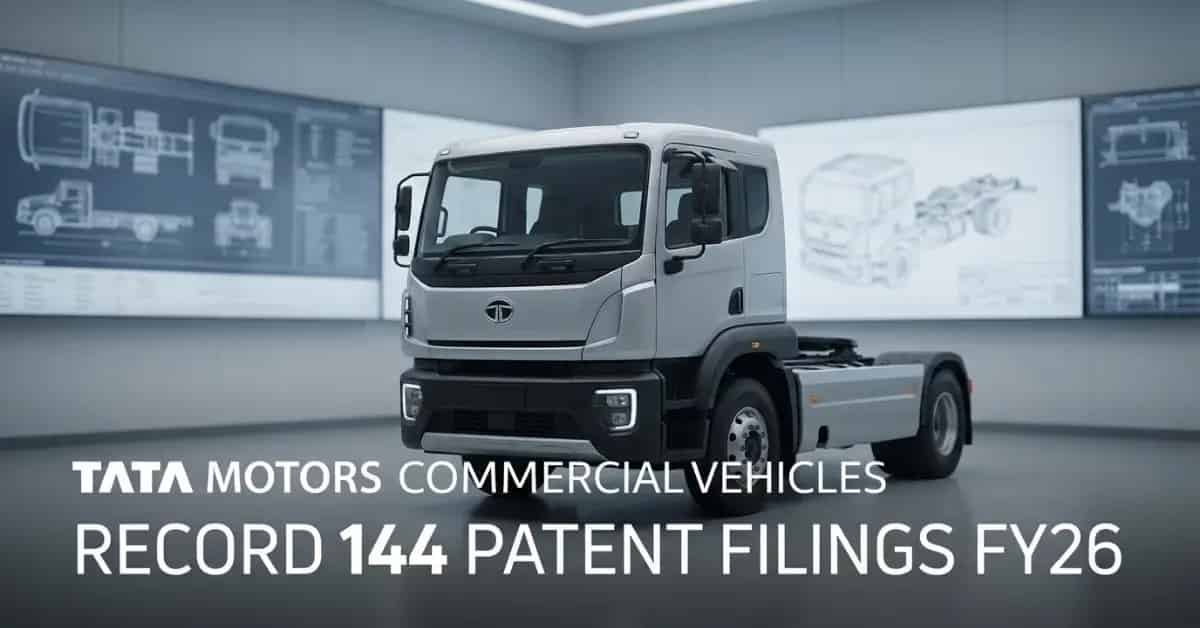


Tata Motors announced on April 29, 2026 that its commercial vehicles division filed 144 patent applications in FY26. That is the highest number of annual patent filings in the company's CV history.
The number sounds like an accounting line. It is actually a signal of where the company is placing its technology bets before the next wave of emission norms, electrification mandates, and fleet digitisation hits simultaneously.
What Tata’s 144 Patents Actually Cover
The filings split across four strategic areas: vehicle safety, operational reliability, total cost of ownership, and occupant comfort. These are the four things fleet owners and drivers push back on hardest during a purchase decision. Tata Motors is building IP around exactly those pressure points.
A notable portion of the filings covers electric vehicle architectures and hydrogen-based internal combustion engines. The H2-ICE work is worth watching. Battery EVs are well-suited to city logistics but face real limitations in long-haul commercial freight. Hydrogen ICE gives fleet operators a bridge option as fuelling infrastructure catches up.
Beyond patents, Tata Motors filed 21 design applications and 35 copyright applications during FY26. The company also secured 15 patent grants in the year, taking its cumulative tally of granted patents past 650.
Why This IP Push Matters for Fleet Operators
An OEM's patent portfolio is not relevant to a transporter buying a truck today. It becomes relevant over a five to seven year ownership cycle.
A company that holds the IP on battery management systems, predictive diagnostics, and connected safety features has more control over how those systems evolve and what it costs to service them. Fleet operators buying Tata Motors trucks are, in effect, buying into that development roadmap.
Aniruddha Kulkarni, VP and Head of Engineering at Tata Motors, said the record filings reflect the technical output of the company's engineering teams and its aim to position Tata Motors as a global benchmark in commercial mobility.
India's CV Market Is About to Get Technically Complex
The timing of this IP push is not accidental. BS7 norms are coming around 2028. Safety and braking regulations arrive in FY27-28. The shift toward electric powertrains in last-mile and intra-city logistics is already underway.
Every one of those transitions creates a window where the OEM with the strongest IP foundation sets the terms on product capability, service access, and long-term parts pricing.
At 650-plus granted patents and the highest single-year filing rate in its CV history, Tata Motors is not just responding to that transition. It is trying to own a portion of it.
Also Read : Atul Auto and Exponent Energy to Build 15-Minute Charging Electric Auto Platform