
News Details
Tata Motors CV Sales Jump 17 Percent to 47,976 Units in March
Summary
The CV giant closes FY26 on a high note — but geopolitical clouds and diesel prices could reshape the picture for fleet owners in the months ahead.
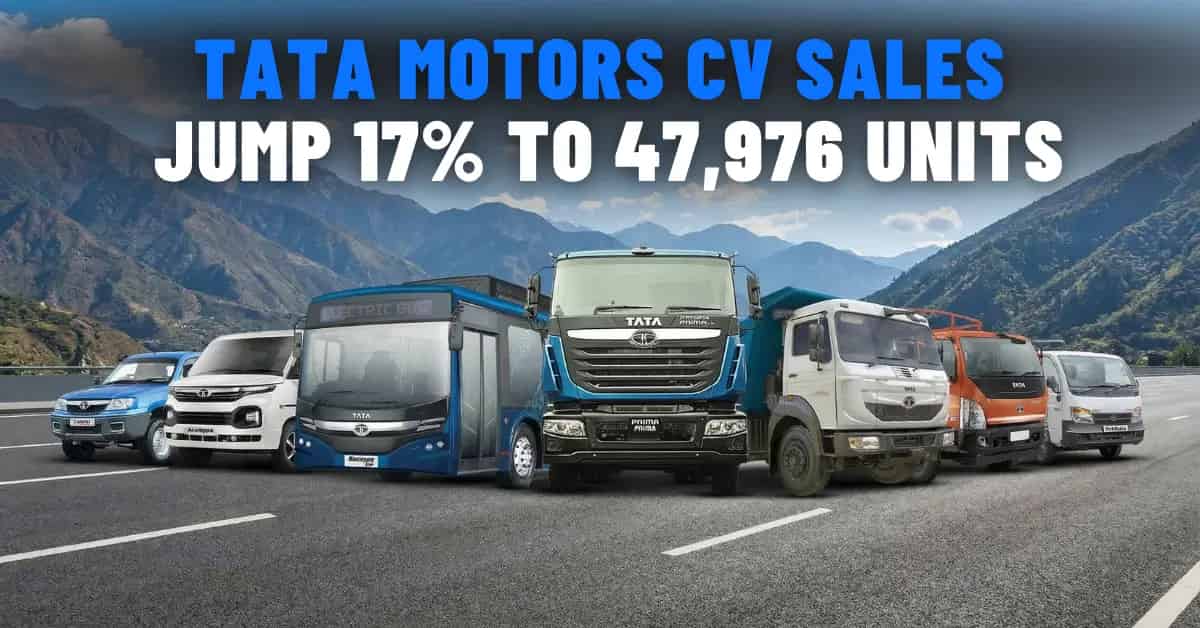


Nearly 48,000 trucks and commercial vehicles in a single month. That's what Tata Motors' commercial vehicle arm delivered in March 2026. And it didn't happen by accident.
Total CV sales for March 2026 came in at 47,976 units, up 17% from 41,122 units in the same month last year, according to a regulatory filing by Tata Motors. For context, that's almost 1,550 vehicles sold every single day of the month. But dig a little deeper, and you'll find the numbers that really matter.
The Full Picture: Month, Quarter, Full Year
Domestic CV sales stood at 45,825 units in March 2026, up 18% from 38,884 units in March 2025. The strong domestic show masked a small dip on the export front — international business CV sales were lower by 4% at 2,151 units compared to 2,238 units in the year-ago month.
Zoom out to the quarter, and the story gets even more compelling. Tata Motors recorded total CV sales of 1,32,465 units in Q4 FY26, a 25% increase from 1,05,643 units in Q4 FY25. Domestic CV sales for the quarter reached 1,25,562 units, up 26%.
And for the full fiscal year? FY26 total CV volumes grew 14% to 4,28,329 units from 3,76,903 units in FY25. Growth that was broad-based across product lines, customer segments, and markets.
The Segment Driving the Recovery
It wasn't just big trucks doing the heavy lifting. Heavy commercial vehicle truck sales grew 29% in Q4, while intermediate, light and medium commercial vehicles recorded a 27% increase. That's broad-based demand. Not one segment carrying the rest.
Domestic MH&ICV sales in March 2026 stood at 23,805 units versus 20,474 units in March 2025, a 16% year-on-year rise. For Q4 FY26, the same segment clocked 64,904 units against 51,551 units in Q4 FY25. A 26% surge.
If you own or operate medium and heavy trucks, that growth figure tells you that confidence is clearly returning among fleet operators.
Why Did FY26 Turn Out This Way?
The year didn't start strong. As Girish Wagh, MD & CEO of Tata Motors, put it: "FY26 saw a subdued first half for the commercial vehicle industry, followed by a decisive recovery in H2 as demand conditions improved with the rollout of GST 2.0 and gained momentum through Q3 and Q4."
The CV segment clocked all-time high volumes in FY26, aided by GST rationalisation and government capital expenditure. A combination that lowered effective ownership costs and kick-started infrastructure-linked freight demand. CRISIL's analysis noted that Q3 acceleration hit 22%, compared to a muted 4% in H1, driven by deferred demand, improved freight availability, and increased infrastructure execution.
Simply put, operators who waited through the first half came back with a vengeance in H2.
The EV Angle Nobody Else Is Talking About
Here's what most coverage quietly glosses over: the electric shift inside Tata Motors CV is accelerating faster than most people realise.
EV volumes grew 59% year-on-year in FY26, reflecting increasing adoption of electrified commercial mobility solutions. That's not a small experiment anymore. That's a trend with real commercial weight behind it. If you're running urban delivery routes or intra-city logistics, the math on electric trucks is shifting in your favour faster than you think.
What Should You Watch in FY27?
This is where things get honest. The strong March finish doesn't mean smooth sailing ahead.
Wagh flagged that the West Asia conflict and its impact on select sectors of the economy caused some moderation in monthly growth. "Diesel prices remain a key monitorable, given their impact on total cost of ownership," he said, adding that Tata Motors is "actively assessing the risk landscape.”
Analysts also warn that demand risks are growing because rising commodity and fuel costs may force price increases. Which could hit price-sensitive buyers and first-time customers hardest, potentially cancelling out affordability benefits from GST 2.0.
If you're planning a purchase or fleet expansion in FY27, here's what to keep in mind:
-
Diesel price movements will directly impact your TCO. Build a scenario where fuel costs rise 10–12% before you finalise your EMI.
-
The EV window is opening. With 59% growth in EV CVs and improving charging infrastructure, urban operators should seriously evaluate electric options for the next addition to their fleet.
-
Don't wait for prices to fall further. The GST 2.0 benefit is already baked in. The next movement is more likely upward than down.