
News Details
Montra Electric EVIATOR 350 and 350L+ Launched at Rs 14.58 Lakh
Summary
Eleven months after the EVIATOR grabbed 30 percent market share in the 3.5-tonne eSCV segment, Montra is expanding the range with two new battery configurations built around 65 lakh km of real fleet data.
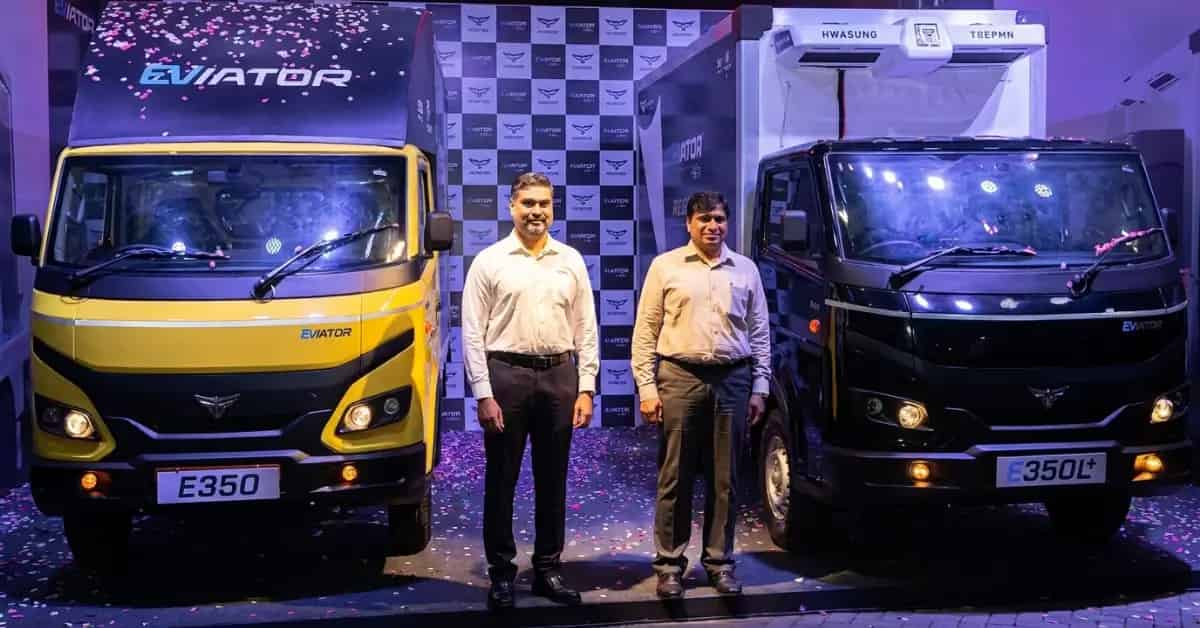


Most EV manufacturers make one truck and ask every operator to fit their business into it. Montra Electric just walked away from that approach.
On April 24, 2026, the Murugappa Group company launched two new EVIATOR variants: the EVIATOR 350 with a 32kWh battery at Rs 14.58 lakh, and the EVIATOR 350L+ with a 50kWh pack at Rs 16.86 lakh. The existing 40kWh EVIATOR 350L stays in the lineup. Three battery sizes. One platform. Different price points for different daily jobs.
EVIATOR 350 vs EVIATOR 350L+: Price, Battery and Range Compared
The EVIATOR 350 at Rs 14.58 lakh carries a 32kWh battery and delivers up to 140 km of real-world range per charge. It is designed for urban last-mile operators running high-frequency city routes who do not need more than 140 km daily.
The EVIATOR 350L+ at Rs 16.86 lakh carries a 50kWh battery. Certified range exceeds 300 km. Real-world range is 200 km or more. Montra is targeting this at intercity freight, refrigerated transport, and municipal service operators, anywhere that a single charge needs to last a long shift without a mid-day top-up.
The existing EVIATOR 350L sits in the middle at 40kWh. All three share the same platform, 80 kW motor, 300 Nm torque, 3,490 kg GVW, and 1,707 kg payload. The only meaningful difference between them is how far they can go on a single charge.
Why 65 Lakh Kilometres of Fleet Data Changed the Product Strategy
This launch is not a guess at what operators need. It is the result of watching how 600 EVIATOR vehicles actually run in the real world.
Those 600 trucks have collectively covered 65 lakh kilometres since the EVIATOR 350L launched in January 2025. That data showed Montra something important: operators split cleanly into two groups. Some run short, dense urban routes and barely touch 100 km a day. Others run inter-city loads that need sustained range and cannot stop mid-route to charge. The 40kWh middle variant could not serve both groups equally well.
MD Jalaj Gupta framed it plainly. The next phase of EV adoption depends on how well products fit real-world operations, not on range claims in a brochure. The 32kWh and 50kWh variants are the result of that thinking applied to actual field data.
How EVIATOR 30-Percent Market Share in 11 Months Makes This Launch Different
The EVIATOR 350L launched in January 2025. By November 2025, it had captured over 30 percent market share in the 3.5-tonne electric SCV segment. That is a significant achievement for a brand competing in a space where Tata Motors and Mahindra both have established commercial vehicle presence.
The new variants are not a turnaround play. They are an expansion from a position of real market traction. Montra has fleet operator trust in the platform. The 99 percent uptime guarantee is not a launch promise anymore. It is a number backed by 65 lakh km of operational data.
All dealerships have been equipped with comparison tools to help customers work out which variant minimises total cost of ownership for their specific route profile. That is a detail worth asking your dealer to walk you through before you sign.
What Rs 14.58 Lakh Means Against the Rest of the eSCV Market
The EVIATOR 350 at Rs 14.58 lakh is the most accessible entry into this platform, but it is not cheap by electric cargo vehicle standards.
Tata Ace EV and Mahindra ZEO both use around 21.3kWh batteries and are priced between Rs 7.52 lakh and Rs 11.43 lakh. They carry significantly less payload and sit in a different GVW class, around 1 to 1.2 tonnes. The EVIATOR carries 1,707 kg. That is not the same category. You are comparing a motorcycle to a 350cc bike and asking why one costs more.
Fleet operators choosing between these platforms are really choosing between two different business models: high-frequency light cargo at lower upfront cost, or higher payload per trip with better range economics at a higher purchase price. The EVIATOR case is strong for anyone running loads above 800 kg regularly and needing real-world range above what the lighter alternatives can offer.
EVIATOR Platform Features Across All Three Variants
The chassis is built at Montra's Ponneri facility in Chennai. ADAS, over-the-air software updates, hill-hold assist, and front disc brakes are all standard across the EVIATOR range. Gradeability is 35 percent. Top speed is 80 km/h.
Fleet management solutions come built in. For operators running multiple vehicles, OTA updates mean software improvements reach every truck without a workshop visit. That reduces service downtime without adding a new process.
Which EVIATOR Variant Should You Consider
If your daily route runs under 130 km and stays within the city, the EVIATOR 350 at Rs 14.58 lakh covers the work and keeps the purchase price lower. The 32kWh battery will rarely be stressed. Charging overnight at 7.4kWh takes just over 5 hours.
If you run inter-city loads, refrigerated cargo, or routes that cross 150 km daily without a reliable charging stop en route, the EVIATOR 350L+ at Rs 16.86 lakh justifies the premium. A 200 km real-world range means you can complete most inter-city runs on a single charge and save the Rs 2.28 lakh price gap in fuel costs within a year on high-mileage duty.
The 40kWh EVIATOR 350L remains the most balanced option for operators whose routes sit between those two extremes and who do not want to overpay for capacity they will not use.