
Blog Details
20 Feet Truck Dimensions in India: Payload, Top Models & Capacity
Summary
A 20 ft truck can carry more than you think. But only if used right. Discover its real capacity, ideal use cases, and when it beats a 19 ft.
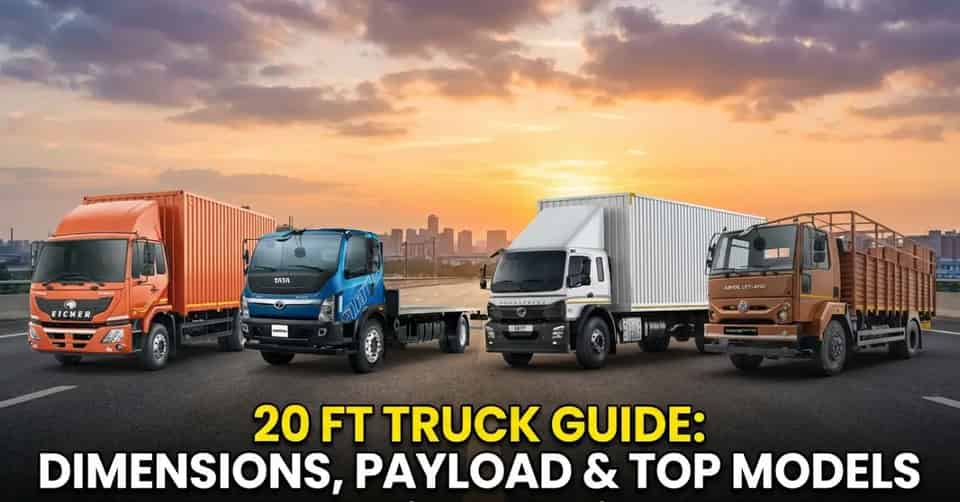


Most shippers step up from a 19-footer to a 20-footer expecting a minor upgrade. And walk away surprised. That one extra foot adds roughly 10–12% more cargo volume and, depending on the axle configuration, unlocks a significantly higher legal payload ceiling. Here is everything you need to know about the 20 feet truck dimensions before you buy it.
Exact Dimensions of a 20 Feet Truck in India
A standard 20 feet truck in India has the following external dimensions:
-
Length: 20 feet (6.1 metres)
-
Width: 7.5 feet (2.3 metres)
-
Height: 8 feet (2.4 metres)
These are typical external figures for a closed container body. Open-body (platform) variants have the same cargo length but no fixed height, allowing taller or irregularly shaped loads.
Internal cargo dimensions (closed container, typical):
-
Internal length: ~19.3 feet (5.9 metres)
-
Internal width: ~7.2 feet (2.2 metres)
-
Internal height: ~7.5 feet (2.3 metres)
-
Cargo volume: approximately 1,043 CFT (cubic feet)
That 1,043 CFT figure is enough to comfortably carry the contents of a 2.5–3 BHK apartment, or 20–25 standard wooden pallets loaded with FMCG goods.
But here is what most people miss: a 20 feet truck operates in the ICV (Intermediate Commercial Vehicle) category in India. Not the heavy truck category. Which means it can navigate more routes, enter more industrial zones, and face fewer permit requirements than a 24-footer or larger.
For a full comparison of all truck sizes, see our truck dimensions in feet in India guide.
20 Feet Truck Payload Capacity
The payload of a 20 feet truck in India depends primarily on its axle configuration. Almost all 20 feet trucks in this class are single-axle (SXL), 6-wheeler configurations, which means:
-
Payload range: 7 to 11.5 tonnes
-
GVW (Gross Vehicle Weight) range: 14,000 kg to 17,500 kg
The exact payload varies by model. For example, the Eicher Pro 3015XP (20 ft) has a payload of 11,500 kg. The Tata Ultra T.16 (20 ft) offers a 10,000 kg payload with a GVW of 16,190 kg.
SXL stands for Single Axle. One rear axle with four tyres. This configuration keeps the truck maneuverable, reducing toll costs and enabling access to weight-restricted state roads.
The most common loading mistake with 20-footers: Shippers often load to volume and forget to check axle weight. Even if the container is not full, heavy items like marble, ceramic tiles, or packaged liquids can push you over the legal axle load limit of 11.5 tonnes on the rear axle (as per the 2018 MoRTH revision). Always confirm cargo density before dispatching.
Best 20 Feet Trucks in India — Top Models in 2026
|
Model |
Engine Power |
Payload (kg) |
Ex-Showroom Price |
Best For |
|
180 HP |
11,500 |
₹26.50 Lakh |
FMCG, white goods, long haul |
|
|
Tata Ultra T.16 AMT (20 ft) |
180 HP |
10,000 |
₹24.03 Lakh |
Urban distribution, e-commerce |
|
Tata LPT 1412 (20 ft body) |
140 HP |
9,500 |
₹21.81 Lakh |
Budget operations, regional runs |
|
170 HP |
9,750 |
₹22.22 Lakh |
Highway runs, premium fleet |
|
|
150 HP |
10,800 |
₹27.50 Lakh |
Mixed cargo, FMCG distribution |
The Eicher Pro 3015XP is the standout choice for operators prioritising payload: its 180 HP E494 engine with a 7-speed gearbox and 11.5-tonne capacity puts it at the top of the 20 ft class. If budget is the primary concern, the BharatBenz 1617R delivers solid highway performance at a more accessible entry price.
Open Body vs Closed Container : Which One to Choose?
At 20 feet, you have two main body options:
Open Body (platform/flatbed):
The cargo area is exposed, with removable side rails or a fixed flat deck. Ideal for construction materials like steel pipes, granite slabs, timber, and machinery that needs crane or side loading. If your cargo is weather-resistant and irregularly shaped, this is your pick.
Closed Container (box body):
Fully enclosed steel or aluminium body with rear shutter doors. Protects cargo from rain, dust, and pilferage during multi-day intercity runs. Preferred for FMCG, electronics, pharmaceuticals, packaged foods, and textiles.
Quick guide: If your goods can withstand outdoor exposure and you load from the side or top, go open body. If you are running 300 km+ with weather-sensitive or high-value goods, go closed container.
Ideal Use Cases of 20 Ft Truck in India
FMCG Distribution (regional DC to retailer runs)
A 20-footer handles 600–800 km regional corridors well. The enclosed container protects goods like edible oils, soaps, and packaged snacks, and the 10–11.5 tonne payload lets you move a full pallet cycle in one shot.
White Goods and Consumer Electronics
Refrigerators, washing machines, air conditioners: these are high-volume, medium-weight items. A 20 ft closed container does the job without the cost of a 24-footer that you will only half-fill.
Pharmaceuticals and Healthcare
Temperature-sensitive medicines are typically moved in insulated box bodies fitted to 20 ft chassis. The ICV category keeps this truck accessible in city zones during daytime hours in most states.
E-commerce Fulfillment (mid-tier shipments)
For last-mile fulfillment centres moving sorted parcels in bulk to hub cities, a 20 ft truck bridges the gap between smaller 14–17 ft vehicles and the larger 32 ft containers used on interstate lanes.
Factory-to-Warehouse Inventory Movement
Automotive ancillaries, ceramic tiles, and sanitary ware commonly travel on this size. Factories prefer the 20 ft because the truck fits most standard factory loading bays.
Household Relocation
A well-packed 20 ft closed container typically handles a 3 BHK apartment move, including furniture, appliances, and packed boxes, in a single load.
3 Questions That YOU Should Answer Before Buying
Ask yourself these three questions before booking:
1. Does your cargo weigh between 7 and 11 tonnes?
If yes, a 20 ft SXL is a good match. If your cargo weighs more than 12 tonnes, look at the 22 feet truck or a multi-axle 24-footer.
2. Is your cargo volume between 800 and 1,050 CFT?
A 20 ft container fits about 1,043 CFT. If your volume regularly exceeds this, a 22 ft truck is worth the marginal price difference.
3. Does your delivery route include restricted zones or weight-limited bridges?
The 20 ft ICV truck is cleared for most state and national highways. For routes with strict GVW enforcement (mining corridors, certain state expressways), confirm the permissible axle load before dispatching.
If your load is consistently lighter (say 5 to 7 tonnes) the 19 feet truck is a more economical choice with lower fuel and toll costs per trip. For heavier or more voluminous cargo, check out our 22 ft truck dimensions guide.
Legal Limits and Permits You Need to Know
Under the Motor Vehicles Act, 1988, and the 2018 MoRTH axle load revision, the following limits apply to a typical 20 ft SXL (6-wheeler) truck:
-
Maximum GVW: Up to 18,500 kg (revised 2018 limits for two-axle rigid trucks)
-
Maximum Vehicle Width: 2.5 metres (8.2 feet). Most 20 ft trucks stay within this
-
Maximum Vehicle Height: 4.75 metres (for closed body trucks). No standard 20 ft container exceeds this
-
Maximum Rigid Truck Length: 12 metres (39.4 feet). All 20 ft trucks are well within this limit
No special permit is required for standard 20 ft closed container or open body trucks under normal cargo conditions. ODC (Over Dimensional Cargo) permits are only needed if your goods protrude beyond the vehicle's registered dimensions.
Overloading carries a minimum penalty of ₹20,000 for the first tonne over the limit, plus ₹2,000 for every additional tonne and repeat violations can trigger vehicle detention. Do not risk it.
Checklist Before YOU Buy 20 Ft Truck
-
Confirm your cargo weight is within the model's payload. DO NOT go by body space alone
-
Check whether you need a closed container or open body before booking
-
Verify the truck's GVW compliance for toll and state permit requirements on your route
-
Ask for the fitness certificate and pollution under control (PUC) document before loading
-
For long-haul runs over 500 km, confirm the driver's rest arrangements and delivery timeline
-
Colculate EMI options before your purchase. Most 20 ft ICV trucks qualify for commercial vehicle finance at 8–12% interest rates