Blog Details
Mahindra Jeeto vs Maruti Suzuki Super Carry Comparison 2026: Which Mini Truck is Best?
Summary
One runs a 670cc commercial engine at 16 HP. The other uses a 1196cc car-derived unit at 72 HP. The engine gap is wider than any comparison in this segment.
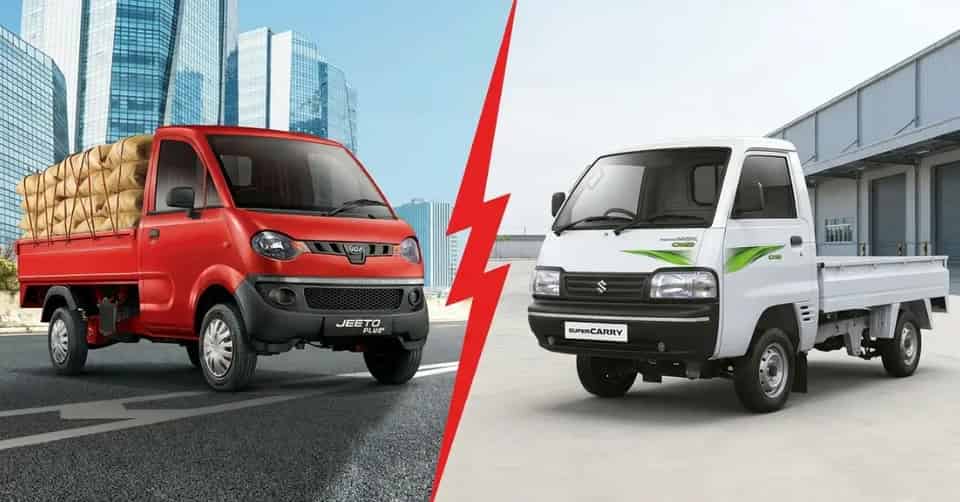


Both trucks carry under a tonne. Both sell in the same price band. Both target the same urban delivery and small business operator. That is where the similarity ends.
The Mahindra Jeeto and Maruti Suzuki Super Carry are built on fundamentally different engineering philosophies. The Jeeto is a purpose-built commercial vehicle optimised for payload and fuel cost. The Super Carry is a car-platform vehicle prioritising power, comfort, and safety. Choosing between them is a business decision, not a spec sheet exercise.
Mahindra Jeeto vs Maruti Super Carry: Price and Variants
The Jeeto range starts lower. Jeeto Plus diesel begins at Rs 4.34 lakh ex-showroom. The Jeeto Strong, the payload-focused top variant, runs from Rs 5.09 to Rs 5.62 lakh depending on configuration.
The Super Carry starts at Rs 5.15 lakh for the petrol chassis variant and goes up to Rs 6.41 lakh for fully-built CNG configurations. On-road pricing for both trucks adds Rs 40,000 to Rs 80,000 depending on state, registration charges, and insurance selection.
In the Rs 5.10 to Rs 5.60 lakh ex-showroom band where both overlap, buyers are comparing the Jeeto Strong diesel against the Super Carry petrol. That is the core battle this article is built around.
Why the Super Carry's 72 HP vs Jeeto's 16 HP Gap Matters
The numbers look alarming at first glance. The Super Carry petrol runs a 1196cc multi-point fuel injection G12B engine producing 72 HP and 104 Nm of torque. The Jeeto Strong diesel runs a 670cc direct injection water-cooled engine at 16 HP and 42 Nm.
That 56 HP gap sounds enormous. In practice, it does not play out the way you expect. The Jeeto's smaller engine is geared and tuned for load-carrying at low speeds, which is what a delivery truck does all day. Towing capacity, hill starts under load, and speed breakers in stop-start traffic are the scenarios it is built for. The engine does not feel underpowered in those conditions because it was never designed to go fast.
The Super Carry's power advantage is felt most in two situations: carrying heavy loads on long inclines, and driving above 60 km/h on open roads. For urban intra-city delivery routes where the truck barely clears 40 km/h, 72 HP is engineering margin that never gets used. For semi-urban or state highway routes where speed matters, it changes the picture.
The Jeeto Strong CNG actually produces 20 HP and 44 Nm, slightly more than the diesel. The Super Carry CNG drops to 64 HP and 85 Nm from its petrol figure. Both lose some performance on CNG, but the Super Carry's relative lead holds.
Fuel Efficiency and Monthly Running Cost Comparison
This is the most important section for most buyers. The Super Carry petrol returns 12 to 15 kmpl in real-world city conditions. The Jeeto Strong diesel returns 32 kmpl. That is not a close contest.
At current fuel prices, diesel at Rs 90 per litre gives the Jeeto a running cost of roughly Rs 2.81 per kilometre. The Super Carry on petrol at Rs 105 per litre and 13 kmpl average works out to Rs 8.07 per kilometre. That gap is Rs 5.26 per kilometre.
On 100 km daily, five days a week, the Jeeto diesel saves Rs 2,623 every week over the Super Carry petrol. That is Rs 10,492 per month and Rs 1.26 lakh per year purely in fuel. Over a three-year loan cycle, the Jeeto diesel user saves approximately Rs 3.77 lakh in running costs compared to someone on Super Carry petrol.
The CNG comparison is closer and more relevant for buyers who have CNG access. Jeeto Strong CNG returns 35 km/kg. Super Carry CNG returns 23 to 26 km/kg. At Rs 85 per kg CNG, the Jeeto costs Rs 2.43 per km. The Super Carry costs Rs 3.27 to Rs 3.70 per km. The Jeeto's CNG efficiency advantage is real and sustained, though less dramatic than the petrol comparison.
Payload Capacity: Jeeto Strong Carries More in Every Fuel Configuration
The Jeeto Strong diesel leads with 815 kg of payload. Super Carry petrol carries 740 kg. On paper that 75 kg difference sounds minor.
Over a day's work it adds up. A brick delivery, a produce run, or a hardware consignment that needs one trip on the Jeeto might need two on the Super Carry if loads are consistently near the ceiling. Fewer trips mean less fuel burned, less driver time, and lower per-delivery cost.
On CNG, the gap widens in the Jeeto's favour. Jeeto Strong CNG carries 750 kg. Super Carry CNG carries 625 to 630 kg. That 120 kg difference on the CNG side is where the Super Carry genuinely loses out for high-load operators. A consignment that fits the Jeeto CNG in one trip needs two on the Super Carry CNG.
Safety Features: Where the Super Carry Has a Real Advantage
This is where the car-derived platform earns its premium. The Super Carry comes with a driver-side airbag, seat belt pretensioners, front disc brakes, a reverse parking sensor, an engine immobiliser, and a battery lock. These are features you find on passenger cars, not typically on mini-trucks.
The Jeeto Strong has an electric vacuum pump-assisted braking system, which Mahindra calls a segment-first. It reduces pedal effort and improves stopping confidence under load. But there is no airbag and no pretensioners on any Jeeto variant.
For operators who carry employees or who run routes with significant pedestrian interaction, the Super Carry's passive safety package is a genuine differentiator. For a solo owner-operator doing a fixed delivery circuit, the Jeeto's braking system covers the day-to-day requirement adequately.
Cabin Comfort and Driver Experience Over a Full Shift
Neither truck wins a comfort award. Both cabins are task-focused with no air conditioning, no music system, and upright seating designed for short stops rather than sustained highway driving.
The Super Carry cabin is wider and benefits from the car-platform's roofline. Headroom and shoulder room are noticeably more generous. For a driver doing 10 to 12 hours a day, that extra space matters by the end of the shift.
The Jeeto's dash-mounted gear lever is better positioned for frequent shifts in traffic. Its digital instrument cluster with service reminders and iMAXX Connect telematics is also more feature-rich than what the Super Carry offers in terms of fleet management tools.
The Super Carry's 5-speed gearbox gives it a finer gear spread for different speed ranges. The Jeeto's 4-speed unit is adequate for urban stop-start but feels stretched at higher speeds.
Service Network: Maruti's Widest Reach vs Mahindra's Commercial Strength
Maruti Suzuki operates one of the widest dealer and service networks in India. Over 3,500 touchpoints nationally, many in Tier-2 and Tier-3 towns that commercial vehicle brands have not penetrated as deeply. For an operator in a smaller town, a Maruti service centre is almost always closer than any alternative.
Mahindra's commercial vehicle network is strong in urban and semi-urban markets. iMAXX Connect's remote diagnostics also means some service issues can be identified before the truck even comes in, reducing unnecessary workshop visits.
If you are in a Tier-3 town or a rural area where Mahindra's commercial network is thin, Maruti's reach is a practical advantage that overrides most spec comparisons. A truck that you cannot get serviced quickly is more expensive than the cheapest vehicle you could have bought.
Mahindra Jeeto vs Maruti Super Carry: Who Should Buy Which
The Jeeto is the right vehicle if your daily route is under 150 km, loads consistently push above 700 kg, you are choosing between diesel or CNG and fuel cost is your primary concern, and your Mahindra dealer is accessible in your town. The CNG 400 variant specifically suits operators who want maximum fuel savings and can plan around CNG station locations.
The Super Carry is the right vehicle if your routes regularly include state highway sections above 50 km/h, loads vary widely and a more powerful engine gives you confidence on hills, your nearest Maruti service centre is closer than Mahindra's, or the airbag and passive safety features matter for your specific use case.
For most urban last-mile delivery operators choosing between diesel variants, the Jeeto Strong's Rs 3.77 lakh fuel saving advantage over three years makes the decision relatively straightforward. For semi-urban operators who drive faster on mixed roads, the Super Carry's power margin is real and should not be dismissed.
Key Takeaway
Fuel efficiency: Jeeto wins by a wide margin in both diesel and CNG configurations.
Payload capacity: Jeeto Strong leads in both diesel (815 kg) and CNG (750 kg) variants.
Engine power: Super Carry's 72 HP and 104 Nm are significantly stronger for hilly or faster routes.
Safety features: Super Carry leads with airbag, pretensioners, and disc brakes standard.
Cabin comfort: Super Carry's wider car-derived cabin is more liveable over long shifts.
Service network: Maruti has broader reach in Tier-2 and Tier-3 India.
Starting price: Jeeto Plus diesel enters at Rs 4.34 lakh, under the Super Carry's Rs 5.15 lakh floor.
Fleet management: Jeeto's iMAXX Connect telematics are more developed for multi-vehicle operators.