Blog Details
What Is a Dump Truck? Types, Uses, Capacity and How It Works
Summary
Explore dump trucks, their types, working mechanisms, load capacity, components and applications in construction, mining and infrastructure, along with their differences from tipper trucks.
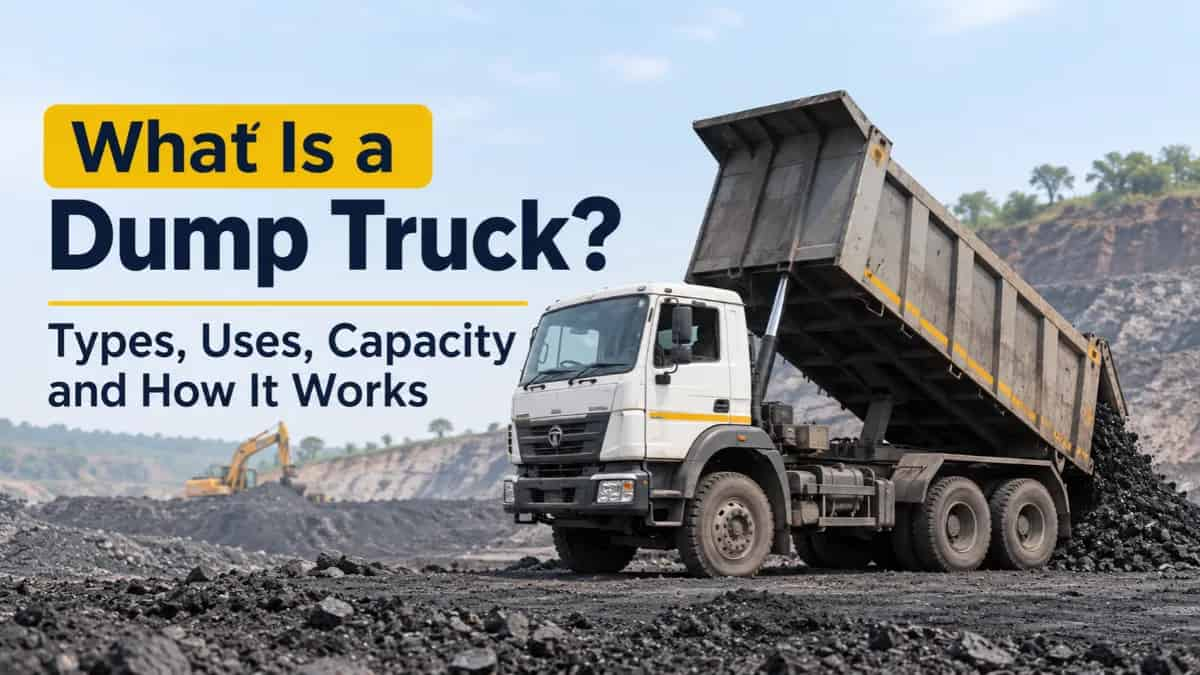


A dump truck is a heavy-duty commercial vehicle designed to transport and unload loose materials such as sand, gravel, soil, rocks, coal and construction debris. It is widely used in construction projects, mining operations, road development, quarrying and infrastructure work where large quantities of material need to be moved efficiently.
Unlike conventional goods trucks, a dump truck has a specially designed cargo body that can be raised using a hydraulic lifting mechanism. This allows the materials to slide out of the vehicle without requiring manual unloading.
Dump trucks are available in different configurations, including rigid, articulated, side-dump and bottom-dump models. Their design, payload capacity and operating capabilities depend on the type of work, terrain and material being transported.
In this guide, we explain what a dump truck is, how it works, its different types, load capacity, major components and applications across industries.
What Is a Dump Truck?
A dump truck is a motor vehicle equipped with an open cargo body that can be hydraulically lifted to unload materials at a selected location. It is primarily used to carry loose and bulk materials from one place to another, particularly at construction sites, mines, quarries and infrastructure projects.
The cargo body of a dump truck is generally designed with a hinged rear section. When the hydraulic system raises the front portion of the body, gravity causes the load to move towards the rear and discharge from the vehicle.
Dump trucks are also known by different names depending on their design and region, including dumper trucks, dumpers and tipper trucks. However, the term dump truck can cover a wider range of vehicle configurations, including large off-highway mining vehicles.
Main Purpose of a Dump Truck
The main purpose of a dump truck is to transport and unload bulk materials with less manual effort. It helps businesses and construction operators move heavy loads efficiently over short or long distances, depending on the vehicle configuration.
Common materials transported by dump trucks include:
-
Sand and gravel
-
Soil and excavated earth
-
Rocks and stones
-
Coal and mining materials
-
Construction and demolition waste
-
Crushed aggregates
-
Asphalt and other road-building materials
Where Are Dump Trucks Used?
Dump trucks are commonly used in industries where bulk materials need to be transported and unloaded regularly.
Some major applications include:
-
Construction sites for moving sand, soil, cement aggregates and debris.
-
Mining operations for transporting excavated minerals and rocks.
-
Quarrying projects for carrying stones and crushed materials.
-
Road construction for moving gravel, asphalt and earth.
-
Infrastructure projects for excavation, land development and material handling.
How Does a Dump Truck Work?
A dump truck works through a combination of an engine, transmission, chassis, cargo body and hydraulic lifting system. The engine provides the power required to move the vehicle, while the hydraulic mechanism raises the cargo body to unload the materials.
The unloading process generally takes place in the following steps.
Loading the Materials
The dump truck is positioned near the loading area, where materials are loaded into its cargo body using equipment such as excavators, wheel loaders or other material-handling machinery.
The load must remain within the vehicle's permitted payload and weight limits. Uneven loading can affect vehicle stability, steering and braking.
Transporting the Load
After loading, the driver transports the materials to the required location. The engine and transmission provide the power needed to move the vehicle, while the suspension, tyres and braking system help maintain control under loaded conditions.
The vehicle configuration and drivetrain depend on the type of dump truck and the terrain in which it operates.
Positioning for Unloading
The driver positions the vehicle on a suitable unloading surface. Ideally, the ground should be firm, stable and as level as possible.
Before unloading, the driver should check the surrounding area for people, overhead obstructions, uneven ground and other potential hazards.
Activating the Hydraulic Lifting System
Once the vehicle is safely positioned, the driver activates the hydraulic control system. Hydraulic pressure moves the lifting cylinder, which raises the front portion of the cargo body.
As the body tilts, the materials move towards the rear discharge opening.
Unloading the Materials
Gravity allows the materials to slide out of the raised cargo body. After unloading, the driver lowers the body back into its original position before moving the vehicle.
The dumping process should only be carried out according to the vehicle manufacturer's operating instructions and site safety procedures.
Different Types of Dump Trucks
Dump trucks are available in different designs depending on their unloading mechanism, operating environment, load requirements and terrain. Some are designed for regular road transportation, while others are built for demanding mining and off-highway operations.
Here are the major types of dump trucks.
Standard Dump Truck
A standard dump truck generally consists of a truck chassis with an open cargo body mounted on the rear. The body is raised using a hydraulic mechanism to discharge the load through the rear opening.
It is commonly used for transporting sand, gravel, soil and construction materials. Its design makes it suitable for construction projects and general material transportation.
Articulated Dump Truck
An articulated dump truck has a flexible joint between the cab and the rear dumping unit. This articulation allows the front and rear sections to move independently, improving manoeuvrability on uneven and challenging terrain.
These trucks are commonly used in mining, quarrying, earthmoving and large construction projects.
Key characteristics:
-
Designed for rough and uneven terrain.
-
Better manoeuvrability in challenging working conditions.
-
Suitable for transporting heavy materials over construction and mining sites.
-
Available with different drivetrain configurations depending on the application.
Rigid Dump Truck
A rigid dump truck has a fixed chassis structure in which the cab and cargo body are mounted on a rigid frame. These vehicles are generally designed for heavy-duty material transportation, particularly in large mining and quarrying operations.
Rigid dump trucks can carry substantial payloads and are commonly used where the operating routes are relatively well-defined and designed for heavy equipment.
Key characteristics:
-
Strong rigid chassis construction.
-
Designed for high-payload operations.
-
Commonly used in open-pit mining.
-
Suitable for transporting large quantities of rocks and minerals.
Off-Highway Dump Truck
An off-highway dump truck is specially designed to operate outside regular public-road transportation environments. It is used in mining sites, large construction projects, quarries and earthmoving operations.
These vehicles typically have heavy-duty components, large tyres and specialised drivetrains to handle challenging site conditions.
They are not necessarily designed or approved for regular public-road use. Their operation is generally restricted to suitable work sites.
Side Dump Truck
A side dump truck unloads its cargo by tilting the body towards one side rather than discharging the material through the rear.
This design can be useful when materials need to be unloaded along a particular side of a road or construction area.
Common applications:
-
Road construction.
-
Earthmoving projects.
-
Large infrastructure development.
-
Material distribution along construction routes.
Bottom Dump Truck
A bottom dump truck uses a discharge opening at the bottom of its cargo body to release materials. Depending on the design, the unloading mechanism may use one or more gates to control the flow of material.
It is particularly useful when materials need to be spread over a surface rather than unloaded in one large pile.
Common applications:
-
Road base material distribution.
-
Gravel and aggregate spreading.
-
Construction material placement.
-
Large-scale earthmoving projects.
Transfer Dump Truck
A transfer dump truck is a combination of a standard dump truck and an additional trailer that carries more material. The trailer is designed to transfer its load into the main dump body through a specialised arrangement.
This configuration can increase the total material transported in a single operation, subject to applicable weight limits and operating conditions.
It is used in certain construction and material transportation applications where higher carrying capacity is required.
Main Components of a Dump Truck
A dump truck contains several mechanical, structural and hydraulic components that work together to transport and unload materials. The specifications of these components vary according to the truck's size, design and intended application.
|
Component |
Function |
|
Chassis and frame |
Supports the vehicle body, engine and load |
|
Dump body |
Stores and carries bulk materials |
|
Hydraulic cylinder |
Raises and lowers the dump body |
|
Hydraulic pump |
Supplies pressurised hydraulic fluid |
|
Engine |
Generates power to operate the vehicle |
|
Transmission |
Transfers engine power to the driving wheels |
|
Axles and suspension |
Support the load and help maintain stability |
|
Tyres and wheels |
Provide traction and support on different surfaces |
|
Braking system |
Controls and stops the vehicle |
|
Cab and controls |
Allow the driver to operate the vehicle |
Hydraulic Lifting System
The hydraulic lifting system is one of the most important parts of a dump truck. It is responsible for raising and lowering the cargo body during unloading.
The system generally includes a hydraulic pump, hydraulic fluid, control valves, hoses and one or more lifting cylinders.
When the driver activates the lifting control, pressurised hydraulic fluid moves the cylinder and raises the dump body. When the system is operated to lower the body, the cylinder retracts and the cargo body returns to its normal position.
The lifting system must be maintained properly because hydraulic leakage, damaged hoses or cylinder problems can affect unloading performance and safety.
Dump Truck Capacity and Load Specifications
Dump truck capacity refers to the amount of material a vehicle can carry during a transportation cycle. However, capacity is not determined by a single measurement. It depends on payload rating, gross vehicle weight, cargo body volume, material density and the vehicle's design.
Understanding these specifications is important when selecting a dump truck for construction, mining or material transportation.
Payload Capacity
Payload capacity refers to the maximum weight of cargo that a dump truck is permitted to carry under its specified operating conditions.
For example, if a vehicle has a permitted gross vehicle weight of 25 tonnes and its kerb weight is 10 tonnes, the theoretical difference is 15 tonnes. However, the actual permissible payload must be confirmed from the manufacturer's specifications and applicable vehicle regulations.
Overloading can increase braking distance, put additional stress on the chassis and suspension, and create safety risks.
Gross Vehicle Weight (GVW)
Gross Vehicle Weight is the total permitted weight of a vehicle when it is loaded. It includes:
-
Vehicle kerb weight.
-
Driver and other occupants, where applicable.
-
Fuel and operating fluids.
-
Cargo or payload.
-
Other equipment carried by the vehicle.
GVW is an important specification because it helps determine the vehicle's legal and operational load limits.
Dump Truck Body Capacity
Dump body capacity refers to the volume of material that the cargo body can hold. It is generally measured in cubic metres (m³).
The body volume is important when transporting materials such as sand, soil, gravel and crushed stone.
However, a larger body does not automatically mean that a truck can carry more weight. The density of the material determines how much it weighs for a given volume.
For example, a cubic metre of loose soil and a cubic metre of rock will not have the same weight.
Payload Capacity vs Body Volume
|
Parameter |
Meaning |
Measurement |
|
Payload capacity |
Maximum permissible cargo weight |
Tonnes or kg |
|
Body volume |
Space available inside the dump body |
Cubic metres |
|
GVW |
Total permitted loaded vehicle weight |
Tonnes or kg |
|
Kerb weight |
Weight of the vehicle without its payload |
Tonnes or kg |
Factors Affecting Dump Truck Load Capacity
Several factors determine how much material a dump truck can carry:
-
Vehicle design: Chassis strength, axle configuration and body construction influence the truck's load limits.
-
Material density: Heavy materials can reach the permitted payload limit before the cargo body is completely full.
-
Body dimensions: Cargo body length, width and height determine its approximate volume.
-
Terrain: Uneven, steep or muddy surfaces can affect safe operating conditions.
-
Axle and tyre ratings: These components must be suitable for the intended load.
-
Manufacturer specifications: The vehicle's rated payload and permitted gross weight must always be followed.
For more information about commercial vehicle dimensions and payload considerations, explore our Truck Dimensions in Feet in India guide.
Dump Truck Uses in Construction, Mining and Infrastructure
Dump trucks play an important role in industries that require the transportation of loose and bulk materials. Their ability to unload materials quickly makes them useful for projects where continuous material movement is required.
Construction Projects
Dump trucks are widely used at residential, commercial and industrial construction sites. They transport materials required for land preparation, foundation work and building development.
Common construction materials include:
-
Sand.
-
Soil.
-
Gravel.
-
Crushed stone.
-
Excavated earth.
-
Construction debris.
Mining Operations
Mining is one of the major applications of heavy-duty dump trucks. These vehicles transport excavated minerals, rocks and overburden from mining locations to processing areas, stockpiles or designated dumping zones.
Large rigid and articulated dump trucks are commonly used depending on the mine layout, haul-road conditions and material requirements.
Quarrying
Quarries produce materials such as granite, limestone, gravel and crushed stone. Dump trucks move these materials from extraction points to crushing plants, storage areas and loading zones.
Their payload capacity and rugged construction make them suitable for demanding quarry operations.
Road Construction
Road construction projects require the regular movement of earth, gravel, aggregates and other materials.
Dump trucks are used for:
-
Carrying soil during road excavation.
-
Transporting gravel and crushed stone.
-
Moving construction waste.
-
Supplying aggregates for road base preparation.
-
Transporting asphalt where the vehicle and body are suitable for the material.
Infrastructure Development
Large infrastructure projects such as highways, bridges, industrial corridors and airport development require substantial earthmoving and material transportation.
Dump trucks support excavation, site preparation, land filling and the movement of bulk construction materials.
Agriculture and Waste Transportation
Dump trucks can also be used in selected agricultural and waste-handling applications. Depending on their body design, they may transport soil, compost, organic waste and other bulk materials.
The vehicle must be suitable for the material being carried and the operating environment.
Dump Truck vs Tipper Truck – Key Differences
Dump truck and tipper truck are closely related terms because both refer to vehicles designed to transport and unload loose materials using a tilting cargo body.
In India, the term tipper truck is commonly used for road-going commercial vehicles that transport construction materials, sand, gravel and other bulk loads. Dump truck is a broader term that can also include specialised off-highway vehicles used in mining and large earthmoving operations.
|
Basis |
Dump Truck |
Tipper Truck |
|
Meaning |
Broad term for vehicles designed to carry and unload bulk materials |
Commonly used term for a truck with a tilting cargo body |
|
Vehicle types |
Includes rigid, articulated and other dump configurations |
Commonly refers to road-going and site-use tipper configurations |
|
Applications |
Mining, construction, quarrying and infrastructure |
Construction, roadwork, sand, aggregates and material transportation |
|
Design |
Varies from road-going trucks to large off-highway vehicles |
Usually based on a commercial truck chassis |
|
Unloading |
Rear, side or bottom discharge depending on design |
Commonly rear tipping |
|
Operating environment |
Public roads, construction sites and specialised mining areas depending on type |
Public roads and construction sites, subject to vehicle configuration |
Are Dump Trucks and Tipper Trucks the Same?
Not always. The terms are often used interchangeably in everyday conversation, especially when referring to conventional road-going trucks that unload materials by raising their cargo bodies.
However, dump truck is also used for specialised vehicles such as large rigid mining dump trucks and articulated dump trucks. These vehicles may have different designs, payload capabilities and operating requirements compared with conventional road-going tippers.
If you are researching road-going commercial tipper models available in India, explore our Tipper Trucks in India category to compare available vehicles and their specifications.
Which Dump Truck Is Suitable for Different Applications?
Choosing the right dump truck depends on the material being transported, the required payload, terrain, travel distance and unloading conditions.
Different types of dump trucks are designed for different working environments.
|
Application |
Suitable dump truck type |
Why it is suitable |
|
General construction |
Standard dump truck |
Suitable for transporting soil, sand and aggregates |
|
Large mining operations |
Rigid dump truck |
Designed for heavy-duty hauling in mining environments |
|
Uneven construction sites |
Articulated dump truck |
Offers better manoeuvrability on challenging terrain |
|
Road material distribution |
Bottom dump truck |
Can spread materials along a surface |
|
Side unloading requirements |
Side dump truck |
Allows materials to be discharged towards one side |
|
Large material transportation |
Transfer dump truck |
Uses an additional trailer to increase carrying capacity |
Dump Trucks for Construction Projects
For general construction work, a standard dump truck or a suitable road-going tipper may be sufficient. The choice depends on the quantity of material, project size, road conditions and transportation distance.
Dump Trucks for Mining Operations
Large mining operations generally require heavy-duty rigid or articulated dump trucks. The choice depends on the haul-road design, loading equipment, operating distance and required payload.
Dump Trucks for Road Development
Road construction may require standard dump trucks, tippers or bottom dump configurations depending on whether the material needs to be unloaded in a pile or spread across a particular area.
Dump Trucks for Sand and Aggregate Transportation
The selection depends on the material's density and the required transportation volume. Operators should consider both body volume and permissible payload rather than choosing a vehicle based only on cargo body size.
Advantages and Limitations of Dump Trucks
Dump trucks are important material-handling vehicles, but their suitability depends on the type of project and operating environment.
Advantages of Dump Trucks
1. Faster Unloading
The hydraulic lifting system allows materials to be unloaded without requiring workers to remove the cargo manually.
2. Suitable for Bulk Material Transportation
Dump trucks can carry loose materials such as sand, gravel, soil and rocks, making them useful for large construction and mining projects.
3. Multiple Vehicle Configurations
Different designs are available for road transportation, mining, quarrying and specialised material distribution.
4. Improved Material Handling
The ability to load, transport and unload materials using one vehicle helps streamline construction and earthmoving operations.
5. Useful Across Multiple Industries
Dump trucks are used in construction, mining, quarrying, road development, infrastructure and selected waste-handling applications.
Limitations of Dump Trucks
1. High Operating Costs
Heavy-duty dump trucks can involve substantial expenses related to fuel, tyres, maintenance and repairs.
2. Fuel Consumption
Large engines and heavy loads can result in significant fuel consumption, particularly during demanding operations.
3. Site Requirements
Large dump trucks need suitable access routes, turning space and stable unloading surfaces.
4. Maintenance Requirements
Hydraulic systems, tyres, suspension, brakes and other heavy-duty components require regular inspection and maintenance.
5. Safety Considerations
Unloading on unstable or sloping ground can create rollover risks. Operators must follow proper procedures and manufacturer instructions.
Factors to Consider Before Buying or Using a Dump Truck
Selecting a dump truck requires an understanding of the project's material-handling needs and operating conditions. Choosing a vehicle only by its advertised capacity or engine power may lead to higher operating costs or unsuitable performance.
Consider the following factors before purchasing or using a dump truck.
Payload and Body Capacity
Check the permitted payload, GVW and cargo body volume. The vehicle should be suitable for the weight and volume of the material being transported.
Engine Power and Torque
Engine power and torque affect the vehicle's ability to move heavy loads, climb gradients and operate under demanding conditions. The required performance depends on the vehicle's application.
Fuel Efficiency
Fuel consumption has a direct impact on operating expenses. Compare the vehicle's expected fuel consumption under similar load and operating conditions rather than relying only on standard claimed figures.
Hydraulic System Performance
The hydraulic lifting mechanism should be suitable for the intended cargo body and load. Check the lifting arrangement, cylinder condition and maintenance requirements.
Terrain and Operating Conditions
A vehicle used on smooth roads may have different requirements from one operating in mines, quarries or muddy construction sites. Consider ground clearance, drivetrain, tyres and suspension.
Maintenance and Spare Parts
Availability of service support, replacement parts and trained technicians can affect vehicle uptime and long-term operating costs.
Safety Features
Check braking performance, visibility, reversing alerts, lighting, mirrors and other safety equipment. Drivers should also be trained in safe loading, driving and unloading procedures.
Conclusion
Dump trucks are essential commercial vehicles for transporting and unloading bulk materials across construction, mining, quarrying and infrastructure projects. Their different configurations, including standard, rigid, articulated, side-dump and bottom-dump designs, make them suitable for a wide range of material-handling requirements.
When selecting a dump truck, businesses should consider payload capacity, body volume, engine performance, hydraulic system, terrain and operating costs. Understanding these factors helps operators choose a vehicle that matches their transportation and project requirements.
For businesses researching road-going tipper vehicles in India, TruckOnWheels provides a dedicated Tipper Trucks category, where they can explore available models and compare their specifications.