Blog Details
Tow Trucks in India – Types, Uses, Capacity and Price
Summary
Explore tow truck types, recovery systems, capacity, applications, and price factors in India. Understand the differences between equipment types and choose the right vehicle for your business.
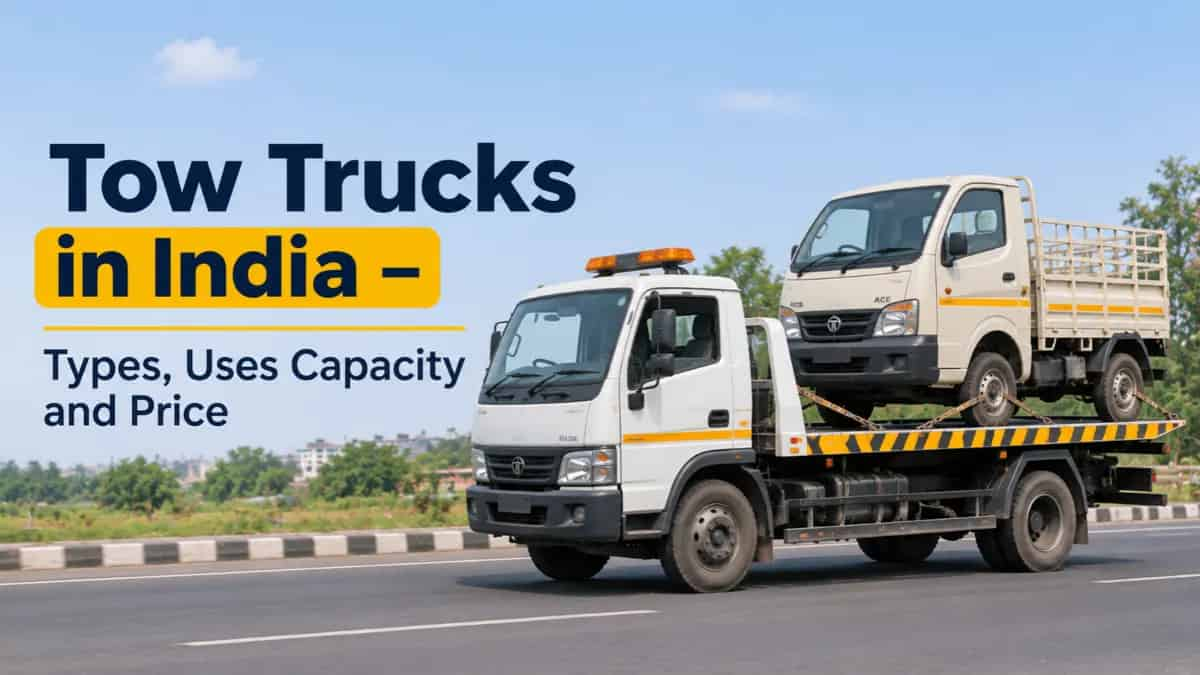


A tow truck is a specialised commercial vehicle used to recover, lift, tow or transport cars, trucks, buses and other vehicles that cannot move independently. These vehicles play an important role in roadside assistance, accident recovery, highway operations, vehicle transportation and commercial fleet management.
In India, tow trucks are used by roadside assistance providers, vehicle recovery operators, automobile dealerships, workshops, logistics companies and highway maintenance agencies. Depending on the application, they can be equipped with hydraulic flatbeds, wheel-lift systems, recovery booms, winches and specialised underlift mechanisms.
Different tow truck configurations are designed for different vehicle weights and recovery requirements. While a flatbed tow truck is suitable for transporting cars and SUVs, a heavy-duty recovery truck can handle more demanding operations involving buses, loaded trucks and construction vehicles.
Understanding the different types of tow trucks, their working mechanisms, recovery capacity, equipment and price factors can help businesses select the right vehicle for their operations.
What Is a Tow Truck?
A tow truck is a specialised vehicle designed to tow, recover or transport another vehicle that has broken down, been damaged in an accident, become stuck or cannot be driven safely.
Unlike conventional commercial trucks, tow trucks are equipped with dedicated recovery systems such as hydraulic lifting arms, winches, wheel lifts, flatbed platforms and towing mechanisms. These systems help operators move disabled vehicles without depending on their engines.
Tow trucks are available in different configurations depending on the size and weight of the vehicle being recovered.
For example:
-
Light-duty tow trucks: Used for towing mini trucks, Tata Ace, pickup trucks and other small commercial vehicles.
-
Medium-duty tow trucks: Suitable for larger vans, pickups, minibuses and compatible commercial vehicles.
-
Heavy-duty tow trucks: Designed for recovering buses, loaded trucks and other heavy commercial vehicles.
-
Flatbed tow trucks: Transport vehicles on a dedicated hydraulic platform.
-
Integrated wreckers: Use specialised booms, winches and underlift systems for demanding recovery operations.
Tow trucks are also commonly known as recovery trucks, breakdown trucks or wreckers, depending on their design and intended application.
How Does a Tow Truck Work?
A tow truck works by using mechanical or hydraulic equipment to lift, pull or transport a disabled vehicle from one location to another.
The working mechanism depends on the type of recovery vehicle. Some tow trucks lift one end of a vehicle using a wheel-lift system, while others use a hydraulic platform to carry the complete vehicle.
The main systems used in tow trucks include the following.
Hydraulic Lifting System
A hydraulic lifting system uses pressurised hydraulic fluid to operate lifting arms, platforms and recovery equipment.
A hydraulic pump generates pressure, which operates cylinders to raise, lower or extend the towing mechanism. These systems are commonly used in flatbed carriers, wheel-lift tow trucks and heavy-duty recovery vehicles.
Winch System
A winch is used to pull a disabled vehicle onto a flatbed or move a stuck vehicle during recovery operations.
It generally consists of a powered drum, steel wire rope or synthetic rope, and suitable pulling attachments.
Winches are particularly useful when a vehicle cannot move under its own power or needs to be pulled onto a recovery platform.
Wheel-Lift Mechanism
A wheel-lift system uses a specialised attachment positioned beneath the wheels of a disabled vehicle.
The hydraulic mechanism raises one axle, allowing the tow truck to pull the vehicle while its other wheels remain on the road, subject to the vehicle manufacturer's towing instructions.
Flatbed Platform
A flatbed tow truck has a movable platform that can be tilted or slid backwards to create a loading ramp.
The disabled vehicle is driven or winched onto the platform and secured before transportation. This arrangement allows all the vehicle's wheels to remain off the road during transportation.
Different Types of Tow Trucks
Tow trucks are available in several configurations, each designed for a particular recovery requirement. The right option depends on vehicle weight, road conditions, recovery methods and operating requirements.
Flatbed Tow Truck
A flatbed tow truck, also known as a rollback tow truck or carrier tow truck, has a long, flat loading platform installed behind the driver's cabin.
The platform can be tilted or slid backwards using a hydraulic mechanism. This creates a ramp that allows a disabled vehicle to be driven or pulled onto the deck.
Key features:
-
Hydraulic tilting and sliding platform.
-
Winch for pulling disabled vehicles.
-
Dedicated vehicle-securing points.
-
Full vehicle transportation on the platform.
-
Different platform capacities and dimensions.
Common applications:
Flatbed tow trucks are commonly used for transporting accident-damaged cars, luxury vehicles, SUVs, electric vehicles and compatible commercial vehicles.
They are particularly useful when all wheels need to remain off the road during transportation. However, the platform capacity and loading dimensions must be suitable for the vehicle being carried.
Wheel-Lift Tow Truck
A wheel-lift tow truck uses a hydraulic lifting assembly to raise the front or rear wheels of a disabled vehicle.
The remaining wheels stay on the road while the tow truck pulls the vehicle to its destination.
Unlike older hook-and-chain systems, modern wheel-lift equipment generally uses a metal yoke or wheel-support attachment to lift the tyres.
Key features:
-
Hydraulic wheel-lifting assembly.
-
Adjustable towing arm.
-
Compact recovery arrangement.
-
Quick attachment for suitable vehicles.
-
Suitable for selected cars, SUVs and light commercial vehicles.
Common applications:
Wheel-lift tow trucks are used for roadside breakdown recovery, vehicle relocation, parking enforcement and short-distance transportation.
However, certain four-wheel-drive vehicles, electric vehicles and vehicles with drivetrain damage may require flatbed transportation or additional equipment. Operators should always follow the vehicle manufacturer's towing instructions.
Hook-and-Chain Tow Truck
A hook-and-chain tow truck uses chains and hooks attached to suitable recovery points to lift or pull a disabled vehicle.
The system generally uses a boom or lifting arm to raise one end of the vehicle.
Key features:
-
Boom and chain arrangement.
-
Mechanical or hydraulic lifting assistance.
-
Basic vehicle recovery mechanism.
-
Suitable only for compatible recovery applications.
Common applications:
Hook-and-chain systems have historically been used for vehicle recovery and movement of damaged vehicles.
However, this method can put pressure on the vehicle's bodywork, suspension and other components. Modern wheel-lift and flatbed systems are generally preferred for transporting most road vehicles.
Integrated Tow Truck
An integrated tow truck combines a recovery boom and underlift mechanism into a single specialised vehicle.
These trucks are designed for demanding recovery operations where both lifting and towing capabilities are required.
Key features:
-
Integrated boom and underlift.
-
Heavy-duty hydraulic equipment.
-
Powerful winching arrangements.
-
Reinforced chassis configuration.
-
Suitable stabilisation systems.
Common applications:
Integrated tow trucks are used for recovering larger commercial vehicles, buses, trucks and vehicles involved in difficult roadside situations.
Their lifting and towing ratings must be checked carefully because permitted capacity can change depending on boom extension, lifting position and equipment configuration.
Heavy-Duty Recovery Truck
A heavy-duty recovery truck is designed for recovering large and heavy vehicles that exceed the operating capacity of ordinary tow trucks.
These vehicles are generally built on heavy commercial vehicle chassis and equipped with specialised recovery equipment.
Key features:
-
Heavy-duty recovery boom.
-
High-capacity hydraulic winches.
-
Reinforced chassis and suspension.
-
Heavy-duty underlift system.
-
Outriggers or stabilisers on suitable configurations.
-
Multiple recovery equipment options.
Common applications:
-
Recovering broken-down heavy trucks.
-
Bus and coach recovery.
-
Construction vehicle recovery.
-
Highway accident recovery.
-
Moving disabled industrial vehicles.
-
Recovering vehicles stuck in difficult terrain.
Rotator Tow Truck
A rotator tow truck is a specialised heavy recovery vehicle equipped with a rotating crane or boom.
Unlike conventional recovery trucks, its boom can rotate to support lifting and recovery operations from different angles.
Key features:
-
Rotating hydraulic boom.
-
Heavy-duty winching equipment.
-
Stabilising outriggers.
-
Advanced lifting arrangements.
-
Designed for complex recovery operations.
Common applications:
Rotator tow trucks are used for recovering overturned trucks, buses and heavy commercial vehicles, particularly where conventional towing equipment cannot provide the required lifting position.
They are specialised recovery vehicles and generally require trained operators, suitable ground conditions and careful load planning.
Tow Truck vs Wrecker Comparison
A tow truck and a wrecker are closely related vehicle categories, but they are not always used to describe the same type of recovery equipment.
A tow truck is a broad term for a vehicle designed to tow or transport disabled vehicles, while a wrecker generally refers to a specialised recovery vehicle equipped with a boom, winch and lifting mechanism.
For example, a flatbed carrier can transport a disabled car without using the traditional boom-and-underlift arrangement associated with many wreckers. A heavy-duty wrecker, on the other hand, is designed for more demanding recovery operations involving trucks, buses and other commercial vehicles.
Key Differences Between a Tow Truck and a Wrecker
|
Comparison factor |
Tow Truck |
Wrecker |
|
Meaning |
Broad category of vehicle used for towing and transportation |
Specialised vehicle recovery configuration |
|
Main function |
Towing or transporting disabled vehicles |
Lifting, pulling and recovering vehicles |
|
Equipment |
Flatbed, wheel-lift, towing arm or winch |
Boom, winch, underlift and stabilisers |
|
Common applications |
Roadside assistance and vehicle transportation |
Accident recovery and heavy vehicle recovery |
|
Vehicle types |
Cars, SUVs and commercial vehicles, depending on configuration |
Light, medium and heavy vehicles, depending on equipment ratings |
|
Recovery capability |
Depends on the installed towing system |
Often designed for more demanding lifting and recovery work |
When Should You Choose a Tow Truck?
A conventional flatbed or wheel-lift tow truck may be suitable when your primary requirement is transporting cars, SUVs, light commercial vehicles or other compatible vehicles.
For example, a vehicle transportation business may prefer a flatbed configuration because it allows the complete vehicle to be loaded onto a platform.
When Should You Choose a Wrecker?
A wrecker is more suitable when your business handles accident recovery, vehicles stuck in difficult locations or commercial vehicles requiring specialised lifting and winching equipment.
Heavy-duty wreckers are particularly useful for recovering buses, loaded trucks and other large vehicles when the recovery operation requires a suitable boom and underlift arrangement.
Important: A wrecker is a type of tow truck in common industry usage rather than a completely separate vehicle category. Actual capabilities depend on the installed equipment and its rated specifications.
Tow Truck vs Recovery Truck vs Car Carrier
Tow trucks, recovery trucks and car carriers are sometimes confused because all three can be involved in moving vehicles. However, their equipment and primary applications can be different.
A tow truck is a broad term covering different towing configurations. A recovery truck is generally designed to recover disabled or stuck vehicles, while a car carrier is primarily intended to transport vehicles from one location to another.
|
Parameter |
Tow Truck |
Recovery Truck |
Car Carrier |
|
Primary purpose |
Towing and vehicle transportation |
Recovering disabled or stuck vehicles |
Transporting vehicles |
|
Main equipment |
Flatbed, wheel-lift or towing arm |
Winch, boom, underlift or flatbed |
Vehicle loading platform or carrier deck |
|
Accident recovery |
Depends on configuration |
One of its primary applications |
Not its main purpose |
|
Heavy vehicle recovery |
With suitable equipment |
With suitable heavy-duty configuration |
Generally not intended for this work |
|
Common users |
Towing operators and vehicle transporters |
Recovery operators and highway assistance providers |
Automobile logistics companies and dealerships |
For businesses transporting new or used vehicles, a dedicated car carrier may be more appropriate. For businesses handling roadside breakdowns and accident recovery, a suitably equipped tow or recovery truck is generally a better choice.
Flatbed vs Wheel-Lift vs Wrecker – Which Is Better?
Choosing between a flatbed, wheel-lift and wrecker depends on the type of vehicles you handle and the recovery work you perform.
Each configuration has different advantages, so the most expensive or powerful option is not necessarily the best choice for every business.
|
Feature |
Flatbed Tow Truck |
Wheel-Lift Tow Truck |
Wrecker |
|
Recovery method |
Carries the complete vehicle on a platform |
Lifts one axle using a wheel-support attachment |
Uses a boom, winch and lifting equipment |
|
Main application |
Vehicle transportation |
Roadside towing |
Vehicle recovery and lifting |
|
Loading method |
Hydraulic tilting or sliding deck |
Hydraulic wheel lift |
Winching and boom operation |
|
Best suited for |
Cars, SUVs and compatible commercial vehicles |
Selected light and medium vehicles |
Vehicles requiring specialised recovery |
|
Heavy-duty applications |
Depends on platform and chassis rating |
Depends on underlift rating |
Suitable with heavy-duty equipment |
|
Main advantage |
Complete vehicle is carried on the deck |
Quick attachment for suitable vehicles |
Better capability for complex recovery work |
Which Configuration Should You Select?
Choose a flatbed tow truck if:
-
You transport cars and SUVs regularly.
-
You handle accident-damaged vehicles.
-
You need to carry vehicles with limited rolling capability.
-
You transport compatible electric and all-wheel-drive vehicles.
Choose a wheel-lift tow truck if:
-
You mainly handle roadside breakdowns.
-
You need a compact towing arrangement.
-
You frequently relocate compatible vehicles over shorter distances.
-
Your work requires quick attachment and removal.
Choose a wrecker if:
-
You handle complex accident recovery.
-
You recover commercial vehicles and buses.
-
You need boom and winch-based lifting operations.
-
Your business requires specialised recovery equipment.
The final selection should always be based on manufacturer-rated capacities and the towing instructions of the recovered vehicle.
Light-Duty vs Medium-Duty vs Heavy-Duty Tow Trucks
Tow trucks are available in different duty classes depending on the size of the base vehicle, installed equipment and intended recovery applications.
Understanding these categories helps buyers select equipment that matches their business requirements.
Light-Duty Tow Trucks
Light-duty tow trucks are generally designed for passenger cars, hatchbacks, sedans, SUVs and selected small commercial vehicles.
They may use a flatbed or wheel-lift arrangement and are commonly used for urban roadside assistance and vehicle transportation.
Typical applications:
-
Car breakdown recovery.
-
Accident-damaged car transportation.
-
Dealership vehicle movement.
-
Local roadside assistance.
Medium-Duty Tow Trucks
Medium-duty tow trucks are designed for larger vehicles that exceed the practical capacity of many light-duty recovery vehicles.
Depending on their configuration, they can be used for vans, minibuses, pickups and selected commercial vehicles.
Typical applications:
-
Commercial van recovery.
-
Pickup truck towing.
-
Minibus recovery.
-
Fleet breakdown assistance.
Heavy-Duty Tow Trucks
Heavy-duty tow trucks are designed for demanding recovery operations involving buses, loaded trucks, construction vehicles and other heavy commercial vehicles.
They generally use stronger chassis configurations and specialised equipment such as heavy-duty underlifts, multiple winches, recovery booms and stabilisers.
Typical applications:
-
Heavy truck breakdown recovery.
-
Bus and coach recovery.
-
Highway accident recovery.
-
Industrial vehicle recovery.
-
Construction equipment recovery.
The duty classification should not be decided by the vehicle name alone. Buyers should check the actual chassis GVW, axle ratings and recovery equipment capacity.
Important Equipment Used in Tow Trucks
The recovery capability of a tow truck depends heavily on the equipment installed on the vehicle. Different recovery configurations use different combinations of hydraulic, mechanical and safety components.
Here are the major equipment systems used in modern tow trucks.
Hydraulic Recovery Boom
A recovery boom is a lifting arm used to raise, pull or reposition disabled vehicles.
It is commonly installed on wreckers and heavy-duty recovery trucks. Boom capacity depends on its extension, operating angle and rated working position.
Hydraulic Winch
A winch uses a powered drum and cable or rope to pull a disabled vehicle onto a platform or out of a difficult position.
Important factors include:
-
Rated pulling capacity.
-
Cable or rope length.
-
Cable diameter and construction.
-
Drum arrangement.
-
Power source and operating controls.
The actual pulling force required can change with slope, ground resistance and the condition of the recovered vehicle.
Underlift System
An underlift is fitted at the rear of a recovery truck and is used to lift one end of another vehicle.
It is particularly useful for towing compatible commercial vehicles and performing specialised recovery operations.
Buyers should check the underlift rating at different extension positions rather than relying on a single maximum capacity.
Hydraulic Flatbed Platform
A hydraulic flatbed platform tilts or slides to allow a disabled vehicle to be loaded.
Its important specifications include:
-
Platform length and width.
-
Maximum rated deck load.
-
Loading angle.
-
Hydraulic operating mechanism.
-
Vehicle securing arrangements.
Outriggers and Stabiliser Systems
Outriggers are support mechanisms used to improve vehicle stability during certain lifting and recovery operations.
They help distribute forces and reduce the risk of unwanted vehicle movement when operating recovery equipment.
Their deployment requirements and ground conditions should always be checked before lifting.
Tow Truck Capacity and Technical Specifications
Tow truck capacity is one of the most important factors to consider before purchasing or operating a recovery vehicle.
A tow truck's capacity is not determined by its chassis alone. It also depends on the lifting equipment, winch rating, platform capacity, axle ratings and the position of the recovered vehicle.
Here are the main specifications to understand.
Gross Vehicle Weight (GVW)
Gross Vehicle Weight refers to the maximum permitted operating weight of the tow truck, including its chassis, recovery equipment, fuel, occupants and other carried items.
The GVW of the base vehicle should not be confused with the weight of the vehicle it can recover.
Payload Capacity
Payload refers to the permitted weight that a vehicle can carry after accounting for its kerb weight and other applicable weight components.
For a flatbed tow truck, the platform's usable load capacity must be sufficient for the vehicle being transported.
Winch Capacity
Winch capacity indicates the pulling capability of the winching equipment under specified operating conditions.
A higher winch rating does not automatically mean that the tow truck can safely recover a vehicle of the same total weight. Actual pulling requirements depend on slope, resistance, vehicle position and the use of suitable rigging equipment.
Boom Capacity
The boom is the lifting arm used in many recovery vehicles.
Its rated lifting capacity depends on the boom's design, extension and operating angle. Capacity can reduce as the boom extends.
Underlift Capacity
The underlift is a lifting assembly installed at the rear of a recovery truck.
It supports and raises part of the recovered vehicle during towing. Its rating depends on the lifting position and extension.
Chassis and Axle Capacity
The recovery equipment transfers significant loads to the truck chassis and axles.
Therefore, the chassis, suspension, brakes, tyres and axle ratings must be suitable for the installed recovery equipment and intended operation.
Important: Always check the manufacturer's rated capacities and the approved vehicle configuration. Do not use GVW, winch capacity, boom capacity and underlift capacity interchangeably.
Uses of Tow Trucks in India
Tow trucks support several transportation, roadside assistance and commercial vehicle recovery operations.
Highway Breakdown Recovery
Heavy commercial vehicles travel long distances across national highways and industrial routes. Mechanical failures, tyre damage and accidents can leave trucks stranded.
Recovery trucks help move these vehicles to workshops, service centres or designated safe locations.
Accident Vehicle Recovery
Vehicles involved in road accidents may become immobile or get stuck in difficult positions.
Flatbed carriers, winch-equipped recovery trucks and heavy-duty wreckers can help recover and transport damaged vehicles, depending on the situation.
Commercial Fleet Operations
Transport companies, logistics operators and fleet owners may require recovery support to reduce vehicle downtime.
A suitable recovery vehicle can help move disabled fleet vehicles to maintenance facilities and reduce disruption to operations.
Industrial and Construction Sites
Construction and industrial locations often use heavy vehicles and specialised equipment.
Recovery vehicles can assist when trucks, loaders and other compatible equipment become stuck or cannot move independently.
Businesses exploring different commercial vehicle categories can also compare commercial trucks in India based on their specifications, GVW, payload and applications.
Vehicle Transportation
Flatbed tow trucks can be used to transport new, used, damaged or non-running vehicles between dealerships, workshops, storage facilities and other locations.
Parking and Vehicle Relocation
Wheel-lift and suitable recovery trucks are also used for relocating vehicles from restricted or unauthorised parking areas, subject to applicable rules and authorisations.
Highway and Infrastructure Operations
Highway maintenance and emergency response operations may require specialised recovery vehicles to remove disabled trucks, buses and other vehicles from roadways.
The required recovery equipment depends on the vehicle weight, accident conditions, road access and operational requirements.
Tow Truck Price in India
The tow truck price in India depends on the base commercial vehicle, recovery equipment, lifting capacity and overall configuration.
A light-duty flatbed tow truck and a heavy-duty integrated recovery truck are not comparable in terms of construction, equipment and operating capability.
Some of the major factors that influence tow truck prices include:
|
Price factor |
How it affects the cost |
|
Chassis and GVW |
Heavier-duty chassis generally require a larger investment |
|
Recovery equipment |
Hydraulic booms, winches, and underlifts affect the total cost |
|
Flatbed design |
Platform length, material and hydraulic mechanism influence pricing |
|
Lifting capacity |
Higher-rated recovery equipment can increase cost |
|
Hydraulic system |
Pump, cylinders and control systems affect equipment costs |
|
Safety equipment |
Stabilisation and vehicle-securing equipment add to the configuration |
|
Customisation |
Specialised recovery requirements can increase the final price |
Additional Costs to Consider
Apart from the initial purchase price, buyers should also consider:
-
Insurance and registration.
-
Fuel and operating expenses.
-
Preventive maintenance.
-
Hydraulic equipment servicing.
-
Winch cable and accessory replacement.
-
Tyres and suspension maintenance.
-
Operator training.
-
Spare parts and service availability.
Since tow trucks are available in different customised configurations, buyers should obtain a quotation based on the exact chassis and recovery equipment specifications rather than relying on a single generic price.
Factors Affecting Tow Truck Operating Costs
Buying a tow truck is only the initial investment. Businesses should also evaluate the ongoing costs of operating and maintaining recovery vehicles.
|
Cost component |
What to consider |
|
Fuel consumption |
Depends on engine, vehicle weight, operating conditions, and distance |
|
Maintenance |
Regular servicing of the base vehicle and recovery equipment |
|
Hydraulic system |
Hydraulic oil, hoses, cylinders, pumps and seals |
|
Winch maintenance |
Cable inspection, drum condition and mechanical servicing |
|
Tyres and brakes |
Wear caused by operating weight and road conditions |
|
Insurance |
Coverage for the recovery vehicle and applicable operations |
|
Operator expenses |
Trained drivers and recovery equipment operators |
|
Equipment replacement |
Replacement of worn cables, attachments and accessories |
How Can Businesses Manage Tow Truck Operating Costs?
Businesses can manage operating costs by selecting a recovery vehicle that matches their actual workload rather than purchasing equipment with unnecessary capacity.
Regular inspection of hydraulic systems, winches, tyres, brakes and lifting equipment can also help reduce unexpected downtime.
Fleet operators should monitor fuel expenses, maintenance schedules, vehicle utilisation and recovery job requirements to understand the overall cost of each operation.
How to Choose the Right Tow Truck for Your Business?
Selecting the right tow truck requires understanding the type of recovery work your business will handle.
Here are the main factors to evaluate before making a purchase.
1. Identify the Type of Vehicles You Will Recover
Start by identifying whether you will mainly recover passenger cars, SUVs, pickups, buses or heavy commercial vehicles.
A light-duty recovery vehicle may be suitable for cars, but it may not have the required lifting and towing ratings for loaded trucks.
2. Select the Right Recovery Mechanism
Choose between flatbed, wheel-lift, integrated boom and heavy-duty recovery configurations based on your operating requirements.
For example, flatbed systems are useful when the complete vehicle needs to be transported on a platform, while integrated wreckers are designed for more demanding lifting and recovery operations.
3. Check Capacity and Technical Specifications
Review the rated capacity of the complete recovery system, including:
-
Truck GVW and axle ratings.
-
Flatbed loading capacity.
-
Winch pulling rating.
-
Boom lifting rating.
-
Underlift capacity.
-
Hydraulic operating specifications.
Do not select equipment based only on a single advertised capacity figure.
4. Consider the Operating Location
The operating environment can influence the choice of tow truck.
Urban roadside recovery may require a compact vehicle with good manoeuvrability, while highway and heavy commercial vehicle recovery may require a larger chassis and more powerful recovery equipment.
For off-road or difficult-terrain recovery, the vehicle's traction, ground clearance and stabilisation requirements should also be considered.
5. Evaluate Maintenance and Service Support
Tow trucks use specialised hydraulic and mechanical equipment that requires regular inspection and maintenance.
Before purchasing, check the availability of spare parts, service technicians, hydraulic components and equipment support.
6. Calculate the Total Ownership Cost
The purchase price is only one part of the overall investment.
Compare fuel consumption, maintenance, insurance, operator costs and expected utilisation before selecting a tow truck.
A suitable recovery vehicle should meet your operational requirements without creating unnecessary ownership expenses.
Tow Truck Buying Checklist – What Should You Check Before Purchasing?
Selecting a tow truck requires more than comparing its engine power or advertised towing capacity. Buyers should evaluate the complete chassis and recovery equipment configuration before making a purchase.
Use the following checklist when comparing tow trucks.
Vehicle and Chassis
-
Check the manufacturer's GVW and axle ratings.
-
Confirm the chassis is suitable for the intended recovery body.
-
Evaluate engine power and torque for the operating conditions.
-
Check the braking system and suspension.
-
Verify the vehicle's dimensions and manoeuvrability.
Recovery Equipment
-
Check the rated capacity of the hydraulic boom.
-
Verify winch pulling capacity and cable specifications.
-
Review underlift capacity at different extension positions.
-
Inspect the flatbed's dimensions and loading angle.
-
Check stabilisers and recovery attachments.
Safety and Operations
-
Check vehicle-securing arrangements.
-
Verify the availability of emergency warning equipment.
-
Evaluate operator controls and visibility.
-
Review equipment inspection and maintenance requirements.
-
Ensure operators receive suitable training.
Ownership and After-Sales Support
-
Compare the complete vehicle and equipment quotation.
-
Check warranty coverage.
-
Confirm spare-parts availability.
-
Evaluate service centre and technician support.
-
Calculate expected fuel and maintenance expenses.
Before finalising the purchase, ask the supplier for the vehicle's technical specification sheet, equipment ratings, approved installation details and maintenance documentation.
A well-matched tow truck can improve recovery efficiency and reduce unnecessary ownership costs over its working life.
Important Safety and Maintenance Considerations During Tow Truck Operations
Tow truck operations require proper equipment, trained operators and careful load management.
Some important safety considerations include:
-
Check the weight and condition of the vehicle before recovery.
-
Verify winch, boom and underlift ratings.
-
Use approved recovery points and suitable attachments.
-
Secure the recovered vehicle using appropriate restraints.
-
Ensure the tow truck is stabilised during lifting operations.
-
Use warning lights and appropriate traffic protection.
-
Follow the vehicle manufacturer's towing instructions.
-
Inspect hydraulic lines, winches, cables and lifting components regularly.
Routine Maintenance of Tow Trucks
Regular maintenance is important for keeping recovery equipment in working condition.
Operators should periodically inspect:
-
Hydraulic hoses, cylinders and connections.
-
Winch cables, hooks and mounting points.
-
Recovery booms and lifting arms.
-
Underlift joints and locking mechanisms.
-
Flatbed platform and securing points.
-
Tyres, brakes and suspension.
-
Warning lights and safety controls.
For heavy-duty recovery, operators should follow the equipment manufacturer's procedures and applicable road safety requirements.
Conclusion
Tow trucks are important commercial vehicles for roadside assistance, accident recovery, vehicle transportation and heavy-duty fleet operations. From flatbed and wheel-lift configurations to integrated wreckers and rotator recovery vehicles, each type serves a different operational requirement.
Before purchasing a tow truck, businesses should evaluate the vehicles they intend to recover, the required lifting and towing capacities, the operating environment and the overall ownership cost.
Understanding the differences between tow trucks, wreckers and recovery vehicles can help businesses select the right equipment for their requirements. Choosing a properly configured recovery vehicle helps operators handle breakdowns more efficiently while maintaining safe and reliable recovery operations.