Blog Details
Bulker Truck: Meaning, Capacity, Types & Price in India 2026
Summary
Guide to bulker trucks: how they work, how much cement they carry, what they cost in 2026 and which chassis to buy.
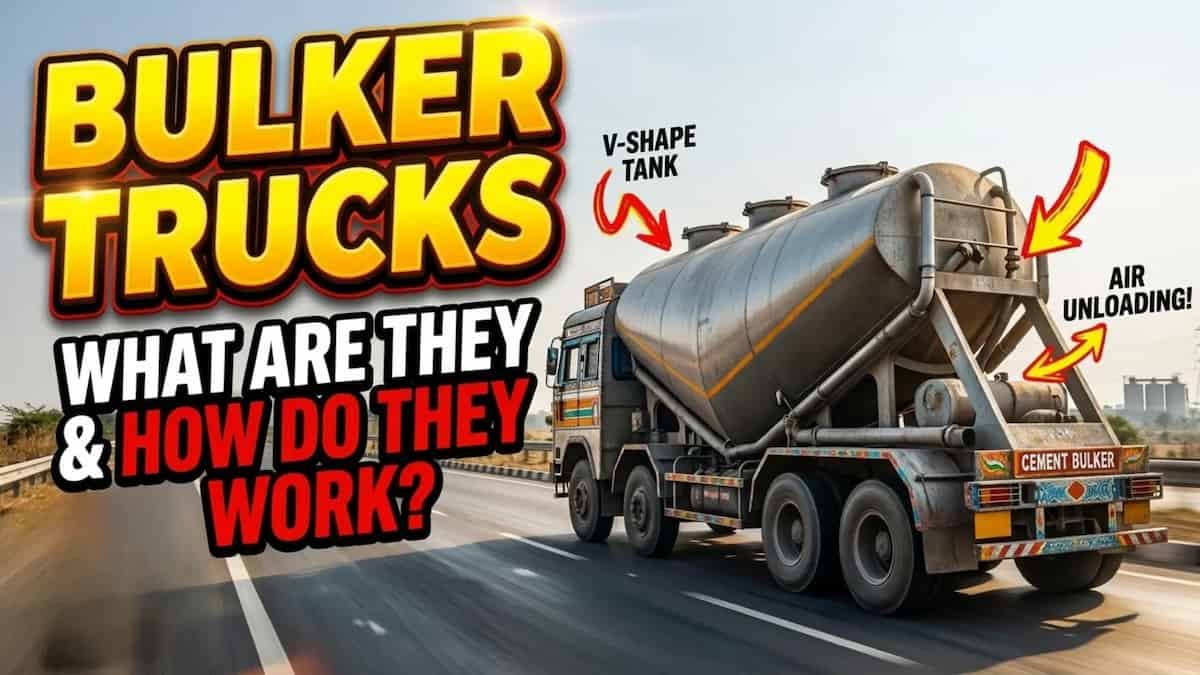


A bulker truck is a heavy truck with a closed tank that carries dry powders such as cement and fly ash loose, without bags. It is loaded from the top and unloaded with compressed air, which pushes the powder through a pipe straight into a storage silo.
You'll spot bulkers on highways near cement plants and big construction sites: they're the trucks carrying a large V-shaped or round tank. This guide explains, in simple words, what a bulker truck is and how it works. I also cover how much cement a bulker carries, what one costs in India in 2026, which trucks are used as bulkers and the rules you should follow as an owner.
What is a bulker truck?
A bulker truck is a goods vehicle built to move dry, powdery material in bulk. Instead of an open body or a container, it carries an airtight steel or aluminium tank, so nobody has to lift a single bag.
Bulker trucks are also called cement bulker truck, bulker lorry, bulk cement tanker, powder tanker or pneumatic tanker. They all mean the same truck. A plain "tanker", though, usually means a truck for liquids, which is a different vehicle (see the comparison further down). In shipping, "bulker" means a bulk-carrier ship; on Indian roads it means this powder truck.
How to recognise a bulker on the road
- A large tank on the chassis, usually V-shaped from the side, sometimes W-shaped or round.
- Round hatches (manhole lids) on top of the tank, used for loading.
- An air compressor mounted near the cabin.
- Valves and a discharge pipe at the back or side, where the unloading hose is connected.
What is a bulker truck used for?
A bulker truck is used wherever large amounts of powder have to move from one silo to another. The usual loads are:
- Cement, from cement plants and grinding units to ready-mix concrete (RMC) plants, batching plants on big projects and bulk terminals.
- Fly ash, from thermal power plants to cement and RMC plants, where it is blended into cement and concrete.
- GGBS (ground granulated blast-furnace slag), another material mixed into cement and concrete.
- Lime powder and other dry industrial powders.
- Food and plastic powders such as flour, sugar and plastic granules, carried in stainless-steel tanks.
The people who use them are cement companies, RMC producers, infrastructure contractors and the transporters who run bulkers for them.
Why move powder in bulk instead of bags?
- No bags to buy, fill, stack or throw away.
- Faster unloading. Bulker trailer makers quote discharge speeds of around 1.5 tonnes a minute.
- Less waste. Makers claim only 0.3–0.5% of the load stays behind in the tank.
- Cleaner sites, because the powder travels from tank to silo through a closed pipe.
How does a bulker truck work?
A bulker truck works on one simple idea: powder mixed with air flows like a liquid. Here's a full trip, step by step.
- Loading. At the plant, cement falls from the silo into the tank through the hatches on top. The hatches are then clamped shut so the tank is airtight.
- Connecting. At the delivery point, the driver connects a hose from the tank's outlet to the inlet pipe of the customer's silo. The pipe should be at least 100 mm wide.
- Pressurising. The driver starts the onboard compressor, which runs off the truck's engine through a power take-off (PTO). A typical truck compressor delivers about 12 m³ of air a minute at up to 2 bar.
- Aerating. Air enters the bottom of the tank through an air chamber and a fluidising bed. It loosens the powder so it flows like a liquid. This is why the tank is V-shaped: its floor slopes down to the outlets, so the aerated powder slides towards them and the bulker empties itself without tipping like a dumper.
- Discharging. When the tank pressure builds up (about 1.8 bar in one maker's design), the discharge valve opens. The air-and-powder mix rushes up the pipe into the silo.
- Finishing. When the tank is empty, the driver closes the valves and lets the pressure out. Only then are the hatches opened.
Types of bulker trucks
Bulker trucks differ in three ways: the tank's shape, what carries the tank, and what the tank is made of.
By tank shape
- V-type: the most common. One sloping floor and one set of outlets.
- W-type: two V-shaped sections side by side, used on longer tanks.
- Cylindrical: a horizontal round tank.
By what carries the tank
- Rigid bulker: the tank is mounted on a truck chassis, usually a 10-wheeler, 12-wheeler, 14-wheeler or 16-wheeler. It's easier to handle in towns and on site roads.
- Bulker trailer: the tank sits on a semi-trailer pulled by a tractor head. It carries bigger tanks, typically 35–45 m³, and the combination is allowed up to 55 t. Here's the difference between trucks and trailers if you're choosing between the two.
By tank material
The material decides the empty weight of the body, and every kilo saved there is a kilo more of legal payload.
|
Material |
Weight and cost |
Best for |
|---|---|---|
|
Mild steel |
Heaviest and cheapest |
Cement and fly ash on a tight budget |
|
High-tensile steel (E350/E450 grades) |
Thinner plates, so lighter for the same strength |
Owners who want more payload |
|
Aluminium |
About 30–40% lighter than steel, as makers claim |
Maximum payload |
|
Stainless steel |
Costlier |
Food-grade and chemical powders |
Bulker truck capacity in cubic metres and tonnes
Bulker truck capacity is quoted in two ways, and mixing them up causes most of the confusion:
- Tank volume, in cubic metres (m³), tells you how much space the tank has.
- Payload, in tonnes, tells you how much weight the truck may legally carry.
Tank sizes vary a lot. Indian body builders list rigid-truck bulkers of about 23–32 m³, bigger bodies of 40–48 m³, and fly-ash trailers as large as 65 m³.
The tank never decides the legal load. The truck's gross vehicle weight (GVW), printed on its registration certificate (RC), does:
\text{Payload} = \text{GVW} - \text{Unladen weight (truck + empty bulker body)}The Road Transport Ministry's notification S.O. 3467(E) of 16 July 2018 caps GVW at 49 tonnes for rigid trucks and 55 tonnes for semi-trailers and truck-trailers. It also sets axle limits. Trucks with air (pneumatic) suspension may carry 1 tonne more on each of these axles, which is the one reason to consider the costlier suspension.
|
Axle type |
Legal limit |
With air suspension |
|---|---|---|
|
Single axle on four tyres |
11.5 t |
12.5 t |
|
Tandem axle |
21 t |
22 t |
|
Tri-axle |
27 t |
28 t |
In practice, the layout of the truck fixes its GVW:
|
Bulker layout |
Typical GVW |
|---|---|
|
10-wheeler rigid |
28 t |
|
12-wheeler rigid |
35 t |
|
14-wheeler rigid |
42 t |
|
16-wheeler rigid |
47.5–49 t (the legal cap for rigid trucks) |
|
Tractor with bulker trailer |
Up to 55 t (the legal cap) |
Here's an example. A 12-wheeler bulker has a GVW of 35 t, and its RC shows an unladen weight of 13 t with the bulker body fitted. Its legal payload is 35 − 13 = 22 t. The 13 t is only an example, so always use the figure on your own RC. For how payload works on other truck sizes, see our guide to 12 tyre truck load capacity.
How much cement is in one bulker?
A typical 12-wheeler bulker (35 t GVW) carries about 22 tonnes of cement, or 440 bags of 50 kg. A cement bulker truck carries as much as its legal payload allows, not as much as its tank can hold. Two numbers make the conversion easy:
- Ordinary cement weighs about 1.44 t per cubic metre (1,440 kg/m³). That's the unit weight listed in IS 875 (Part 1) and the figure Indian site engineers use.
- One tonne of cement is 20 bags of 50 kg.
|
Legal payload |
Equal to (50 kg bags) |
Tank space needed as loaded (about 1.1 t/m³) |
|---|---|---|
|
22 t |
440 bags |
About 20 m³ |
|
28 t |
560 bags |
About 25 m³ |
|
35 t |
700 bags |
About 32 m³ |
Why use 1.1 t/m³ for the tank and not 1.44? Freshly loaded cement is loose and full of air, so it takes more room than settled cement, and the tank needs air space to unload. One trailer maker, for example, rates its 27 m³ tank for 30 t of cement, about 1.1 t per cubic metre.
Cement plants weigh each bulker on a weighbridge at dispatch, and the weight slip records the exact load you're carrying.
Bulker truck price in India 2026
A new rigid bulker truck costs roughly ₹39–76 lakh in India in 2026, before registration and insurance. That is two prices added together: the truck (chassis) at ₹35–50 lakh and the bulker body built on it at ₹4–26 lakh. A 35 t bulker with a standard mild-steel body, the most common buy, lands at about ₹39–55 lakh. A tractor-trailer bulker is priced separately, because the tractor head and the trailer with its tank come from different sellers.
|
What you're buying |
Price range (Nov 2026) |
|---|---|
|
Bulker body only, mild steel, most sizes |
₹4–12 lakh |
|
Larger or premium bulker body (for example 48 m³) |
₹18–26 lakh |
|
Rigid chassis, 35 t (12-wheeler) |
₹34.7–43.3 lakh ex-showroom |
|
Rigid chassis, 42–49 t (14- and 16-wheeler) |
₹38.2–50.2 lakh ex-showroom |
|
Tractor head for a bulker trailer, 54–55 t |
₹37.7–57.6 lakh ex-showroom |
|
Used bulker trucks |
From under ₹10 lakh for old units to about ₹28 lakh for 2023 models |
A few things move the final price:
- Body size and material. Bigger tanks, high-tensile steel and aluminium cost more but save weight.
- The compressor. Ask whether it's included and what make it is.
- GST. Trucks now attract 18% GST, cut from 28% by the GST Council in September 2025.
Prices change by city and dealer, so take a written on-road quote for both the chassis and the body before you decide. Compare chassis on our BharatBenz, Tata, Ashok Leyland, Mahindra and Eicher pages.
Cement bulker truck for sale: buying used
A used cement bulker truck for sale is priced on the chassis, and the tank is often treated as a bonus. Check the tank as closely as the engine:
- Look inside the tank for pitting and thinning plates, and ask for a pressure test before you pay.
- Check the hatch seals, the discharge valves and the safety valve, which are the parts that fail first.
- Run the compressor and check its oil, hours and output pressure.
- Weigh the truck empty and match the figure to the unladen weight on the RC, since that number sets your legal payload.
- Confirm that the RC records the bulker body, not a bare chassis.
Best bulker truck models in India 2026: price list
Most bulkers in India are built on heavy trucks from BharatBenz, Tata Motors, Ashok Leyland, Mahindra and Eicher, with tractor-trailers used for the biggest tanks. A quick tip: in most Indian truck names, the first two digits give the GVW in tonnes. So the 3526R is a 35 t truck, the 4220 is 42 t and the Signa 4932.T is 49 t.
The list below has rigid trucks first, from the heaviest down, then the tractor heads that pull bulker trailers. BharatBenz also names the lighter 2826R (28 t) and the 4028T tractor for bulker work, and Tata lists the Signa 4425.T (44 t) beside the 4932.T.
|
Model |
Type |
GVW / GCW |
Ex-showroom price |
Why it makes the list |
|---|---|---|---|---|
|
Tata Signa 4932.T |
16-wheeler |
49 t |
₹45–50 lakh |
Most powerful rigid truck here (320 hp), at the 49 t legal limit. 9-speed gearbox; Tata lists bulker as an application |
|
Mahindra Blazo X 49 |
16-wheeler |
49 t |
₹45.20–45.40 lakh |
The full 49 t for about ₹45 lakh. 9-speed gearbox |
|
16-wheeler |
47.5 t |
₹45.10–50.20 lakh |
Most torque of the 16-wheelers (1,200 Nm). Its lift axle can be raised when empty, which saves tyres on return trips |
|
|
14-wheeler |
42 t |
₹41.30–43.90 lakh |
More power and a lower price than the Eicher Pro 6042 and Blazo X 42 |
|
|
Ashok Leyland 4220 10x2 |
14-wheeler |
42 t |
₹38.2–38.7 lakh |
Cheapest 42 t chassis here, and a common sight with bulker bodies in used-truck listings |
|
Mahindra Blazo X 35 (lift axle) |
12-wheeler |
35 t |
₹34.73–38.13 lakh |
Cheapest 35 t truck, with more power and torque than the BharatBenz 3526R |
|
12-wheeler |
35 t |
₹39.02–43.30 lakh |
On BharatBenz's own list of cement bulker trucks. A cab-chassis version with the PTO already fitted costs ₹40–44.5 lakh |
|
|
Eicher Pro 8055 |
Tractor |
55 t |
₹56.93–57.64 lakh |
Most powerful diesel on the list (350 hp), for long or hilly routes, but the most expensive |
|
BharatBenz 5532T |
Tractor |
55 t |
₹46.93–47.73 lakh |
Reaches the 55 t legal limit with strong torque, for about ₹10 lakh less than the Eicher Pro 8055 |
|
BharatBenz 5528T (4x2) |
Tractor |
55 t |
₹37.65–39.61 lakh |
Cheapest way to run a full 55 t combination, but the least power per tonne of the four tractors |
|
BharatBenz 5432T |
Tractor |
54 t |
₹40.23–40.51 lakh |
Same power and torque as the 5532T for about ₹7 lakh less |
Ex-showroom prices are from TrucksBuses and 91trucks, checked 8–9 November 2026, and change by city. BharatBenz and Tata name bulker work on their own pages; the Ashok Leyland 4220 is seen with bulker bodies in used listings.
Before you buy: five checks
- Check for a PTO. The compressor needs a power take-off on the engine, and some chassis come with it fitted.
- Match the GVW to your contract. A higher GVW means a bigger legal payload per trip.
- Ask for the empty weight of the bulker body. A lighter body leaves more room for cement.
- Consider air suspension, which earns 1 tonne more on each eligible axle under the 2018 rules.
- Make sure the RC records the bulker body and its unladen weight correctly, since your legal payload depends on it.
Bulker truck business: how to work out your monthly earnings
Bulkers usually run on contract: a cement company or its transport contractor supplies the loads and pays per tonne. Whether a bulker makes money comes down to four things: the rate per tonne, the tonnes per trip, the trips per month and your running costs.
Use this worksheet with your own numbers, and our truck EMI calculator for the loan line. The sample column assumes a 12-wheeler bulker carrying 22 t on a 60 km route (120 km round trip), two trips a day for 26 days, returning empty. These are example figures, not market rates.
|
Item |
How to work it out |
Sample |
|---|---|---|
|
Freight earned |
Payload × trips × rate per tonne |
22 t × 52 trips × ₹350 = ₹4,00,400 |
|
Diesel |
Monthly km ÷ km per litre × diesel price |
6,240 km ÷ 3.5 × ₹90 ≈ ₹1,60,500 |
|
Loan EMI |
From your loan (sample: ₹42.5 lakh at 10% for five years) |
≈ ₹90,300 |
|
Driver |
Salary plus allowances |
₹35,000 |
|
Tyres and maintenance |
Amount set aside each month |
₹25,000 |
|
Insurance, permit and tax |
Yearly cost ÷ 12 |
₹15,000 |
|
Tolls |
Per trip × trips |
₹0 on this sample route |
|
Left over, before income tax |
Freight earned − all costs |
≈ ₹74,600 |
Three things usually decide whether that last line is healthy:
- A return load. A bulker can only carry powders, so it often comes back empty. A load on the return trip (fly ash, for example) changes the maths.
- Staying within the legal payload. One overloading fine (see the rules below) can wipe out a week's margin.
- Diesel discipline. Fuel is the biggest cost line, so track litres per trip and fix leaks and tyre pressure early.
Bulker vs transit mixer vs tanker vs tipper
These four trucks are often confused because they all carry construction or bulk material. The difference is what they carry and how they unload it.
|
Truck |
What it carries |
How it unloads |
Typical use |
|---|---|---|---|
|
Bulker |
Dry powder: cement, fly ash, GGBS, lime |
Compressed air pushes it through a pipe into a silo |
Plant to RMC plant, batching plant or terminal |
|
Ready-mixed wet concrete |
A rotating drum pours it out down a chute |
RMC plant to the construction site |
|
|
Tanker |
Liquids: diesel, water, milk, chemicals |
Pump or gravity through a valve |
Fuel, water and milk supply |
|
Loose solids: sand, aggregate, soil |
The body tips up and dumps the load |
Mining, roads and earthwork |
So a bulker brings cement to the RMC plant, and a transit mixer carries the finished concrete from there to the site.
Safety and rules every bulker owner should know
Rules and papers
- Stay within the GVW on your RC. Overloading is fined under Section 194(1) of the Motor Vehicles Act: ₹20,000 plus ₹2,000 for every extra tonne, along with the cost of off-loading. The truck can't move until the extra load is removed.
- Carry valid papers: RC, permit (a national permit for interstate work), fitness certificate, insurance and PUC. The driver needs a licence valid for heavy transport vehicles.
- Keep the plant's weight slip with your trip papers.
Safe unloading
- Earth (ground) the truck before unloading, because moving powder builds up static electricity.
- Never open a hatch while the tank is under pressure. Let the pressure out first.
- Keep the pressure gauge and the tank's safety valve in working order. Typical truck compressors work at up to about 2 bar, so never push past the tank's rated pressure.
- Watch the end of the discharge. The last rush of air can over-pressurise the customer's silo and blow its safety valve.
- Check the compressor's oil before every use.
- Train your drivers. Unloading is a manual job, so the driver's skill matters, and most problems come from rushing it.