Blog Details
LR Full Form & Bilty Meaning with Free Lorry Receipt Format
Summary
This guide explains LR (lorry receipt) and covers who issues it, what the LR number means, its 3 copies, LR vs e-way bill and the law, plus a free LR format you can copy.
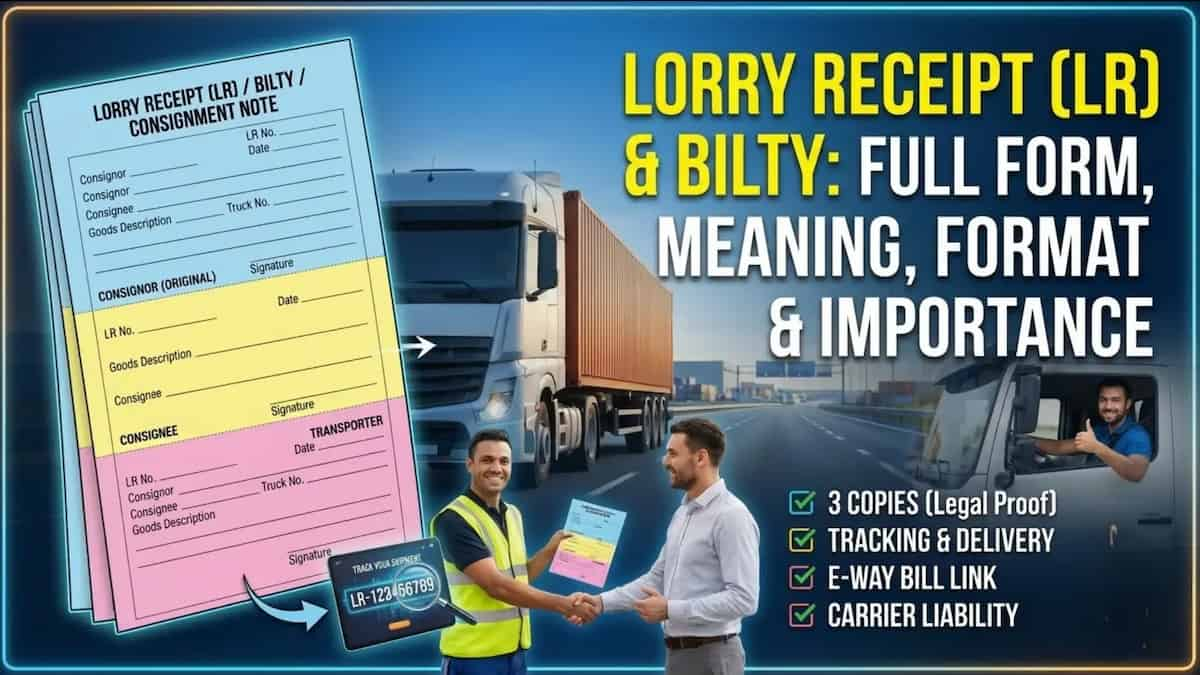


LR full form in transport is Lorry Receipt. A lorry receipt, also called a bilty, is the receipt a transporter issues when they accept goods for transport. This receipt names the sender and receiver, lists the goods and packages, gives the truck number and freight, and carries a unique LR number used for tracking, delivery and billing.
Who Issues a Lorry Receipt and Its Importance
The transporter issues the lorry receipt. When a truck operator or transport company accepts your goods, they note down the LR and hand it back to you.
The Carriage by Road Act, 2007 says a common carrier must issue the LR as soon as it accepts the goods. If you load the truck yourself, the carrier issues it once loading ends.
Three Key Importance of Lorry Receipt
-
It proves the transporter took your goods. From that moment, the goods are in the carrier's custody.
-
It is prima facie evidence of what was handed over: the weight, the number of packages and the details written on it (Section 9(3)). If a dispute ever reaches a court, the LR is the first record they look at.
-
It carries the LR number that every later step depends on: delivery, the freight bill, tracking and any claim.
LR, Bilty, GR and Consignment Note : What's the Difference
Transporters use four names for the same document. A Bilty is the lorry receipt and the name changes depending on who is speaking and which law they have in mind.
|
Name |
Who uses it |
What it means |
|
Lorry receipt (LR) |
Transporters, shippers and logistics teams, in English |
The receipt for goods accepted for carriage by truck |
|
Bilty (also spelt bilti or builty) |
The Hindi-Urdu trade word, heard at every transport nagar |
The same receipt |
|
Goods receipt (GR) |
The Carriage by Road Act, 2007 |
The same receipt, in the Act's words |
|
Consignment note (CN or GC note) |
GST law |
The same receipt, when a goods transport agency issues it |
LR Number Meaning and What It Tells You
The LR number meaning is a serial number from the transporter's LR book or software. Each consignment gets one LR number, and the transporter never reuses it.
Next to it sits the LR date, the day the transporter accepted the goods. Together, the number and the date identify one shipment with one carrier.
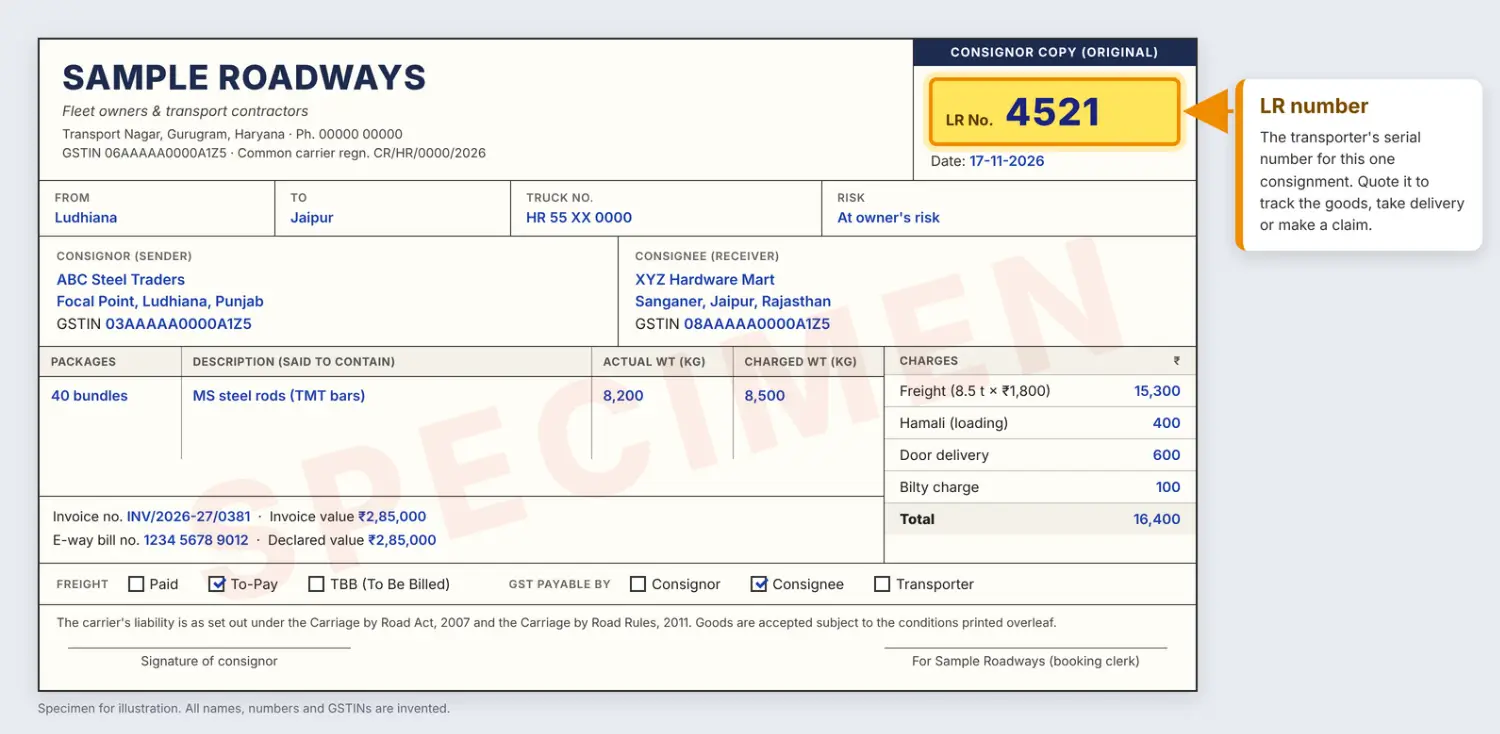
The LR number is used in five places:
-
Tracking: the receiver quotes it to find out where the goods are.
-
Delivery: the transporter's branch matches it against the consignee copy before releasing the goods.
-
Freight bill: the carrier's invoice lists LR numbers, so each charge can be matched to a shipment.
-
Claims: a loss or damage claim starts with the LR number.
-
E-way bill: the number is entered as the transport document number, as explained in the e-way bill section below.
How to Track a Lorry Receipt Online
There is no national website for LR number tracking in India. Every transporter issues its own LR numbers, so you track an LR with the transporter that issued it. Keep three details ready: the LR number, the LR date and the transporter's name.
-
On the transporter's website or app. Large carriers have a tracking box on their home page. Enter the LR number and, if asked, the LR date or the booking branch.
-
At the branch. Call the booking or delivery branch printed on the LR and quote the number.
LR Copy Meaning: 3 Copies of a Lorry Receipt and Who Keeps Each
An LR is written in three copies, and each of the three LR copies goes to a different person. The Carriage by Road Act requires the goods receipt in three sets, with the original going to the consignor.
|
Copy |
Who keeps it |
What it does |
|
Consignor copy (the original) |
The sender |
Proof that the goods were handed over; needed for the freight bill and any claim |
|
Consignee copy |
Travels with the goods, then goes to the receiver |
The receiver presents it to take delivery |
|
Transporter copy |
The transporter's booking branch |
Signed by the receiver at delivery, so it becomes the proof of delivery |
Many LR books carry a fourth copy marked driver or accounts. The law does not ask for it. It is trade practice: the driver copy stays with the truck during the trip, and the accounts copy helps the transporter raise its bill. A four-copy bilty book is fine. Three copies is the legal minimum.
Lorry Receipt Format: Fields Every LR or Bilty Should Show
A lorry receipt format needs about 20 fields, and they fall into six groups. I list all fields in the table below, so use it as a checklist when you design a bilty format or check one you have received.
|
Group |
Fields |
Why they matter |
|
LR basics |
LR number, LR date, booking branch, from (origin), to (destination) |
The number and date identify the shipment; GST expects the places of origin and destination |
|
Parties |
Consignor name and address, consignee name and address, GSTIN of each |
GST expects both names on a consignment note |
|
Vehicle |
Truck registration number |
GST expects it, and it goes into Part B of the e-way bill |
|
Goods |
Description, number of packages, actual weight, charged weight, declared value, invoice number, e-way bill number |
GST expects the details of the goods; the declared value sets the carrier's liability |
|
Freight |
Rate, freight amount, Paid / To-Pay / TBB, who pays the GST, other bilty charges such as loading, unloading and door delivery |
GST expects the consignment note to name who is liable to pay the tax |
|
Liability and signatures |
The carrier's liability undertaking, the transporter's signature, the receiver's signature at delivery |
The Act requires the undertaking on every goods receipt (Section 9(4)) |
The six fields GST expects on a consignment note are the serial number, the consignor and consignee names, the vehicle registration number, the details of the goods, the place of origin and destination, and the person liable to pay GST. Every one of them is in the table above.
Free LR and Bilty Format Download: Word, Excel and PDF by TruckOnWheels
Download the lorry receipt format in Excel, the bilty format in Word, or the PDF version. Each file is laid out in triplicate with every field from the table above, so you can print it as an LR book or fill it on screen.
Each file holds all three copies: consignor (original), consignee and transporter, with a delivery receipt on the transporter copy. In the Excel file, fill the consignor copy and the other two copies fill themselves.
Sample Filled Bilty: How to Fill LR Copy
The sample below uses invented names, and the numbers on the image match the steps here.
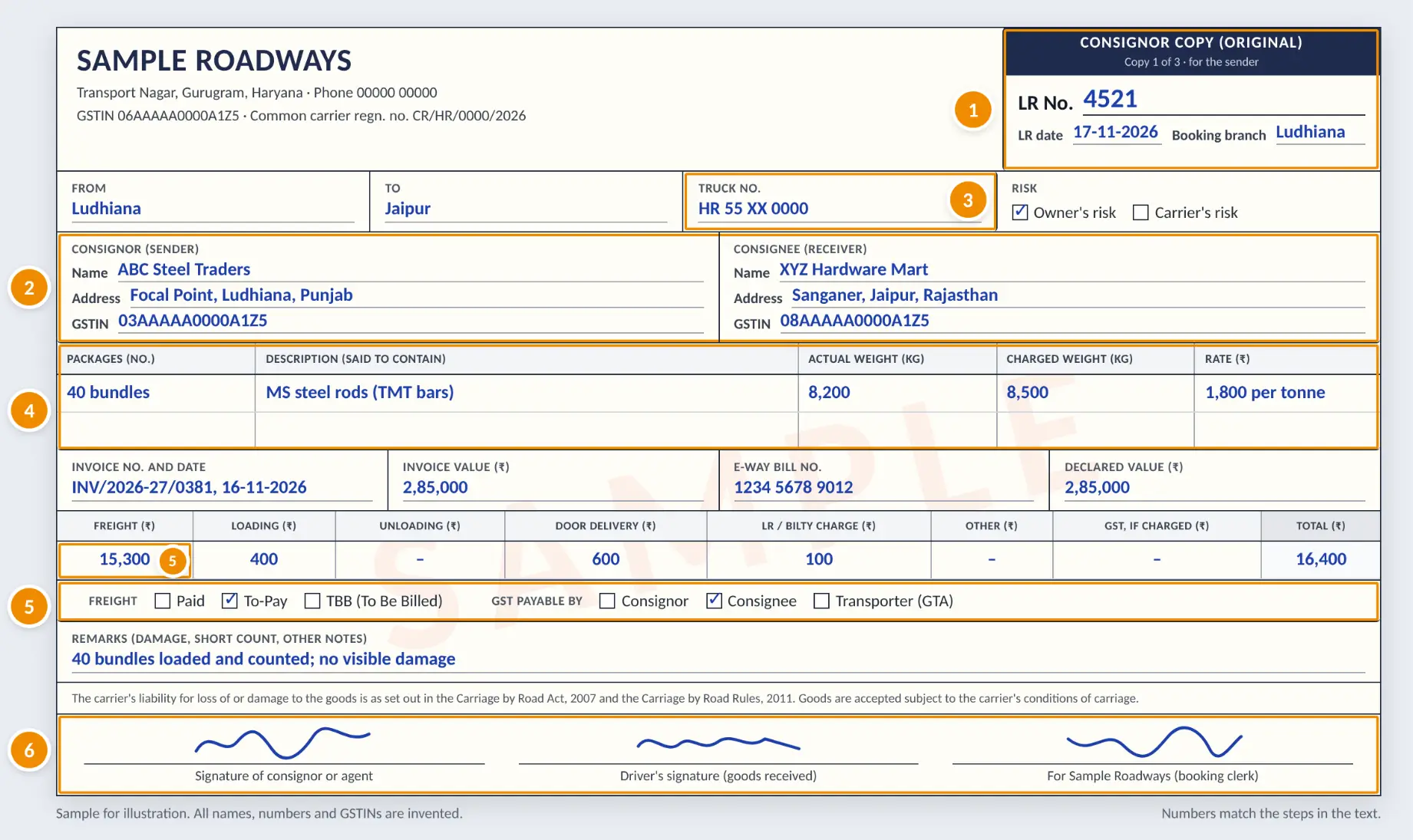
Take the LR number and date from your book or software (1). Copy the consignor and consignee details, with GSTINs, from the tax invoice (2). Write the truck number as it appears on the registration certificate (3). Describe the goods exactly as the invoice does, count the packages and enter the weighed and charged weights (4). Tick Paid, To-Pay or TBB and write the freight (5). Sign, and have the driver sign for the goods (6).
Paid, To-Pay and TBB (To Be Billed) Bilty: Who Pays the Freight
Every bilty says who pays the freight and when. Three terms cover it, and the TBB full form is the one people search for most.
|
Term |
Who pays |
When |
|---|---|---|
|
Paid bilty |
The sender |
At booking, before the truck leaves |
|
To-Pay bilty |
The receiver |
At delivery, before the goods are released |
|
TBB bilty (To Be Billed) |
An account customer, usually the sender |
Later, against the transporter's periodic freight bill |
TBB is how regular customers work with a transporter: no cash changes hands per trip, and the LR numbers on the monthly bill show what was carried.
LR vs E-Way Bill vs Tax Invoice: What Each Transport Document Does
The LR copy and the e-way bill are not the same document. The LR is the transporter's receipt; the e-way bill is a GST document generated online before the goods move. A loaded truck usually carries six papers, and each one does a different job.
|
Document |
Who issues it |
Under which law |
What it proves |
When it is needed |
|---|---|---|---|---|
|
Lorry receipt (LR, bilty) |
The transporter |
Carriage by Road Act, 2007; GST, for a GTA |
The carrier accepted the goods, and on what terms |
Every consignment a transporter carries |
|
E-way bill |
The sender, the receiver or the transporter, on the GST portal |
CGST Rule 138 |
The movement has been reported to GST |
Consignment value above ₹50,000 |
|
Tax invoice |
The seller |
CGST Act |
The sale, its value and the GST charged |
Every taxable supply |
|
Delivery challan |
The sender |
GST rules |
Goods moved without a sale, such as job work or a branch transfer |
When there is no invoice |
|
The weighbridge |
No specific law |
The loaded and empty weight of the truck |
When freight is charged by weight, and at checks on the road |
|
|
Proof of delivery |
The receiver, by signing the transporter copy of the LR |
No specific law |
The goods reached the consignee |
To close the consignment and support the freight bill |
Two e-way bill basics decide most questions. It is required when the consignment value is above ₹50,000, and it is valid for one day for every 200 km for normal cargo.
Where the LR Number Goes on the E-Way Bill
Form GST EWB-01 has two parts. Part A carries the invoice and goods details. Part B carries the vehicle number and the transport document number, which for road transport is the goods receipt number, your LR number. Part B can be skipped for a move of up to 50 km within a state between the business and the transporter's premises.
Is a Lorry Receipt Mandatory? What the Carriage by Road Act and GST Say
Yes, a lorry receipt is mandatory for a transporter that accepts goods for carriage, under two laws. But it is not one of the documents the driver must carry under the e-way bill rules. The three parts below keep the two questions apart.
Carriage by Road Act, 2007: Common Carriers Must Issue a Goods Receipt
The Act applies to common carriers, meaning transporters who carry goods for others for a fee. They must be registered (Section 3). Before the goods move, the sender signs a goods forwarding note that declares the value of the goods and whether they are dangerous. The carrier then issues the goods receipt (Section 9). There is no value limit, so the rule covers a ₹2,000 parcel as much as a full truckload.
GST Rules: A Transporter Is a GTA Only If It Issues a Consignment Note
Under GST, a goods transport agency (GTA) is any person who supplies road transport of goods and issues a consignment note, by whatever name it is called. The consignment note is the test. A truck owner who carries goods but never issues one is not a GTA, and the GTA rules do not apply to that owner.
Since 22 September 2025, after the 56th GST Council meeting, GST on GTA freight is 5% without input tax credit, under reverse or forward charge, or 18% with credit. The old 12% rate is gone. The fields a consignment note must show are already marked in the format table above.
Must the Driver Carry the LR?
CGST Rule 138A lists what the person in charge of the truck must carry: the tax invoice or delivery challan, and the e-way bill. The LR is not on that list.
Courts have read it the same way. In April 2019, the Gujarat High Court released a truck and goods that had been detained because the driver carried a photocopy of the LR instead of the original; it was an interim order in F S Enterprise v. State of Gujarat. In June 2026, the Madras High Court set aside an input tax credit denial that rested only on missing lorry receipts and weighment slips, and sent the case back to check whether the supply was genuine.
Carry the LR and keep it anyway. It is the proof of carriage, and it is the first paper a tax officer asks for when checking that a supply really moved.
Trip Documents Checklist: What a Truck Driver Should Carry
|
Goods papers |
Vehicle papers |
|---|---|
|
Tax invoice or delivery challan (Rule 138A) |
Driving licence |
|
E-way bill, printed or on the phone (Rule 138A) |
Registration certificate (RC) |
|
Lorry receipt, consignee copy |
Insurance certificate |
|
Weight slip |
Fitness certificate and permit |
Officers can ask for the driving licence, the insurance certificate, the fitness certificate and the permit under Section 130 of the Motor Vehicles Act, 1988.
Is a Lorry Receipt a Document of Title? LR vs Bill of Lading
A lorry receipt is not named as a document of title in Indian law, and it does not prove who owns the goods. Section 2(4) of the Sale of Goods Act, 1930 lists the bill of lading and the railway receipt, among others, but not the lorry receipt.
The section does end with a catch-all for any document used in the ordinary course of business as proof of the right to possess goods. An LR can fit that catch-all when it is used to hand over control of the goods, for example when it is made out to a bank and endorsed. Even then, it shows who may take delivery, not who owns the goods. A bill of lading is a document of title by name, and it belongs to sea shipping. [Reviewed by: add the lawyer's name and date.]
Lost or Damaged Goods on an LR
If goods are lost or damaged in transit, the carrier is liable, and you do not have to prove negligence (Section 12(2)). The amount you can recover and the deadlines come from the Act and the Carriage by Road Rules, 2011.
- How much: for total loss, liability is capped at 10 times the freight, up to the value declared in the goods forwarding note (Rule 12(1)). For high-value goods, pay the carrier's higher-risk rate, which buys more cover (Section 11).
- Hidden damage: report it to the carrier in writing within six days of delivery (Rule 12(6)).
- Going to court: send the carrier a written notice within 180 days of booking (Section 16), or the suit cannot proceed.
What to Check on the LR at Pickup and Delivery
Before anyone signs, check five things: the package count matches what was loaded, the weight matches the weight slip, the declared value is filled in, the truck number matches the vehicle in front of you, and any damage or short count is written in the remarks. A signature without remarks says the goods arrived in good condition, and that makes a later claim much harder.
How to Make a Bilty Using LR Book or Transport Software
To make a bilty, you need the right to issue one and a numbered book or software to issue it from. Whether you run a single pickup or a fleet of multi-axle trucks or any types of trucks in India, the steps are the same.
- Register as a common carrier. Under Rule 4, you need at least two commercial vehicles, or a contract letter for vehicles, and a net worth of at least ₹5 lakh.
- Get a serially numbered triplicate LR book printed, or set up transport software that generates LR numbers. Build it on the format table above.
- Keep the series unbroken. Never skip or reuse a number, because the LR number is what links the goods, the freight bill and any claim.
- Keep quarterly records of the goods carried in Form 5 (Rule 8).
A bilty book still works for a small transporter. Software earns its cost once you issue more than a few LRs a day, because it fills the e-way bill number, prints all three copies and keeps the records for you.