
Blog Details
24 Feet Truck Dimensions in India: Payload, Price, Top Models in 2026
Summary
Same 24 ft body, completely different trucks. Find out when a 6-wheeler is enough. And when you need a 10-wheeler.
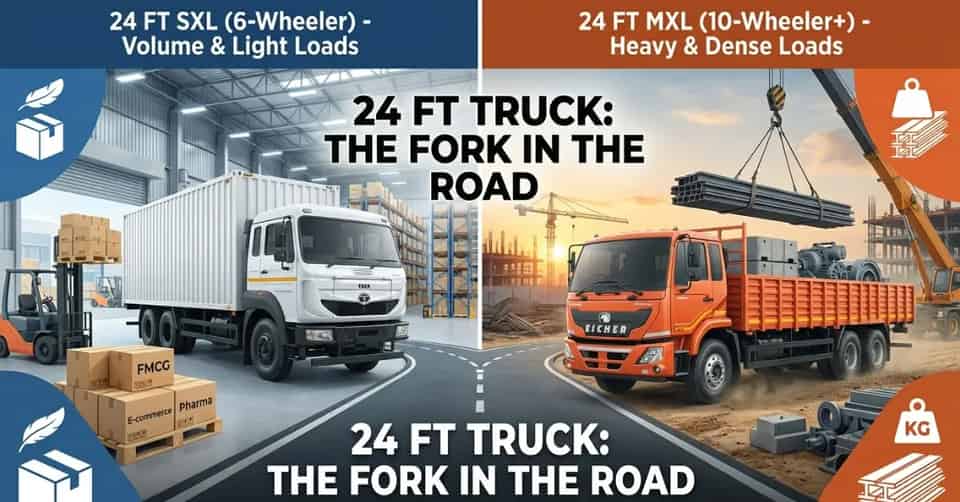


Most transport buyers who search for a 24-footer already know they have outgrown the 20–22 ft class. What surprises them is what they find next: the 24 ft is not a single truck. It is a fork in the road. The same body length can sit on a 6-tyre single-axle chassis or a 10-tyre multi-axle chassis. And those two options have completely different payload limits, toll costs, and permit requirements. Get this wrong and you will either overload a 6-tyre truck on day one or pay for a 10-tyre vehicle on routes where 6 tyres were always enough.
Exact Dimensions of a 24 Feet Truck in India
A standard 24 feet truck in India has the following typical external dimensions:
-
Length: 24 feet (7.3 metres)
-
Width: 8 feet (2.4 metres)
-
Height: 8 feet (2.4 metres)
These are the external figures for a standard closed container body. Open-body (platform) variants share the same cargo length but have no fixed roof, enabling crane loading, side loading, and stacking of weather-resistant bulk goods.
Internal cargo dimensions (closed container, typical):
-
Internal length: ~23.2 feet (7.1 metres)
-
Internal width: ~7.5 feet (2.3 metres)
-
Internal height: ~7.5 feet (2.3 metres)
-
Cargo volume: approximately 1,305 CFT (cubic feet)
That 1,305 CFT is enough to carry the contents of a large 3–4 BHK apartment in one load, or 26–30 standard FMCG pallets. It is also the size at which refrigerated (reefer) bodies are most commonly ordered for cold-chain pharma and food distribution.
But here is what most first-time 24 ft buyers underestimate: a 24-footer starts crossing into the ICV–HCV boundary. Its GVW bracket, axle configuration, and toll classification all depend on which chassis you build on. And that decision affects your running costs every single trip.
For a full comparison of all truck sizes available in India, see our truck dimensions in feet in India guide.
24 Feet Truck Payload Capacity
This is where the 24 ft class splits into two lanes.
SXL (Single Axle — 6-wheeler):
-
One rear axle, four rear tyres + two front tyres
-
Payload: approximately 10,000–11,500 kg
-
GVW range: 15,500–18,500 kg
-
Lower toll cost, better city manoeuvrability, easier parking
-
Best for: FMCG, pharma, white goods, e-commerce : goods that are volume-heavy but moderate in weight
MXL (Multi Axle — 10-wheeler and above):
-
Two rear axles, eight rear tyres + two front tyres
-
Payload: approximately 14,000–21,000 kg
-
GVW range: 25,000–31,000 kg
-
Higher toll cost, requires a more experienced driver on city routes
-
Best for: heavy industrial goods, steel, auto components, bulk cement, construction materials : dense, heavy cargo that would overload a 6-tyre chassis
The most common mistake with 24-footers: a buyer books a 6-tyre SXL based on body length, loads 14 tonnes of steel plates, and gets caught at a weighbridge. The container fits the cargo perfectly by volume. But the axle is overloaded by nearly 3 tonnes. Always match the axle configuration to cargo weight, not just body length.
India’s Best 24 Feet Trucks in 2026
SXL (6-Wheeler) Options
|
Model |
Engine Power |
Payload (kg) |
Ex-Showroom Price |
Best For |
|
180 HP |
11,500 |
₹26.50 Lakh |
FMCG, white goods, cold chain ICV |
|
|
160 HP |
10,572 |
₹21.46 – ₹29.80 Lakh |
Industrial goods, beverages, long-lead routes |
|
|
185 HP |
11,740 |
₹30.00 Lakh |
Long-distance haulage, high payload ICV |
MXL (10-Wheeler and Above) Options
|
Model |
Engine Power |
Payload (kg) |
Ex-Showroom Price |
Best For |
|
Tata LPT 3118 Cowl (24 ft body) |
180 HP |
23,500 |
₹37.00 Lakh |
Wholesale goods, construction materials |
|
150 HP |
~15,000 |
₹29 Lakh* |
Regional distribution, mid-weight cargo |
|
|
BharatBenz 2826R (24 ft body) |
230 HP |
~12,000 |
₹41.20Lakh* |
Highway haulage, heavier industrial loads |
For volume-oriented FMCG and pharma runs where cargo weight stays under 11 tonnes, the Eicher Pro 3015XP (24 ft) is the standout SXL choice. 180 HP, 7-speed gearbox, 11,500 kg payload, and a GVW of 17,500 kg. For operators regularly moving 12–16 tonnes of dense goods, the 10-wheeler MXL options justify the higher upfront cost through legal load compliance and lower per-tonne running cost.
Open Body vs Closed Container: Which One to Choose?
Both body types are widely available and actively used on the 24 ft chassis in India.
Open Body (platform/flatbed)
No roof or fixed sides, with removable iron rails or a flat steel deck. Built for construction materials like steel bars, granite slabs, I-beams, PVC pipes, and timber. Also used for agricultural inputs and machinery that needs crane or top-loading. If your cargo is weather-resistant and heavy, open body gives you the flexibility a container never can.
Closed Container (box body)
Fully enclosed steel or reinforced aluminium body with rear shutter or swing doors. The default choice for FMCG, electronics, pharmaceuticals, garments, and packaged foods on intercity runs of 400 km and above. Insulated box bodies (reefer-ready) are also popular on the 24 ft chassis for cold-chain dairy, poultry, and vaccine distribution.
Quick Decision Rule: If the cargo can sit in the rain and be lifted by crane or loaded from the side, go open body. If it needs protection from weather, dust, or pilferage on a multi-day run, go closed container.
Top Use Cases of 24 Feet Truck in Industries
FMCG Distribution
The 24 ft closed container is one of FMCG India's most used vehicles for C&F agent-to-distributor runs. The 1,300 CFT volume handles a full pallet configuration of packaged foods, beverages, and personal care goods on 400–800 km corridors.
Pharmaceuticals and Cold Chain
Insulated and refrigerated box bodies on 24 ft ICV chassis are standard in India's pharma cold chain, especially for vaccine distribution, insulin, and temperature-sensitive diagnostics. The ICV GVW bracket keeps the truck accessible in hospital and clinic delivery zones.
E-commerce Hub-to-Hub
India's large e-commerce platforms use 24 ft closed containers to move sorted parcels between zonal fulfilment centres and state hubs on overnight lanes. Sealed container bodies reduce pilferage risk on these high-value runs.
Automotive Ancillaries
Engine components, brake assemblies, body panels, and gearbox units move regularly on 24 ft MXL trucks between tier-1 and tier-2 suppliers and assembly plants. The MXL's higher payload handles the dense, packed weight of metal components without legal risk.
Retail and Wholesale Distribution
Regional distributors servicing general trade (GT) and modern trade (MT) outlets across a state use 24 ft trucks for weekly stock replenishment runs. The vehicle size allows full-store drops in a single delivery, reducing multi-trip logistics costs.
Construction Materials (open body MXL)
Steel rebar, granite, cement bags, and ceramic tiles are regularly dispatched from manufacturing clusters on 24 ft open-body 10-wheelers. The MXL's 14,000+ kg payload handles the weight, and the open body accommodates crane and front-loader unloading at construction sites.
3 Questions to Answer: Whether to Buy 24 Ft Truck or Not
Ask yourself these three questions before buying a 24 ft truck:
1. Does your cargo volume regularly reach 1,100–1,300 CFT?
If yes, the 24 ft is your size. If your loads consistently run under 1,000 CFT, the 22 Feet Truck Payload Capacity will serve you more economically per trip with lower toll and fuel costs.
2. Does your cargo weigh 10–11 tonnes (go SXL) or 12–16 tonnes (go MXL)?
This is the single most important decision in the 24 ft class. Choose your axle configuration based on cargo weight. Not container size. Getting this wrong is the most expensive mistake you can make at this stage.
3. Does your route involve city delivery zones with daytime restrictions?
A 24 ft SXL ICV typically does not face the daytime city-entry restrictions that apply to HCVs. However, a 24 ft MXL, depending on its GVW, may be classified as an HCV in your state. Verify with your local RTO before planning urban delivery schedules.
If you are regularly loading above 16 tonnes and need more cubic volume, the next step up is a 26 ft truck. If your cargo is lighter and city accessibility is a priority, the 22 ft truck dimensions guide is worth a read before you decide.
Legal Limits and Permits You Must Know
Under the Motor Vehicles Act, 1988 and the 2018 MoRTH axle load revision:
-
Two-axle Rigid Truck (SXL): Maximum GVW of 18,500 kg. Confirmed by the 2018 revision
-
Three-axle Rigid Truck (MXL): Maximum GVW of 25,000 kg for a tri-axle configuration
-
Maximum Vehicle Width: 2.5 metres, all standard 24 ft trucks comply
-
Maximum Vehicle Height: 4.75 metres, no standard 24 ft closed container exceeds this
-
Maximum Rigid Truck Body Length: 12 metres (39.4 feet), a 24 ft (7.3 m) body is well within this limit
No special ODC (Over Dimensional Cargo) permit is required for a standard 24 ft closed container or open body truck under normal cargo conditions. ODC permits are only needed when cargo protrudes beyond the vehicle's registered dimensions.
Overloading penalties under the revised Motor Vehicles Act start at ₹20,000 for the first excess tonne and ₹2,000 per additional tonne above the limit. For repeat violations, the vehicle can be detained and the fitness certificate suspended. The financial and operational cost of a single weighbridge detention on a time-sensitive FMCG run almost always exceeds an entire week of additional toll costs from running the correct MXL truck.
Checklist Before You Book a 24 Ft Truck
-
Decide SXL or MXL first: based on your cargo weight, not body length
-
Confirm internal cargo volume (CFT) matches your typical load before committing to a body type
-
Choose between open body and closed container based on cargo sensitivity and route duration
-
Verify GVW bracket for toll calculations on your route: toll charges are GVW-linked and differ significantly between SXL and MXL
-
For cold-chain loads, confirm whether the body builder offers insulation rating and whether it suits your temperature range
-
Ask for the vehicle's fitness certificate, PUC, and insurance documents before the first dispatch
-
Use TruckOnWheels' EMI calculator to compare monthly outgo across SXL and MXL models. The higher upfront cost of a 10-wheeler often delivers a better cost-per-tonne over 5 years for heavy-cargo operators