Blog Details
40 Feet Container Truck Dimensions in India: Payload, Models in 2026
Summary
A 40 ft truck isn't one vehicle. It's two. And most shippers who book it for the first time don't realise that until the tractor and trailer show up separately at the loading dock.
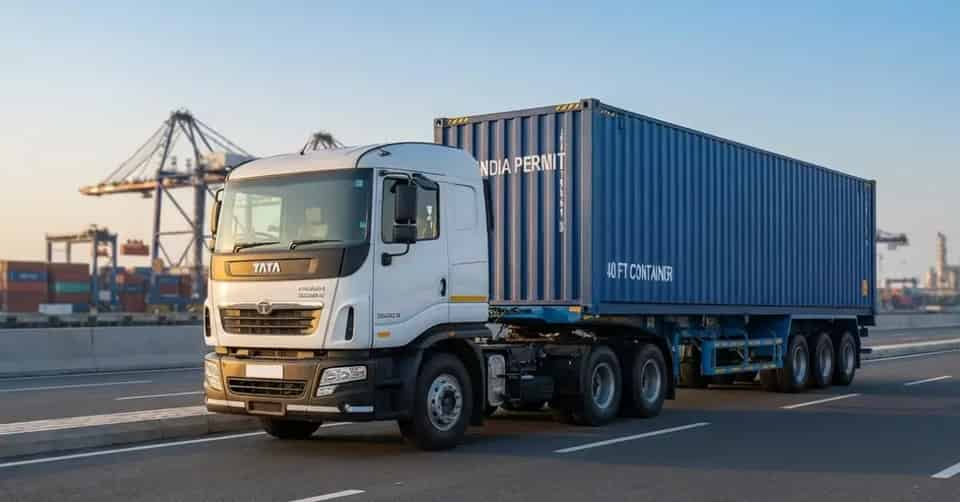


India's maximum standard road freight size is the 40 foot container truck combination. A tractor head paired with a detachable semi-trailer. It is the workhorse of port logistics, automobile transport, bulk industrial freight, and heavy manufacturing supply chains. Before you book one, you need to understand exactly what you're getting: the dimensions, the real payload ceiling, the legal framework, and the scenarios where this is the right call versus when a 32 ft MXL would serve you better at a fraction of the cost.
Exact Dimensions of a 40 Feet Container Truck in India
A 40-foot truck in India is not a rigid vehicle. It is a tractor-trailer combination. A powered tractor unit (the "head") coupled to a detachable 40-foot semi-trailer. This structural distinction matters enormously for permits, routes, and loading bay requirements.
Standard 40 Ft Trailer (dry container / flatbed)
|
Measurement |
In Feet |
In Metres |
|
Trailer body length |
40 ft |
12.19 m |
|
Width |
8 ft |
2.44 m |
|
Height (standard dry box) |
8 ft |
2.44 m |
|
Total combination length (tractor + trailer) |
~55–61 ft |
~16.7–18.75 m |
High Cube (HQ) Variant
-
Height increases to 9.5 ft (2.9 m) : Matching the ISO 40 ft high-cube standard used in international ocean shipping
-
Ideal for voluminous, lightweight cargo: furniture, packaged consumer goods, mattresses, bulk textiles
Internal Cargo Volume
-
Standard 40 ft closed box: approximately 2,560 CFT
-
High Cube 40 ft: approximately 2,870 CFT
-
Real-world scale: a 40 ft standard container holds the equivalent of a fully furnished large 4 BHK home. Roughly 1,200 large cartons or 20+ domestic household pallets
For a full comparison of every standard truck size in India from 14 ft to 40 ft, see our truck dimensions in feet in India guide.
40 Feet Truck Loading Capacity
No other standard road vehicle in India comes close to what a 40 ft combination can legally carry.
Net payload range: 25 to 35 tonnes, depending on the tractor's GCW (Gross Combination Weight) rating and the combined tare weight of the tractor and trailer.
Under the MoRTH 2018 revised axle load norms, semi-articulated trailer combinations are permitted a maximum GVW of 55 tonnes. In practice, after subtracting the tractor's unladen weight (~8–10 tonnes) and the trailer body weight (~6–8 tonnes), the net cargo payload available is 25–35 tonnes.
Common Axle Configurations and Their Payloads
|
Tractor Configuration |
Trailer Axles |
Total Wheels |
Typical Net Payload |
|
4x2 tractor |
2-axle trailer |
~10 wheels |
20–25 tonnes |
|
6x2 / 6x4 tractor |
3-axle trailer |
14–18 wheels |
28–35 tonnes |
The most common loading error on a 40 ft: Shippers calculate volume capacity, fill the trailer to the roof, and only discover they've overloaded when the combination hits a weighbridge. The rule is simple : always get the tractor's rated GCW from the transporter before loading, and subtract tractor + trailer tare weight to find your actual cargo limit. Overloading beyond GVW starts at a ₹20,000 penalty for the first tonne, plus ₹2,000 for each additional tonne.
The 40 Ft Is a Different Operation — Know This Before You Book
Every other truck in this cluster is a single rigid vehicle: it shows up, loads, and drives away. The 40 ft tractor-trailer does not work that way.
The tractor and trailer are separate units. The trailer can be dropped at a loading terminal, decoupled, loaded at its own pace (hours or even overnight), and picked up when ready. This "drop-and-hook" model is a significant operational advantage for ports, container freight stations (CFSs), and large manufacturing plants with 24-hour loading cycles. For a small business booking a one-off move, the added coordination complexity requires more planning than booking a rigid truck.
If your cargo weighs under 18 tonnes or your dispatch point cannot handle a ~55–61 ft combination, the 32 ft MXL is almost always the more practical and economical choice.
Best 40 Feet Container Trucks in 2026
The trailer body is usually fabricated separately by a local body builder. The commercial vehicle you purchase or hire is the tractor head. This is where brand, engine power, and GCW rating determine your operational capability.
|
Model |
Power |
Payload |
Price (ex-showroom) |
Best For |
|
300 HP |
40,000 kg |
₹38.71 Lakh |
Max-payload long-haul container |
|
|
250 HP |
32,000 kg |
₹31.69 Lakh |
Mid-range trailer operations |
|
|
300 HP (A-series i-Gen6) |
~ 30,000 kg |
₹47.00 Lakh |
Port-to-DC container haulage |
|
|
280 HP |
31,250 kg |
From ₹47.64 lakh |
Premium fleet, cold chain |
Tata Prima vs Ashok Leyland AVTR for 40 ft operations: On India's premium long-haul corridors. These two platforms share the lion's share of container volume. The Prima 5530.S has a higher GCW ceiling (55 T) and a proven Cummins powertrain, making it the top pick for maximum-payload interstate runs. The AVTR's modular platform suits fleet operators who need to configure tractors for different trailer types across a diverse freight mix.
Body Types Available at 40 Ft Container Truck
-
Dry Closed Container
The most common configuration. Weatherproof, tamper-evident, and lockable. Used for EXIM trade, FMCG consolidation, electronics, pharmaceuticals, and any cargo that needs protection from rain, dust, humidity, or pilferage. Available in standard height and High Cube.
-
Flatbed / Open Platform Trailer
No sides, no roof. The right choice for oversized cargo, heavy machinery, steel sections, pre-fabricated structures, and anything that requires crane or top loading. A 40 ft flatbed is the backbone of India's project cargo and construction materials logistics.
-
Low-bed (lowboy) Trailer
The deck sits much lower. typically 1.0–1.3 m from ground to accommodate very tall cargo like excavators, transformers, large industrial equipment, and wind turbine nacelles that would otherwise breach the 4.0 m legal height limit on a standard platform.
-
Reefer (refrigerated) Trailer
A closed container with an integrated cooling unit. Essential for pharmaceutical cold chain (Hyderabad–Mumbai, Bengaluru–Chennai corridors), dairy export, frozen seafood, and agri-export. At 40 ft, the reefer combination is used for high-volume cold chain consolidation over distances above 400 km.
-
Flat-rack and Open-top Container
For cargo that is too tall for a standard box but needs side wall support, or cargo loaded by crane from above. Wind turbine components, large machinery, steel rolls, and marble blocks commonly move on flat-rack and open-top trailers.
Ideal Use Cases of 40 Feet Container Truck in India
Port Logistics and EXIM Trade
The 40 ft combination is the direct bridge between ocean containers and inland destinations. At India's major ports like JNPT (Nhava Sheva), Mundra, Chennai, Vizag, and Tuticorin — 40 ft trailers carrying ISO containers move between terminals and inland container depots (ICDs) around the clock. If your business imports or exports containerised goods, this is the standard vehicle.
Automobile Transport
OEM plants in Pune, Chennai, Gurugram, and Sanand dispatch finished vehicles to regional distribution points on 40 ft multi-tier auto carriers. These are specialised 40 ft combinations with racked upper decks that can carry 6–10 cars per load, operating under the 4.75 m combined height limit for vehicle carriers.
Bulk Industrial and Manufacturing
Steel coils, large machinery, industrial presses, and construction materials too heavy for a single 32 ft MXL trip move on 40 ft combinations. A single well-loaded 40 ft trailer at 30 tonnes replaces two 32 ft MXL trips at 15 tonnes each. Cutting fuel, toll, and driver costs on long corridors by nearly 40%.
Textile and Garment Export Clusters
India's garment export hubs route high-cube 40 ft containers to ports. The 2,870 CFT volume of a 40 ft HC fits approximately 18–20% more fabric rolls and packed cartons than a standard 32 ft closed container, reducing port handling cost per unit.
Cold Chain and Pharma Logistics
Hyderabad's pharma cluster and Maharashtra's agri belt use 40 ft reefer combinations for high-volume cold chain runs to ports and distribution centres. At this scale, the 40 ft reefer cuts cost per temperature-controlled tonne significantly versus two 22 ft reefer trips.
Wind and Solar Energy Sector
Nacelles, turbine tower sections, and large solar inverter panels that are too long or heavy for standard containers move on 40 ft flat-rack and low-bed trailer combinations. Often under ODC permits with escort vehicles.
Before YOU Buy Ask Yourself These 3 Questions
1. How much does your cargo weigh?
-
Under 18 tonnes → 32 ft MXL is more economical; you'll be paying for capacity you don't need
-
20–35 tonnes → the 40 ft combination is the right call
-
Above 35 tonnes → you need a multi-axle specialised trailer and likely an ODC permit
2. Does your cargo move to or from a port or ICD?
-
Yes → a 40 ft ISO-compatible trailer is the only operationally standard choice; using a non-ISO size creates expensive handling mismatches at port terminals
-
No → evaluate the 32 ft first unless cargo weight or volume demands more
3. Can your loading/unloading point handle a ~55–61 ft combination?
-
Yes → proceed with 40 ft
-
No → the 32 ft is the largest size that fits most standard industrial and warehouse docks
Legal Limits and Permits to Run a 40 Ft Truck
Vehicle Length
-
Maximum rigid truck length (CMVR): 12 m, a 40 ft body cannot move as a rigid vehicle
-
Maximum trailer combination length (MoRTH 2020 amendment): 18.75 m — the 40 ft combination is compliant within this limit
Height
-
Standard closed-body container: maximum 4.0 m including cargo
-
Vehicle carrier / closed body for indivisible loads: maximum 4.75 m
Weight
-
Semi-articulated trailer combinations: maximum permissible GVW of 55 tonnes (MoRTH 2018 revised axle load norms)
Licences
-
Tractor driver: valid HMV (Heavy Motor Vehicle) licence is mandatory; verify this before allowing departure
ODC Permit
-
Standard 40 ft ISO dry container or flatbed with cargo within body dimensions: no ODC permit needed
-
Cargo protrudes beyond trailer body in length, width, or height: ODC permit required from MoRTH and relevant state transport authorities — involves a route survey, police escort in many states, and movement time restrictions (usually daylight hours only)
Overloading Penalty
₹20,000 for the first tonne over the GVW limit, plus ₹2,000 per additional tonne. Vehicle detention at weighbridges is possible for repeat violations.
City entry restrictions: Mumbai, Delhi, Chennai, and Bengaluru all impose windows restricting trailer entry during peak hours or at certain city boundaries. Always confirm entry norms on the route before scheduling pickup.
Checklist to Buy a 40 Ft Truck
-
Confirm the tractor's rated GCW. Not just the trailer's structural holding capacity, but also verify it covers your total load weight
-
Specify body type upfront: dry container, flatbed, low-bed, or reefer : These are different trailer categories with different rates
-
Check that your loading bay can physically accommodate a 55–61 ft combination, including the tractor's swing radius during docking
-
Verify the driver holds a valid HMV licence and that the tractor's fitness certificate (FC), road tax, and permit are all current
-
For port and EXIM moves, confirm the trailer chassis has ISO-standard twist locks compatible with 40 ft containers
-
Get the tare weights of both tractor and trailer before loading to calculate your exact available cargo payload
Browse verified 40 ft tractor-trailer listings and freight rates on TruckOnWheels.