Blog Details
New Hit and Run Law in India 2026 and Rules for Drivers After an Accident
Summary
The 10-year hit and run punishment was never notified. Here is what BNS Section 106 actually says, and what it means for drivers on the road today.
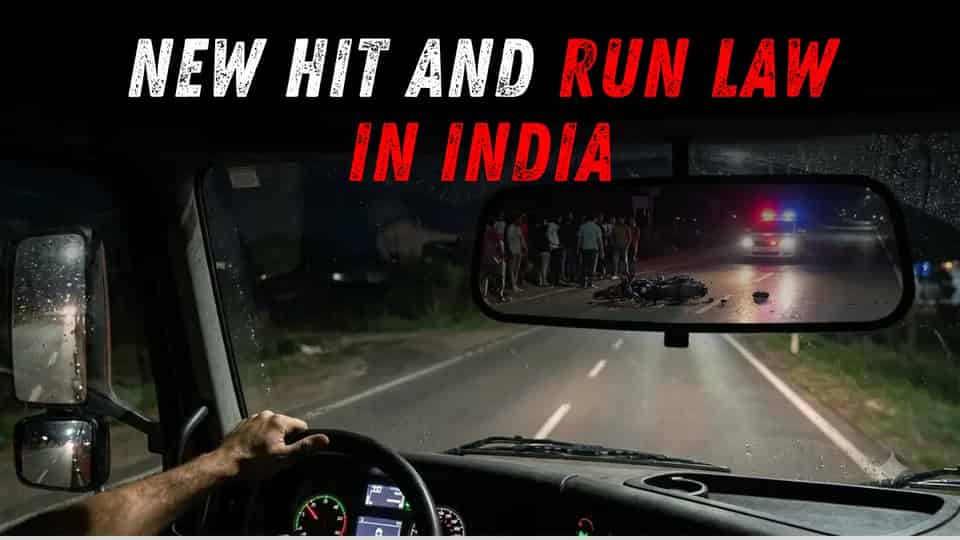


Early in the morning, you are driving a truck carrying parcels that must be delivered before 10 am. You try to overtake a slow moving pickup. And before you can press the brakes, you realise you have hit a man crossing the road.
This happens 68,783 times a year in India. Many drivers drive away. Not because they don't care, but because they are scared of ten years in jail and a ₹7 lakh fine.
Here is what almost none of them know: that punishment has never come into force. It was passed, then frozen, and it is still frozen today. The ₹7 lakh figure was never in the law at all.
This article explains what the new hit and run law exactly says, what part of it is actually in force today, what part is still sitting unnotified, and what a driver should do in the ten minutes after a crash.
The Short Answer First
Section 106(2) of the Bharatiya Nyaya Sanhita — the ten-year hit and run clause — has never been brought into force. It was passed by Parliament. It was never notified. As of today, no driver in India can be charged under it.
Section 106(1) is in force, and has been since 1 July 2024. It carries up to five years.
So the clause everyone struck over never took effect. But the clause that did take effect quietly raised a driver's exposure from two years to five. That is the change that actually happened to you, and almost nobody talked about it.
I'll explain both.
What Is the New Hit and Run Law
The Bharatiya Nyaya Sanhita, 2023 replaced the Indian Penal Code on 1 July 2024. Section 106 is the provision that deals with causing death by negligence, and it splits the offence into two sections.
Section 106(1):
"Whoever causes the death of any person by doing any rash or negligent act not amounting to culpable homicide, shall be punished with imprisonment of either description for a term which may extend to five years, and shall also be liable to fine."
Section 106(2):
"Whoever causes death of any person by rash and negligent driving of vehicle not amounting to culpable homicide, and escapes without reporting it to a police officer or a Magistrate soon after the incident, shall be punished with imprisonment of either description of a term which may extend to ten years, and shall also be liable to fine."
Read the second one slowly, because the entire law turns on eleven words: "escapes without reporting it to a police officer or a Magistrate."
The higher punishment is not for the accident. It is for leaving without telling anyone. Two drivers can cause the identical death in the identical way — and the one who reports it faces half the maximum of the one who drives off.
That is the whole design of the new rules for driver accident cases. It is a reporting law dressed as an accident law.
BNS Section 106 Punishment and What Changed from the Old IPC
Under the old code, causing death by a rash or negligent act was Section 304A IPC, and the ceiling was two years.
|
Old law (IPC) |
Current law (BNS) |
|
|---|---|---|
|
Causing death by negligence |
Section 304A — up to 2 years |
Section 106(1) — up to 5 years |
|
Causing death and fleeing |
No separate offence |
Section 106(2) — up to 10 years (not notified) |
The ₹7 Lakh Fine Does Not Exist
Section 106(2) says "shall also be liable to fine." No figure. No amount. No ₹7 lakh.
That number was never in the Bharatiya Nyaya Sanhita. It spread through WhatsApp forwards during the January 2024 strike. The fine under Section 106 is left to the court's discretion, with no ceiling written into the section.
Why Section 106(2) is Still Frozen in 2026
When the January 2024 strike escalated, the government moved fast. The then Union Home Secretary met the All India Motor Transport Congress and gave a public assurance that Section 106(2) would not be implemented without consulting the AIMTC. The AIMTC called off the strike on that basis. (Source : DD News)
Then the rest of the BNS was notified on 1 July 2024 and 106(2) was deliberately left out.
It has stayed out ever since. And in 2026 that position was tested in court.
On 15 July 2026, the Delhi High Court dismissed a PIL (Public Interest Litigation) that asked for Section 106(2) to be enforced. Advocate Ritu Gauba had argued that leaving the provision unnotified endangered road users and violated the right to life, and sought a direction to the Police Commissioner to implement it. A Division Bench headed by Chief Justice Devendra Kumar Upadhyaya, with Justice Tejas Karia, held that the decision whether and when to notify a statutory provision falls within the exclusive domain of the Central Government, and dismissed the petition.
That order matters for two reasons:
First, it is a judicial confirmation, in the middle of 2026, that the section was still unnotified.
Second, it means no court can switch it on.
Only a notification from the Centre can. Until that notification appears in the Gazette, Section 106(2) is text on paper.
What this means practically: there is no ten-year hit and run punishment operating in India today. There is also no guarantee it stays that way — a notification could be issued at any time, without a fresh law and without a fresh debate.
What Actually is the Hit-and-Run Law in India Right Now?
If 106(2) is frozen, what does a driver who flees a fatal crash actually get charged under? Here is the answer in order:
1. BNS Section 106(1) — up to 5 years. The default section for a fatal crash caused by rash or negligent driving. Applies whether you stayed or fled; fleeing simply doesn't add the extra exposure right now.
2. BNS Section 105 — culpable homicide not amounting to murder. In extreme cases — very high speed, drunk driving, driving on knowing the likely consequence — police can and do invoke the far more serious homicide provisions instead of the negligence section. This is exactly what happened in Pune (below), where police pushed for Section 304 IPC rather than 304A.
3. Motor Vehicles Act, Section 134 — the duty to stop and report. This is the provision that already requires you to secure medical attention for the injured and report the accident to the nearest police station, with an outer limit of 24 hours. Crucially, Section 134 contains a safety carve-out that Section 106(2) does not — it accounts for circumstances beyond the driver's control. That difference is the legal heart of the truckers' objection, and it was flagged in a detailed analysis of 106(2) published on Bar & Bench.
4. Motor Vehicles Act, Section 187 — punishment for breaching Section 134. A short custodial term or fine. Minor next to the BNS sections, but it is a live offence and it is regularly added to the FIR.
5. Motor Vehicles Act, Section 185 — drunk driving, where applicable.
So: the ten-year clause is off, but a driver who flees a fatal crash today is still looking at a five-year offence, a separate MV Act offence for not reporting, a seized vehicle, and — depending on the facts — a homicide section instead of a negligence one.
Truck Driver Accident Report by MoRTH
The Ministry of Road Transport and Highways publishes the official count every year. Its Road Accidents in India 2023 report gives the most recent verified national picture:
-
4,80,583 road accidents
-
1,72,890 people killed
-
4,62,825 people injured
Within that, hit and run cases specifically:
-
68,783 hit-and-run accidents
-
31,209 people killed
-
54,574 people injured
-
Roughly 18% of all road accident deaths in India
Nearly one in five road deaths in this country involves a vehicle that didn't stop. That is the number driving the government's interest in Section 106(2), and it is the number that will be cited the day it is finally notified. It's worth knowing before that day arrives.
Two Real Cases Where the Driver Stayed and Drove Away
The argument over this law is usually theoretical. It shouldn't be. Here are two documented incidents I found that show both halves of the problem.
When the driver stayed in Kondaiah, Bengaluru
A BBMP garbage truck was involved in a crash in the Thanisandra area of Bengaluru in which an eight-year-old boy was killed. The driver, Kondaiah, 59, was set upon by a crowd at the scene and thrashed. He was taken to hospital, failed to respond to treatment, and died of his injuries. The matter went to Sampigehalli police.
A driver in a municipal truck, on his route, involved in a fatal accident — and the accident did not kill him. The crowd did.
This is not a rare story to anyone who drives a heavy vehicle for a living, and it is the precise fear that emptied the highways in January 2024. Section 106(2) as drafted contains no exception for a driver who leaves a scene because staying would get him killed. Section 134 of the MV Act does. That gap is not a small drafting quibble — for the man behind the wheel it is the entire question.
When the driver stayed and it still went badly in the Pune Porsche crash
At around 2:30 AM on 19 May 2024, a Porsche Taycan travelling at roughly 200 km/h hit a motorcycle at Kalyani Nagar junction in Pune. Aneesh Awadhiya and Ashwini Koshta, both 24-year-old IT professionals, were thrown several metres. Koshta died at the scene; Awadhiya died in hospital.
The driver was a 17-year-old. He did not flee — a crowd at the scene beat him before police arrived and took him to Yerawada police station. Police invoked IPC Section 304 (culpable homicide) rather than the negligence section, along with 304A, 337, 338, 427 and MV Act Section 185 for drunk driving.
Then came the part that made the case national news: the Juvenile Justice Board granted bail within hours, on conditions that included writing a 300-word essay on road accidents. The bail was cancelled on 22 May; the Bombay High Court later held the remand illegal and released him in June 2024. As of March 2026, his father had been granted bail after 22 months in custody, and the juvenile remained under trial as a minor after the Board rejected the police plea to try him as an adult in July 2025.
Two lessons for a commercial driver. First, staying at the scene does not protect you from a mob — it only protects you legally. Second, when the facts are bad enough, police will not stay inside Section 106 at all; they will reach for the homicide sections, where the numbers are far worse than ten years.
When the driver drove away in Greater Noida, September 2026
Around 4:30 AM on 5 September 2026, a speeding car hit a pedestrian named Himanshu at Ek Murti Chowk in the Bisrakh police station area of Greater Noida. Himanshu had gone out with his wife after work to celebrate his birthday. He later said the car was doing well over 100 km/h.
The driver fled. Bisrakh police registered the case and traced and arrested him, and the vehicle was seized.
Note the timeline: this was two weeks ago, with Section 106(2) still unnotified. The driver was found anyway. Between CCTV coverage, FASTag records, toll data, Vahan and e-DAR, the assumption that driving away ends the matter is badly out of date. It buys hours, not escape — and it converts a negligence case into one where the police, the court and the public all treat you as someone who ran.
What to do in the first ten minutes after a crash
This is the part worth keeping on your phone. It follows the duty already imposed by Section 134 of the Motor Vehicles Act.
1. Stop. Do not move the vehicle further than needed to clear the carriageway.
2. Get the injured to medical help. This is a statutory duty, not a choice — and it is the single fact that most improves your legal position.
3. Call 112. Ambulance and police on the same number. Note the time of the call; the call record itself becomes evidence that you reported.
4. If the crowd turns, leave — and drive straight to a police station. Do not go home. Do not go to the transport office. Go to the nearest thana and report, and make sure the report is recorded with the time. Section 134 gives an outer limit of 24 hours, but every hour you delay makes "I left because I was in danger" harder to sustain.
5. Inform the owner or fleet operator immediately. They need to trigger the insurance intimation.
6. Note the vehicle number of any other vehicle involved, and take photographs of the position of the vehicles before anything is moved, if it is safe to do so.
7. Do not pay cash at the scene. It is treated as an admission, and it does not prevent an FIR.
8. Get yourself medically examined even if you feel fine — it establishes your own condition, including that you were not intoxicated.
9. Cooperate with the investigation. Give your statement, hand over the licence, permit, fitness and insurance papers.
If you take away one line from this section: reporting is the entire difference between the five-year offence and the ten-year one. The day 106(2) is notified, that difference becomes the most important decision of your working life.
What the Victim's Family Gets and What Your Insurer Covers
Compensation in hit and run cases — MV Act Section 161. Where the offending vehicle is never traced, compensation is still paid from the government scheme: ₹2,00,000 in case of death and ₹50,000 for grievous hurt.
Cashless treatment in the golden hour — MV Act Section 162. This is the newest piece and very few drivers know it exists. Under the Ministry's scheme for cashless treatment of road accident victims, a victim is entitled to treatment worth up to ₹1,50,000 per person, for a maximum of 7 days from the date of the accident. It covers any victim of a road accident caused by the use of a motor vehicle on any category of road in India — including hit-and-run cases and accidents involving uninsured vehicles.
It runs through MoRTH, with the National Health Authority and the General Insurance Council, paid out of the Motor Vehicle Accident Fund. The hospital registers the victim, coordinates with the police for an e-DAR victim ID, treats, and claims reimbursement afterwards.
The practical value: if you get an injured person to an empanelled hospital fast, the first ₹1.5 lakh of treatment is not a bill anyone at the scene has to argue about. That is a real reason to stop, and it did not exist during the 2024 protests.
Good Samaritan protection — MV Act Section 134A. A bystander who helps an accident victim cannot be forced into civil or criminal liability for doing so. Useful to know, and useful to say out loud at a scene when people hesitate to help.
What Fleet Owners and Transporters Should be Doing Now
If you run vehicles rather than drive them, the exposure is different.
-
Put a written accident SOP in every cab. One laminated card, in Hindi, with the nine steps above and the numbers to call. This is the cheapest risk control available to a transport business.
-
Keep licence, permit, fitness and insurance current and in the vehicle. A lapsed document turns a defensible accident into an indefensible one and can affect the insurer's response.
-
Verify and record driver credentials properly. Licence class against vehicle class, verified at source.
-
Have one number that a driver can call at 3 AM. A driver stranded at a scene with a hostile crowd and no one answering the phone is the situation that produces flight.
-
Brief your drivers that 106(2) is not active — and that it can be switched on by notification. Train for the stricter rule, not the current one.
Will the Ten-year Hit and Run Law Ever Come Into Force?
Nobody outside the Ministry can say. What can be said is what the record shows:
-
The provision is passed law, sitting unnotified.
-
The Centre has publicly committed to consulting the AIMTC before implementing it.
-
The Delhi High Court held in July 2026 that notification is the Centre's call alone, and refused to compel it.
-
The 2023 casualty figures give the government a standing argument to act.
There is no sunset on an unnotified section. It does not expire. It waits. The realistic planning assumption for a transport business is that it may be notified — possibly with amendments addressing the mob-safety gap — and that the operational habits you build now are what will protect you when it is.
We will update this page on the day the notification is issued.
Author's Note: This article explains the law as it stands on the last updated date and is not legal advice.