
Blog Details
Weight Slip for Truck: Free Format, Sample, and How to Read It
Summary
Free truck weight slip format in PDF, plus a filled example. Learn to read gross, tare and net weight, and check if your weighbridge slip is valid.
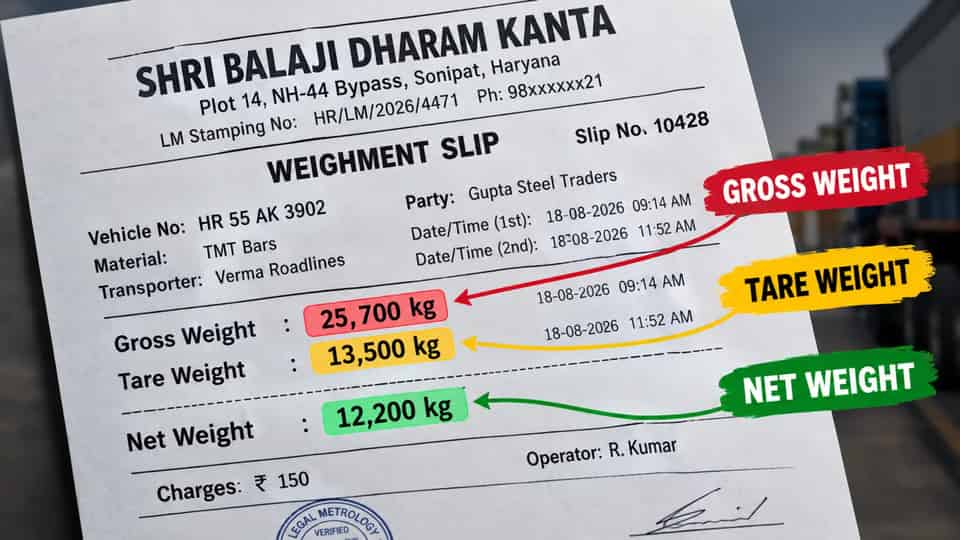


Three numbers on your weight slip matter. Read them wrong, and you either pay freight for a load you never carried, or you roll out overloaded and collect a ₹20,000 challan.
That slip is the truck weight slip. And here I will tell you how to read it the right way. Below is the format that you can copy, a filled sample with real numbers, and how to read it in ten seconds. It also covers the part nobody explains — when the slip holds up as proof, and when it is just paper.
truck-weight-slip-format.pdf -TruckOnWheels
What Is a Weight Slip for a Truck?
Weight slip is the printed receipt a weighbridge gives you after weighing your vehicle. It records what the truck weighed, when, and which vehicle it was.
In India the same document goes by five names:
-
Weight slip
-
Truck weighment slip
-
Vehicle weighment slip
-
Weighbridge slip
-
Kanta parchi or dharam kanta slip
They all mean one thing. The name changes with the state and the trade, not the document.
You need it in three situations. To bill a consignor for the exact load. To prove your truck is within its legal weight. And to settle an argument when the receiving party claims the load came up short.
What Goes On a Weight Slip: The Standard Format
A usable weight slip format carries these fields. Miss any of them and the slip loses value the moment someone disputes it.
|
Field |
What it records |
|---|---|
|
Weighbridge name and address |
Who weighed the vehicle |
|
Licence / Legal Metrology stamping number |
Proof the machine is verified |
|
Slip serial number |
Makes the slip traceable |
|
Vehicle number |
Links the weight to one truck |
|
Date and time of first weighment |
When the loaded or empty weight was taken |
|
Date and time of second weighment |
When the other weight was taken |
|
Material / commodity |
What was carried |
|
Party name |
Consignor or consignee |
|
Gross weight (kg) |
Truck plus load |
|
Tare weight (kg) |
Empty truck |
|
Net weight (kg) |
The load alone |
|
Charges |
What the kanta charged you |
|
Operator signature or seal |
Who issued it |
Two fields decide whether the slip survives a dispute: the serial number and the stamping number. A slip without either is a receipt for the money you paid the kanta. Nothing more.
Truck Weight Slip Format You Can Copy
Here is the layout in the order it should print on an A4 or thermal slip.
SHRI BALAJI DHARAM KANTA
Plot 14, NH-44 Bypass, Sonipat, Haryana
LM Stamping No: HR/LM/2026/4471 Ph: 98xxxxxx21
WEIGHMENT SLIP Slip No: 10428
Vehicle No: ______________ Party: ______________
Material: ______________ Transporter: __________
Gross Weight : __________ kg Date/Time: __________
Tare Weight : __________ kg Date/Time: __________
-----------------------------------------------
Net Weight : __________ kg
Charges: ₹ ______ Operator: ______________
Keep it on one page. Print two copies — one for the driver, one for the kanta register.
Truck Weight Slip Example With Real Numbers
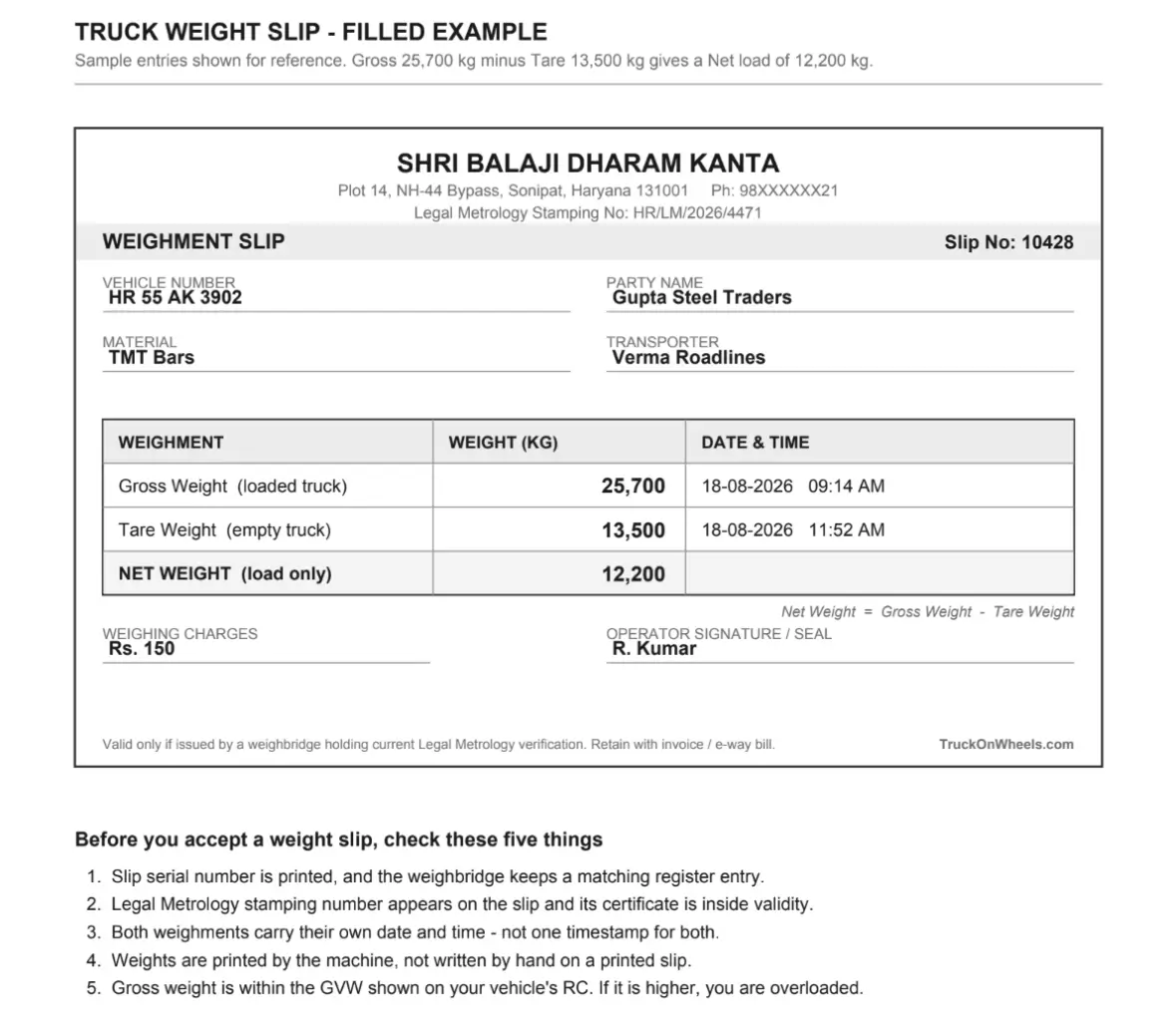
A filled slip reads like this.
SHRI BALAJI DHARAM KANTA
LM Stamping No: HR/LM/2026/4471
WEIGHMENT SLIP Slip No: 10428
Vehicle No: HR 55 AK 3902 Party: Gupta Steel Traders
Material: TMT Bars Transporter: Verma Roadlines
Gross Weight : 25,700 kg 18-08-2026 09:14 AM
Tare Weight : 13,500 kg 18-08-2026 11:52 AM
-----------------------------------------------
Net Weight : 12,200 kg
Charges: ₹ 150 Operator: R. Kumar
Use this as your weight slip template. Swap the header, keep the structure.
How to Read a Weight Slip in Ten Seconds
Three numbers. One subtraction.
Gross weight is the loaded truck — chassis, body, fuel, driver and maal together.
Tare weight is the same truck empty.
Net weight is what you are actually paying for:
Gross − Tare = Net 25,700 − 13,500 = 12,200 kg
Now do the second check, the one most owners skip. Compare the gross weight against the truck's registered GVW on the RC. If gross is higher, you are overloaded before you leave the gate.
Take the example above. A two-axle truck is allowed 18,500 kg GVW under the MoRTH 2018 axle load norms. A 25,700 kg gross reading means that truck is carrying roughly 7 tonnes more than the law permits.
The Two-Weighment Method And Your Right to the Second Slip
A weighbridge cannot separate the load from the truck. So it weighs twice.
Loaded first, empty second. Or empty first, loaded second. Either order works. The gap between the two timings on the slip tells you which.
Here is where owners lose money. Some kantas take the first weighment, then refuse to hand over anything until the second. Others print only the final net figure and keep the raw readings.
Ask for both weighments on one slip, with both timestamps. If the operator refuses, walk to another kanta. A single-number slip cannot be verified by anyone later.
When Is a Weight Slip Legally Valid?
The slip is only as good as the machine behind it.
Every weighbridge used for commercial weighing in India must be verified and stamped by the state Legal Metrology department under the Legal Metrology Act, 2009. That verification carries a validity period — for weighbridges and platform scales it usually runs one year, after which the kanta must get it re-stamped.
So check three things before you trust a slip:
-
The stamping certificate is displayed at the kanta and is inside its validity date
-
The stamping number is printed on your slip
-
The slip carries a serial number from the kanta's own register
A slip from an unstamped weighbridge carries no weight in a billing dispute, an insurance claim or a court matter. Weighment slips have been examined as evidence in Indian tax proceedings, and the first question asked is always which weighbridge issued it.
The ₹20,000 Line: Overloading and Section 194
This is why the gross figure matters more than the net one.
Under Section 194 of the Motor Vehicles Act, 1988, as amended in 2019, driving a goods vehicle beyond its permissible weight attracts a fine of ₹20,000, plus ₹2,000 for every extra tonne. On top of that, you pay the off-loading charges. The truck does not move until the excess comes off.
Run the example again. Seven tonnes over means ₹20,000 + ₹14,000 = ₹34,000, before off-loading and before the delay cost.
A weight slip taken before dispatch costs ₹150. That is the whole argument for weighing.
Weight Slip, GST and the E-Way Bill
Two practical points here, both worth money.
You do not need an e-way bill to reach the kanta. Under the e-way bill rules, goods moved up to 20 km from the consignor's place of business to a weighbridge for weighment — and back — are exempt, as long as the movement is covered by a delivery challan. So weigh first, generate the e-way bill after, with the correct figure.
Match your LR to your slip. The weight written on the bilty or lorry receipt should equal the net weight on the weighment slip. When those two disagree, the freight bill gets held up and the consignee asks questions. Copy the figure, do not estimate it.
How to Spot a Fake or Tampered Slip
Fleet owners get handed doctored slips more often than they realise. But you can spot it with these five checks:
-
Missing serial number. A genuine kanta prints sequential numbers and keeps the register.
-
Only one timestamp. Two weighments must show two times.
-
Round numbers. Real weighbridges throw odd figures — 19,970 kg, not 20,000 kg.
-
Handwritten weights on a printed slip. The weight should come off the printer, not a pen.
-
No stamping number. Ask which kanta issued it, then ask to see the certificate.
Keep your slips for at least as long as you keep the matching invoice. Photograph each one the day it is issued — thermal print fades inside a few months.
How to Make a Weight Slip
Three ways, depending on your volume.
By hand. Pre-printed books with your kanta's header. Cheapest, and fine at low volume. Number every slip.
In Excel. Build the format above with one formula in the net weight cell: =Gross − Tare. Lock the header, leave the entry cells open, print to PDF. This is what most small kantas and transport offices run on.
With weighbridge software. The indicator sends the reading straight to the slip, so no one types a weight by hand. Worth it once you cross roughly 30 weighments a day, or when you need GST billing and reports out of the same system.
Whichever you pick, keep one rule: the slip design never changes mid-year. A consistent format is what makes your records easy to audit.
Before Your Next Trip
Weigh loaded, weigh empty, check gross against your RC, and file the slip with the invoice. Four steps, ₹150, and it removes the two costliest surprises in road transport — an overloading challan and a freight bill you cannot defend.
Not sure what your truck should weigh empty? Start with the kerb weight and GVW on its spec sheet, then compare it to the tare reading on your next slip. If the two are far apart, something on your slip is wrong.