Blog Details
Difference Between Trucks and Trailers: Types, Key Differences & Uses
Summary
Truck vs trailer explained simply: what each one is, the types of trailers used in India, how much each carries, what licence you need, and which one to choose
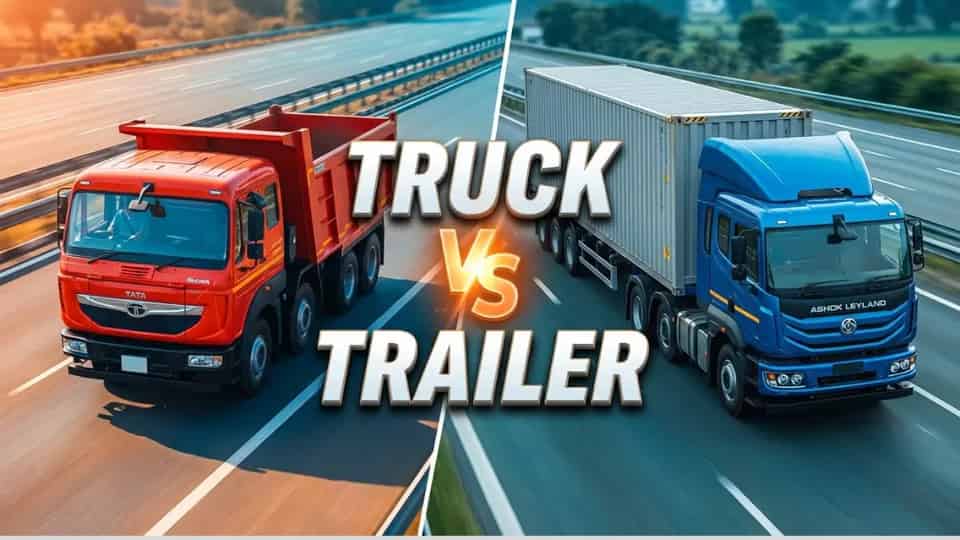


The difference between trucks and trailers is that a truck has its own engine and drives itself. A trailer has no engine and goes nowhere until a truck pulls it.
But that’s not it. You still have to figure out which one to buy, what type of licence you need, and how much load you can carry.
You will have everything figured out once you complete this read.
Quick Overview of Truck vs Trailer
|
Truck |
Trailer |
|
|
Engine |
Yes |
No |
|
Driver's cab |
Yes |
No |
|
Moves on its own |
Yes |
No — must be towed |
|
Registration |
Own RC |
Its own separate RC |
|
Number plate |
One |
Its own, different from the puller |
|
Common payload |
3–25 tonnes |
25–45 tonnes as a combination |
|
Max legal weight |
49 t GVW (rigid) |
55 t GCW (with tractor unit) |
|
Bed length |
7 ft to 32 ft |
20, 32 or 40 ft |
|
Toll class |
2 or 3 axle |
4 to 7+ axle |
|
Bought as |
One complete vehicle |
Tractor unit and trailer, usually separately |
What Counts as a Truck in India
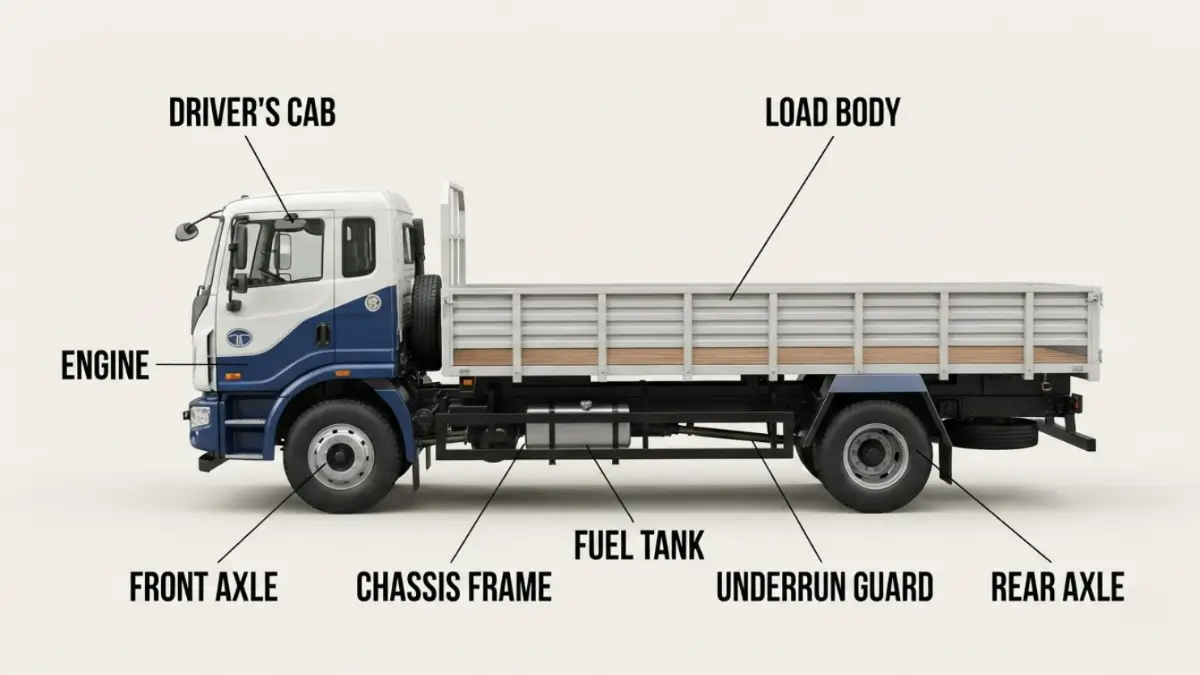
A truck is one rigid frame. Engine, cab and load body sit on a single chassis, welded into one unit. You can't split it.
On that one chassis, body builders fit whatever the job needs — open flatbed, closed container body, tipper, tanker, reefer. The chassis stays the same. Only the body changes.
You must have seen all these truck bodies doing different jobs. The Tata Ace does local delivery. Tata 407 Gold carries slightly more within the city. Tata 1109g LPT and 1512 LPT run loads between towns. The big ones like the Signa 3118.T and AVTR haul steel and cement across states.
One thing worth clearing up: lorry and truck both are the same thing.
And when someone in transport says "tractor," they don't mean a farm tractor. They mean the prime mover — the short powered unit that pulls a trailer. Also called a horse.
What a Trailer Actually Is
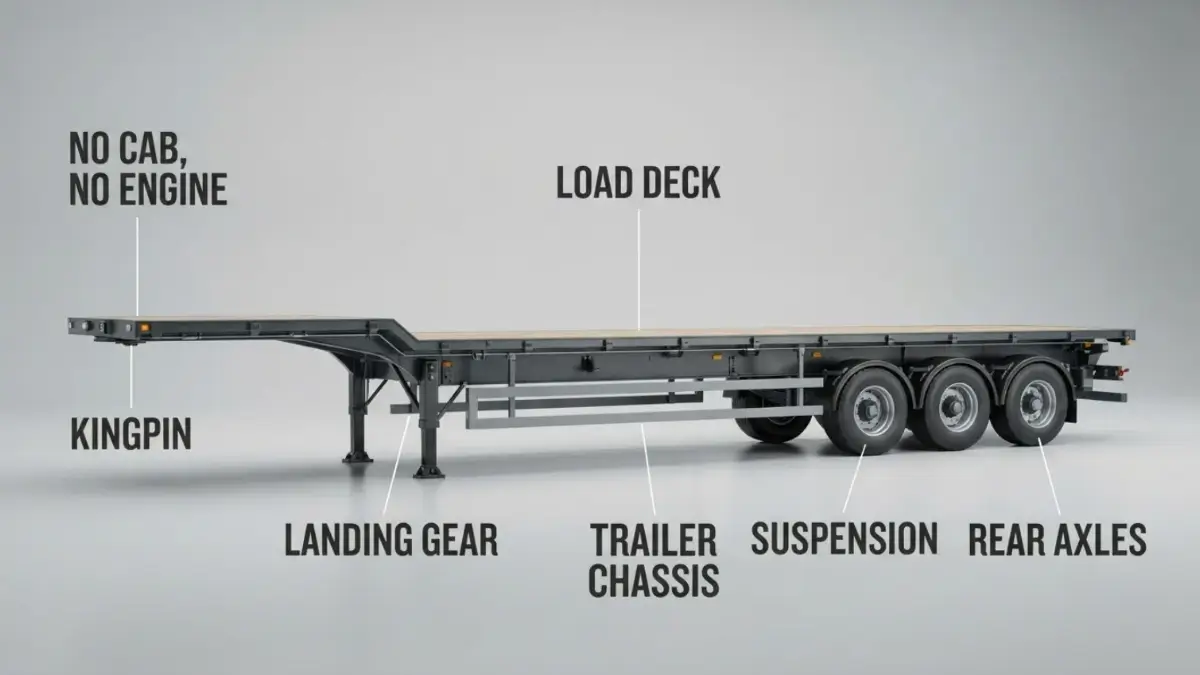
A trailer is a load platform on wheels. It has a chassis, axles, suspension, brakes and a deck. It has no engine, no steering wheel and no cab.
It connects to the tractor unit through a coupling called the fifth wheel. A steel pin on the trailer — the kingpin — drops into that coupling and locks. That joint is why the rig bends in the middle when it turns.
When the trailer is parked alone, two legs called landing gear hold the front end up.
Here's the bit that surprises most first-time buyers: in India the trailer is registered in its own right. It gets its own RC and its own number plate, separate from the tractor unit pulling it. The RTO treats it as a vehicle, not as an attachment. So one tractor unit can legally work with several different trailers.
That also explains why the two are usually bought separately. Tractor units come from the OEM. Trailers often come from fabricators. Two purchases, two papers, two budgets.
Types of Trailers You'll See on Indian Highways
Before the body types, there's a structural split worth knowing.
Semi-trailer vs full trailer. A semi-trailer rests its front end on the tractor's fifth wheel, so the tractor carries part of the load weight. That's what almost every rig on an Indian highway is. A full trailer carries its own weight on its own axles at both ends and connects by a drawbar instead. It's rarer here.
Now the types of trailers by what they haul:
Flatbed trailer — an open deck with no sides. Steel coils, machinery, pipes, anything long or awkward. Load gets strapped and sheeted.
Container or skeletal trailer — a bare frame with twist-locks that grip a shipping container. Standard sizes are 20 ft, 32 ft and 40 ft. This is the workhorse of port and EXIM movement.
Tanker trailer — a sealed cylindrical barrel for liquids and gases. Diesel, chemicals, edible oil, LPG, milk. Inside, baffle walls stop the liquid from surging forward when the driver brakes. A tanker trailer carrying hazardous cargo needs a specially endorsed driver and extra clearances, so operators treat it as a separate business line.
Tipper trailer — hydraulic bed that lifts and dumps. Sand, aggregate, coal, ore.
Low-bed trailer — the deck sits low, close to the road, to gain height clearance. Excavators, transformers, cranes. This is ODC territory.
Car carrier trailer — a two-deck cage. Moves finished cars from plant to dealership.
What Is a Truck With a Trailer Called?
A truck with trailer is called an articulated vehicle. In the trade, people just say "trailer" and everyone understands.
It has two halves. The tractor unit up front carries the engine, cab and fifth wheel. The semi-trailer behind carries the load and rides on a bogie — a cluster of two or three axles at the rear.
Trucks with trailers dominate long-haul lanes, port runs and container corridors. Rigid trucks own the city and the regional route. The reason is turning space, not power.
When a tractor unit runs without a trailer attached, that's called bobtailing. It's legal and you'll see it near every port. But a bobtailing truck earns nothing, and it actually brakes worse than a loaded one, because the rear axles have no weight pressing them down.
One more thing that trips people up. If you've read an American article, you'll have seen semi-truck, tractor-trailer and 18-wheeler. All three describe the same machine we call a trailer.
How Much Can Each One Carry?
MoRTH raised India's weight limits in July 2018 — the first change in 35 years. The numbers that matter:
-
Two-axle rigid truck: up to 18.5 tonnes GVW, raised from 16.2 t
-
Three-axle rigid truck: up to 28.5 tonnes, raised from 25 t
-
Five-axle vehicle: up to 43.5 tonnes, raised from 37 t
-
Hard ceiling: 49 tonnes for any rigid vehicle, 55 tonnes for semi-articulated trailers and truck-trailers
Two terms get mixed up constantly here. GVW is the total legal weight of a single vehicle — its own weight plus its load. GCW is the total for the tractor and trailer together. When a spec sheet quotes 55 t for a rig, that's GCW, and the actual payload after subtracting the vehicles' own weight lands closer to 35–40 tonnes.
Axles decide everything. Add an axle, spread the load, carry more legally. That single rule is why a container trailer out-earns a rigid truck per trip.
Licence, Permit and Papers
A rigid truck needs a Heavy Motor Vehicle licence. Standard commercial licence, standard test.
An articulated rig needs more. A driver holding a heavy vehicle licence has to add a trailer endorsement on top of it. That means a separate test and a separate approval at the RTO, which is exactly why trailer drivers are scarcer and get paid more than rigid truck drivers.
On paperwork, remember the doubling. Two RCs. Two fitness certificates. Two insurance policies. Two sets of renewal dates to track. Fleet owners who move from rigid trucks to trailers usually underestimate this admin load in year one.
Running Cost of Truck and Trailers
Toll is the cost line most people tend to overlook. NHAI charges by axle count, and the jump is steep.
A two-axle truck sits in the heavy commercial class and pays around 3.5 times the car rate. A three-axle vehicle pays roughly 4.7 times. A five-axle rig pays about 7 times, and anything with six or more axles pays over 8 times. On a long national highway lane, that gap runs into thousands per trip.
Tyres are the second line. A two-axle truck runs six tyres. A five-axle articulated rig runs twenty-two. Every replacement cycle costs three to four times more.
So why does anyone run a trailer? Two reasons.
Cost per tonne. Toll and tyres rise, but tonnes rise faster. Move 35 tonnes in one trip instead of splitting it across two 18-tonne runs, and your cost per tonne-kilometre drops — along with one driver's wages and one set of trip expenses.
Drop-and-hook. Because the trailer is a separate registered vehicle, the tractor unit doesn't wait for loading. It drops a loaded trailer, hooks an empty one and leaves. A rigid truck sits idle at the dock for the same hours. On high-volume lanes, that utilisation gain beats every other saving on this page.
The flip happens on short lanes and scattered drops. There, the trailer's toll bill and turning trouble eat the tonnage advantage, and the rigid truck wins outright.
Which One Should You Buy?
City distribution and multi-drop FMCG — rigid truck. You need to turn into narrow lanes and stop twelve times a day.
Construction and mining — tipper truck for site-to-site work, tipper trailer once volumes justify the toll.
Port, container and EXIM — container trailer. Nothing else moves a 40-ft box.
Fixed long-haul lanes with steady volume — articulated rig, every time.
Liquid cargo — tanker truck for regional runs, tanker trailer for bulk and long distance.
First vehicle, first business — rigid truck. Lower capital, simpler licence, easier resale, fewer papers. Nearly every large fleet in India started here.
Three questions settle it. How long is your typical lane? Is your load volume steady or seasonal? Can you fund a tractor unit and trailer as two separate purchases?
If your lane is under 200 km or your volume swings month to month, buy the truck.