Blog Details
Truck Fuel Tank Capacity in India – Diesel, CNG and Lorry Tank Sizes
Summary
Explore truck fuel tank capacity in India, including diesel, CNG and petrol trucks. Compare tank sizes in litres, popular truck specifications and estimated driving range.
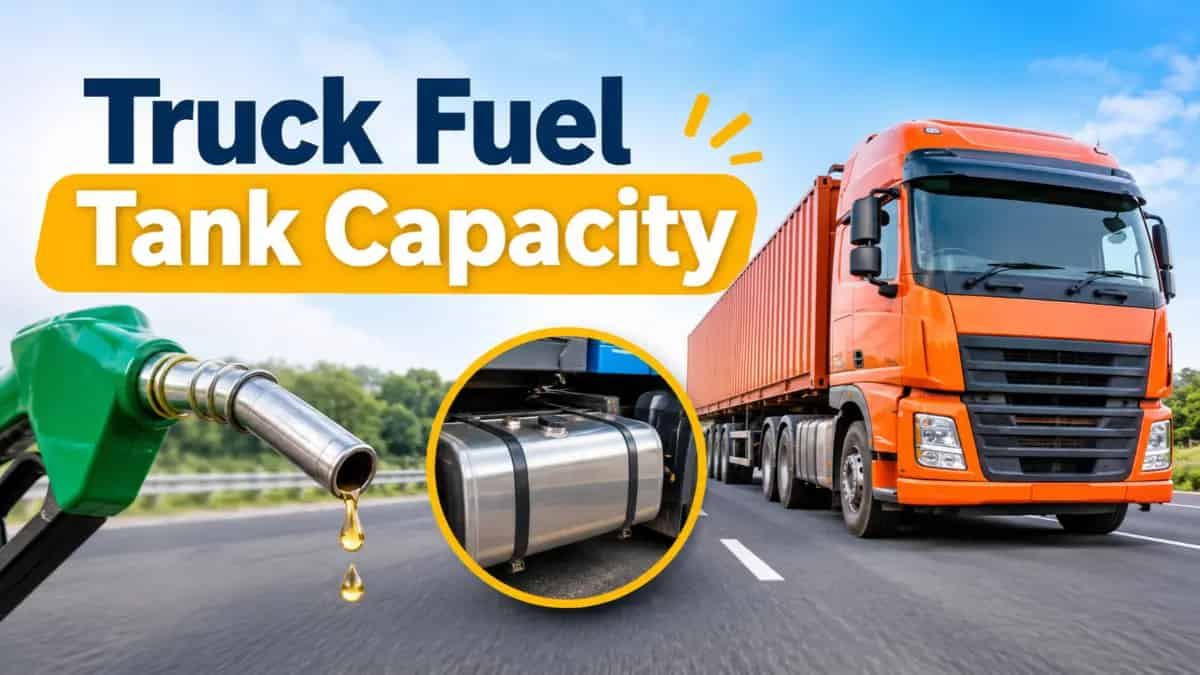


Truck fuel tank capacity is an important specification for commercial vehicle buyers, transporters and fleet operators. It determines how much fuel a truck can carry and helps businesses plan refuelling stops, long-distance journeys and daily transportation operations.
In India, fuel tank capacity varies depending on the truck's size, engine, fuel type and application. A mini truck used for city deliveries has different fuel storage requirements from a heavy-duty truck designed for interstate transportation. Some commercial vehicles also offer multiple fuel tank configurations to support longer journeys.
But how many litres of diesel can a truck hold? What is the average fuel tank capacity of Indian trucks? And how does a bigger fuel tank affect mileage and driving range?
In this guide, we explain truck fuel tank capacity in litres, compare diesel and CNG storage, look at specifications from Tata, Ashok Leyland, Eicher and BharatBenz, and explain how to estimate the driving range of a truck.
What Is Fuel Tank Capacity?
Fuel tank capacity refers to the amount of fuel a vehicle's storage system is designed to hold. It is generally measured in litres for diesel and petrol vehicles.
For example, if a truck has a 160-litre diesel tank, its stated fuel tank capacity is 160 litres. However, the actual quantity dispensed during refuelling may be lower because of the manufacturer's specified filling capacity and the fuel already remaining in the tank.
Fuel tank capacity, mileage and driving range are three different specifications:
-
Fuel tank capacity: The amount of fuel a truck can store.
-
Mileage: The distance a truck can travel per litre of fuel, generally measured in kmpl.
-
Driving range: The estimated distance a truck can cover using its available fuel.
For commercial vehicle buyers, comparing these three specifications is more useful than looking at fuel tank capacity alone.
Average Fuel Tank Capacity of Indian Trucks
There is no fixed average fuel tank capacity for all Indian trucks. It varies according to vehicle category, GVW, engine configuration, fuel type and transportation requirements.
A mini truck used for local deliveries generally needs less fuel storage than a heavy-duty truck covering long highway routes. Similarly, a truck with a larger engine and higher GVW may offer a bigger fuel tank, although this is not a universal rule.
The following table provides a general understanding of fuel storage requirements across truck categories.
|
Truck type |
Typical application |
Fuel tank requirement |
|
Mini trucks |
Local deliveries and last-mile transportation |
Smaller fuel storage for shorter routes |
|
Light commercial trucks |
City and regional goods transportation |
Capacity suited to regular daily operations |
|
Medium trucks |
Intercity and regional transportation |
Greater fuel storage for longer journeys |
|
Heavy-duty trucks |
Interstate logistics and long-distance freight |
Larger or dual-tank configurations may be available |
These are general category descriptions, not fixed fuel tank capacity ranges. Actual capacity depends on the manufacturer, model and variant.
For example, a Tata LPT 712 offers 90-litre and 120-litre fuel tank options, while the Tata Ultra T.18 has a listed 250-litre diesel tank. The BharatBenz 1917R also offers a 760-litre dual-tank configuration on a specified variant.
This shows why buyers should compare actual truck specifications instead of relying on a single average figure.
Fuel Tank Capacity by Truck Category
Truck fuel tank capacity changes with the size and application of the commercial vehicle. Understanding these differences can help buyers select a truck that suits their transportation requirements.
Mini Truck Fuel Tank Capacity
Mini trucks are commonly used for local transportation, e-commerce deliveries, agricultural goods and last-mile logistics.
These vehicles generally operate on shorter routes, so their fuel storage requirements are different from those of medium and heavy commercial trucks.
When comparing mini trucks, buyers should check fuel tank capacity alongside mileage, payload and daily running distance. A smaller tank can be sufficient for a vehicle operating within a city, provided that refuelling is convenient.
Light Commercial Truck Fuel Tank Capacity
Light commercial vehicles (LCVs) are used for transporting goods between cities, warehouses, markets and distribution centres.
Their fuel tank capacity depends on the engine, GVW, wheelbase and vehicle configuration. Some models also offer multiple tank options.
For example, Tata LPT 712 has listed 90-litre and 120-litre fuel tank options. Buyers should confirm which capacity is available with their selected variant.
Medium Truck Fuel Tank Capacity
Medium commercial trucks are commonly used for industrial goods, construction materials, agricultural products and intercity transportation.
These vehicles may require greater fuel storage because they often cover longer distances and carry heavier loads.
For example, the Eicher Pro 2119 has a manufacturer-listed diesel fuel tank capacity of 190 litres. The Tata Ultra T.18 has a 250-litre diesel tank.
When comparing medium trucks, check the fuel tank capacity, mileage under load and permissible payload to understand their operating suitability.
Heavy-Duty Truck Fuel Tank Capacity
Heavy-duty trucks are designed for long-distance freight movement, industrial transportation and demanding commercial applications.
Some models offer large fuel tanks or dual-tank configurations to reduce the need for frequent refuelling.
For example, the BharatBenz 1917R offers a 215-litre fuel tank on specified configurations and a 760-litre dual-tank option on another configuration.
A larger fuel storage system can be useful for long-distance operations, but transporters should also consider the additional fuel weight and its effect on available payload.
Diesel Truck Fuel Tank Capacity
Diesel trucks are widely used for goods transportation, logistics, construction, industrial operations and long-distance freight movement in India.
Diesel truck fuel tank capacity depends on the vehicle's GVW, engine, chassis design and intended application. Some models offer different tank sizes depending on the selected wheelbase or configuration.
Here are some examples from manufacturer specifications:
|
Truck model |
Manufacturer |
Fuel type |
Fuel tank capacity |
|
Tata Motors |
Diesel |
90 / 120 litres |
|
|
Tata Motors |
Diesel |
160 / 250 litres |
|
|
Tata Motors |
Diesel |
250 litres |
|
|
Eicher |
Diesel |
190 litres |
|
|
Eicher |
Diesel |
190 litres |
|
|
BharatBenz |
Diesel |
215 litres / 760 litres (dual tank) |
Capacities are manufacturer-listed options. Availability depends on the exact model and variant. For BharatBenz 1917R, the corresponding filling capacities are 200 litres and 710 litres respectively.
Lorry Diesel Tank Capacity
Lorry diesel tank capacity varies according to the vehicle's size, engine, axle configuration and transportation application.
A light commercial lorry used for regional deliveries does not have the same fuel storage requirements as a heavy-duty truck used for interstate freight transportation.
For example, the BharatBenz 1917R has the following manufacturer-listed fuel tank configurations:
|
Configuration |
Fuel tank capacity |
Filling capacity |
|
Standard tank |
215 litres |
200 litres |
|
Dual-tank configuration |
760 litres |
710 litres |
This difference is important when comparing lorry tank capacity.
Fuel tank capacity represents the stated tank size, while filling capacity indicates how much fuel can be filled under the manufacturer's specified conditions.
A transporter should check both figures before calculating the expected driving range of a lorry.
CNG Truck Tank Capacity
CNG trucks are another option for businesses looking to use alternative fuels for commercial transportation. They are commonly considered for city deliveries, regional transportation and operations where CNG refuelling infrastructure is available.
Unlike diesel and petrol, compressed natural gas is stored under high pressure in specially designed cylinders.
CNG storage may be specified using two different measurements:
-
Water capacity in litres: The internal volume of the CNG cylinders.
-
CNG quantity in kg: The actual mass of gas stored in the cylinders.
These measurements are not interchangeable. A CNG cylinder with a water capacity of 120 litres does not necessarily contain 120 kg of CNG.
For example, Ashok Leyland's Dost Twin Fuel offers 120 litres of CNG storage and a separate 5-litre petrol tank. The Dost+ XL Twin Fuel offers 148 litres of CNG storage alongside a separate 5-litre petrol tank.
|
Truck model |
CNG storage |
Petrol tank |
|
Ashok Leyland Dost Twin Fuel |
120 litres |
5 litres |
|
Ashok Leyland Dost+ XL Twin Fuel |
148 litres |
5 litres |
The CNG figures are stated cylinder storage capacities, not kilograms of gas.
These vehicles use a twin-fuel system that allows operation on CNG and petrol. The separate petrol tank provides additional operating flexibility when CNG is not readily available.
Before purchasing a CNG truck, check its cylinder storage capacity, rated gas quantity if provided, driving range and availability of CNG stations along your regular routes.
You can also explore CNG trucks in India to compare available commercial vehicles and their specifications.
How Fuel Tank Capacity Affects Truck Mileage and Driving Range
Fuel tank capacity and mileage work together to determine how far a truck can travel before it needs to refuel.
However, a larger fuel tank does not automatically mean better mileage. It only allows the vehicle to carry more fuel.
For example, a truck with a 250-litre diesel tank may cover a longer distance between refuelling stops than a truck with a 160-litre tank, assuming both vehicles have the same mileage and usable fuel quantity.
How to Calculate Truck Driving Range
You can estimate the driving range of a truck using this simple formula:
Estimated driving range = Usable fuel quantity × Average mileage
For example, consider a truck with:
-
Usable diesel quantity: 150 litres
-
Average mileage: 6 kmpl
Calculation:
150 × 6 = 900 km
The estimated driving range is 900 km under the assumed mileage.
This is a theoretical estimate, not a guaranteed real-world distance. Actual driving range can be lower because of traffic, vehicle load, road gradients, idling, driving style and other operating conditions.
Truck Fuel Tank Capacity and Estimated Driving Range
The following examples show how fuel quantity and mileage affect the estimated driving range.
|
Usable fuel quantity |
Assumed mileage |
Estimated driving range |
|
90 litres |
7 kmpl |
630 km |
|
120 litres |
6 kmpl |
720 km |
|
160 litres |
6 kmpl |
960 km |
|
250 litres |
5 kmpl |
1,250 km |
|
375 litres |
4 kmpl |
1,500 km |
These are illustrative calculations, not actual mileage claims for specific truck models. The calculation assumes that the entire stated quantity is usable.
For a more realistic estimate, use the actual usable fuel quantity and mileage recorded during regular truck operations.
Does a Bigger Fuel Tank Increase Truck Mileage?
No. A bigger fuel tank does not automatically improve truck mileage.
Fuel tank capacity determines how much fuel a truck can store, while mileage measures how efficiently the engine uses that fuel.
A larger tank can provide several operational advantages:
-
Fewer refuelling stops on suitable long-distance routes.
-
More flexibility when planning interstate transportation.
-
Better convenience on routes with fewer fuel stations.
-
Greater flexibility in managing refuelling schedules.
However, buyers should also consider the additional weight of the fuel, permissible payload, tank placement and vehicle operating requirements.
Fuel Tank Capacity of Popular Trucks in India
Comparing actual truck specifications is more useful than relying on general estimates of fuel tank capacity.
Tata Motors, Ashok Leyland, Eicher and BharatBenz offer commercial vehicles with different fuel storage configurations for various transportation requirements.
Here are some examples based on manufacturer-listed specifications.
Tata Truck Fuel Tank Capacity
Tata Motors offers different fuel tank configurations across its commercial vehicle range.
|
Truck model |
Fuel type |
Fuel tank capacity |
|
Diesel |
90 / 120 litres |
|
|
Diesel |
160 / 250 litres |
|
|
Diesel |
250 litres |
The Tata LPT 712 offers fuel tank options suitable for its light commercial vehicle application, while the LPT 1212 provides different tank configurations for its transportation requirements.
The Tata Ultra T.18 has a manufacturer-listed 250-litre diesel tank, making it a useful example when comparing medium commercial truck fuel storage.
Buyers should check the exact variant before comparing fuel tank capacity.
Ashok Leyland Truck Fuel Tank Capacity
Ashok Leyland offers diesel and alternative-fuel commercial vehicles for different applications.
Its Dost Twin Fuel range is a useful example of a commercial vehicle with separate CNG and petrol storage.
|
Truck model |
Fuel type |
Listed storage capacity |
|
Dost Twin Fuel |
CNG + Petrol |
120 litres CNG + 5 litres petrol |
|
Dost+ XL Twin Fuel |
CNG + Petrol |
148 litres CNG + 5 litres petrol |
These vehicles provide flexibility for operators who want to use CNG while retaining a separate petrol backup system.
Eicher Truck Fuel Tank Capacity
Eicher offers light, medium and heavy-duty commercial vehicles with different fuel tank configurations.
|
Truck model |
Fuel type |
Fuel tank capacity |
|
Eicher Pro 2119 |
Diesel |
190 litres |
|
Eicher Pro 3018 Plus |
Diesel |
190 litres |
|
Eicher Pro 3016 N |
Diesel |
250 litres |
The Eicher Pro 2119 and Pro 3018 Plus have manufacturer-listed 190-litre diesel tanks, while the Pro 3016 N has a 250-litre tank.
These differences highlight why buyers should compare individual truck models and variants rather than assuming all vehicles in the same category have identical fuel storage.
BharatBenz Truck Fuel Tank Capacity
BharatBenz offers different fuel tank configurations for its commercial vehicles.
The BharatBenz 1917R is one example of a truck with different diesel tank options.
|
Truck model |
Fuel type |
Fuel tank capacity |
Filling capacity |
|
Diesel |
215 litres |
200 litres |
|
|
BharatBenz 1917R (dual tank) |
Diesel |
760 litres |
710 litres |
The dual-tank configuration offers significantly greater fuel storage than the standard configuration.
However, the availability of this configuration depends on the vehicle variant and wheelbase. Buyers should confirm the exact specification with an authorised dealer.
Conclusion
Truck fuel tank capacity is an important specification when purchasing a commercial vehicle, particularly for transporters who regularly cover long distances.
However, choosing a truck based only on the largest fuel tank can lead to the wrong buying decision. Mileage, payload, GVW, route conditions and fuel availability are equally important.
Before purchasing, compare the actual fuel tank capacity of different truck models and estimate their driving range using realistic mileage figures.
Explore TruckOnWheels to compare truck prices, mileage, specifications, payload and fuel options before choosing a commercial vehicle that suits your transportation business.