
News Details
Indian Trucking Gets Safer: Tata Adopts ECE R29.03 Cabin Safety
Summary
Your truck's cabin should save your life. Tata Motors just made global crash standards standard across all its trucks. What ECE R29.03 means for driver safety inside.
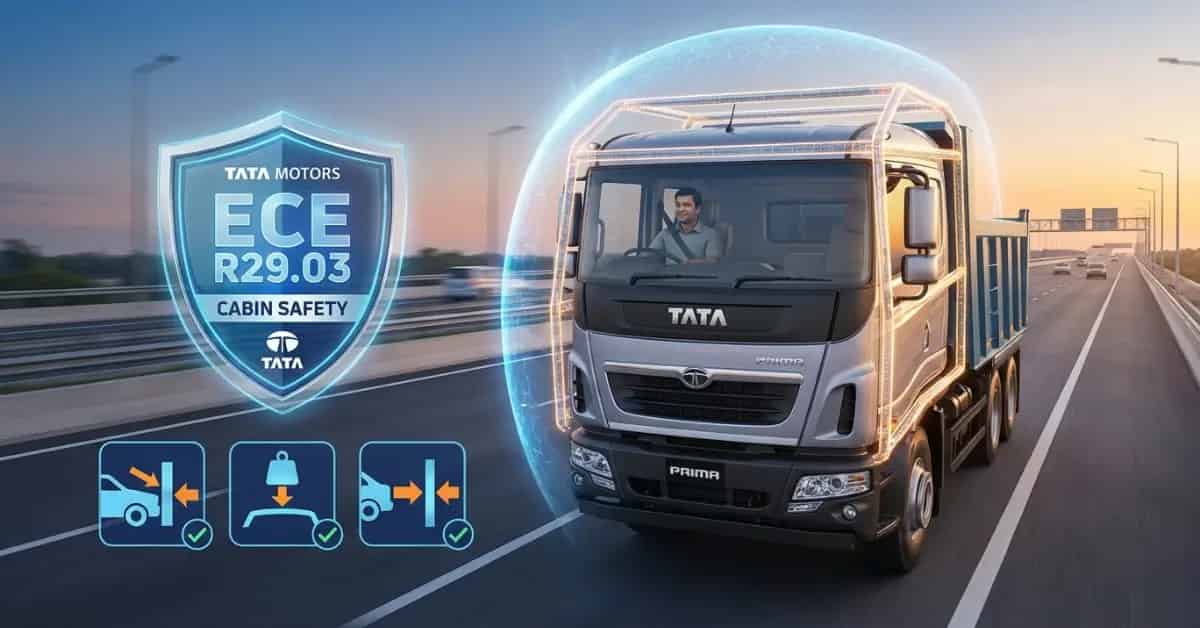


India's highways carry lakhs of trucks that power the country's economy. For years, trucks were judged by strength, payload, and fuel efficiency. But highways are getting wider and faster. Priorities are changing. Safety. Especially cabin safety is now a critical factor in operational reliability. The conversation is shifting from "How much can a truck carry?" to "How well can it protect the person driving it?"
ECE R29.03 Meaning
ECE R29.03 is one of the world's most stringent standards for truck cabin safety. It tests whether a cabin can maintain its structure and preserve the driver's survival space during severe crashes. The regulation subjects cabins to demanding structural tests. These include frontal impact, roof strength for rollover simulation, and rear wall load assessments. The tests go beyond superficial reinforcements. They focus on how the cabin behaves under extreme stress. It ensures the cabin acts as a protective shell for the driver.
Why The Global Standards Matter for India
India records among the highest road fatalities globally, especially on highways. High-speed corridors and longer driving distances mean crash energy has increased. Stronger cabins are no longer optional. ECE R29.03 is particularly relevant because it evaluates the cabin as an integrated protective structure. It sets strict requirements for key load-bearing elements. These become critical in rollovers and high-impact collisions—common patterns in highway accidents. By preserving cabin shape and preventing structural intrusion, the standard directly improves driver protection and reduces operational disruption.
Tata Motors' Wide Range Portfolio Commitment
A notable shift has come from Tata Motors Commercial Vehicles. The company upgraded its entire truck portfolio to comply with ECE R29.03. This includes the Prima, Signa, Ultra, and Azura ranges. The move is not limited to select premium models. It represents a portfolio-wide shift, embedding global cabin safety standards across key truck platforms. When a leading manufacturer adopts such stringent requirements across its range, it raises the benchmark for engineering standards. It also redefines what the market expects as standard.
Engineering for India – Beyond Compliance
Tata's approach goes beyond meeting regulations. Engineering teams analyzed real-world crash data from Indian highways. They studied accident patterns, collision angles, deformation behavior, and cabin intrusion risks. These insights were translated into additional internal validation scenarios. The company calls these "due care" tests. They are designed specifically around Indian road conditions. These tests push cabin structures beyond minimum regulatory thresholds. The goal is to ensure performance is not only globally compliant but also reinforced for the severe crash conditions Indian drivers may encounter. Together, these efforts strengthen the cabin's ability to protect occupants in real-world operating environments.
Also Read : Volvo Launches India’s First Ever 13.5m 4x2 Coach Bus