
News Details
Why Delhi Supreme Court is Hiking Entry Fees for Trucks
Summary
Truckers, get ready to pay more entering Delhi. The Supreme Court just approved a big hike in environment charges. Here's why they did it and where your money goes.
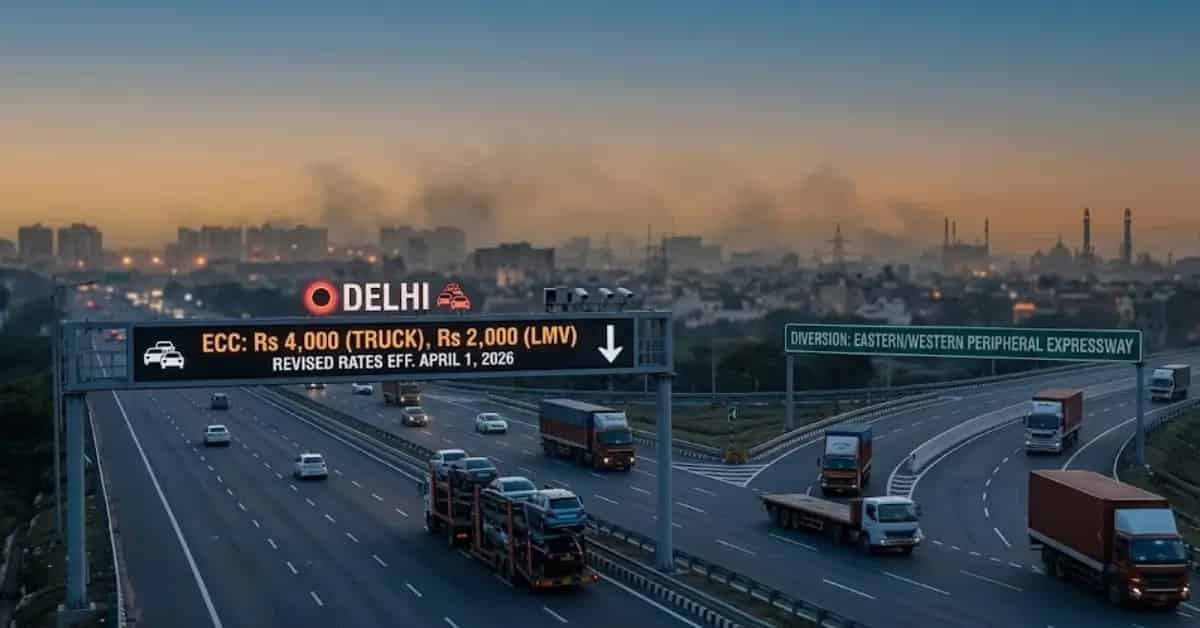


The Supreme Court has approved a steep hike in Environment Compensation Charge for commercial vehicles entering Delhi. The move aims to cut pollution caused by transit vehicles passing through the capital. It pushes non-destined trucks to take the eastern and western peripheral expressways instead of using Delhi as a shortcut.
What Are the New Rates?
Light motor vehicles will now pay Rs 2,000 instead of Rs 1,400. Trucks will pay Rs 4,000, up from Rs 2,600. The revised rates take effect from April 1, 2026. The decision came during a hearing before a bench of Chief Justice Surya Kant, Justices Joymalya Bagchi, and Vipul M. Pancholi.
Why the Hike Now?
Additional Solicitor General Aishwarya Bhati told the court that ECC rates had not been revised since 2015. The Commission for Air Quality Management believes the revision will restore the deterrence value originally fixed in 2015. Over time, the charge lost its impact due to inflation and rising vehicle operating costs.
The revised structure creates a significant cost difference between passing through Delhi and taking diversion routes like the peripheral expressways. This difference makes the expressways more attractive for transit traffic.
Annual Increases Coming from 2027
The court was informed that ECC rates will be revised upwards by 5% from April 1 every year. However, the bench clarified that the first annual revision will take effect from April 1, 2027. This aligns with the average annual rise in toll rates on national highways.
Court's Directive on Enforcement
While accepting the CAQM recommendations, the Supreme Court issued clear directions. All stakeholders must ensure that heavy commercial vehicles are not permitted to transit through Delhi. Instead, they should be diverted to the eastern and western peripheral expressways. This will reduce traffic congestion and pollution within the city.
What CAQM Recommended to MCD
The Commission on Air Quality Management also recommended that the Municipal Corporation of Delhi rationalise its toll structure. This includes revising existing toll rates and addressing disparities in vehicle classification compared to NHAI's framework.
CAQM suggested carrying out a comprehensive traffic and revenue study. The study would assess traffic potential and route diversion patterns, particularly considering the proposed ECC revision.
Also Read : drivebuddyAI Gets Patent for Facial Recognition System for CV Drivers
How Enforcement Will Work
The commission has pushed for technology-based enforcement systems. The proposed revision will be coupled with time-bound installation of barrier-free Multi-Lane Free Flow systems. These systems will be integrated with RFID and Automatic Number Plate Recognition technology by MCD.
Such systems allow seamless toll and ECC collection without requiring vehicles to stop. This reduces congestion at Delhi's border entry points. The technology-enabled enforcement, combined with periodic escalation of charges, aims to discourage entry of diesel commercial goods vehicles into Delhi. It will divert non-destined freight traffic away from the capital and consequently reduce the pollution load.
Also Read : Pune Truck Fitness Tests Halted Again Due to ATS Unavailability