Blog Details
Truck Types in India 2026: Mini Truck, Pickups, Tipper, HCV, Trailers
Summary
The Indian truck market has never offered more truck options. That's the opportunity. It's also where the wrong choice hides.
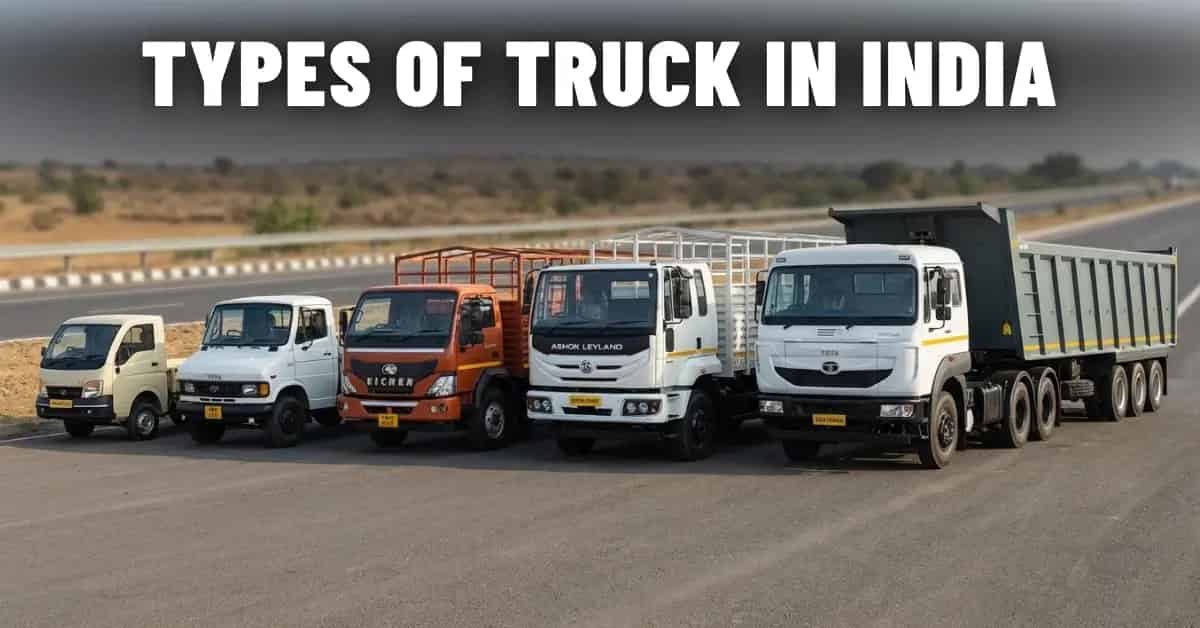


There are mainly 6 types of trucks in India. And buying the wrong truck type in India doesn't just waste money, but it can mean an overloaded vehicle, an invalid permit, or a challan that wipes out your one week's margin.
This article isn't a list of truck types. It's a decision guide. One that connects what you're carrying to what type of truck you should be driving, across every category from the Tata Ace to a 40-foot trailer.
How India Officially Classifies Trucks
The classification of trucks in India is based on GVW (Gross Vehicle Weight). That is the total weight of the truck, including its maximum legal load.
Quick distinction: GVW = truck weight + maximum legal cargo weight
India's official truck categories under MoRTH:
|
Category |
Full Name |
GVW Range |
Examples |
|
SCV |
Small Commercial Vehicle |
Up to 3.5T |
|
|
LCV |
Light Commercial Vehicle |
3.5T – 7.5T |
|
|
ICV |
Intermediate Commercial Vehicle |
7.5T – 12T |
Eicher 14–19ft range |
|
MCV |
Medium Commercial Vehicle |
12T – 16.2T |
|
|
HCV |
Heavy Commercial Vehicle |
16.2T – 25T |
|
|
MHCV |
Multi-Axle / Heavy |
25T+ |
Types of Trucks in India: All Categories Explained
Small Commercial Vehicles (SCVs) : Up to 3.5T GVW
SCVs are built for narrow lanes, city traffic, and loads under 1,000 kg. Payload typically runs between 500 kg and 1T. Body length is usually 7–8 feet. Four tyres. Fuel options now include petrol, CNG, diesel, and electric variants.
Who uses them: kirana store restocking, e-commerce last-mile, vegetable distribution, short courier runs.
The Tata Ace made this category famous. The Mahindra Jeeto kept it competitive.
Light Commercial Vehicles (LCVs) : 3.5T to 7.5T GVW
The Tata 407 built the LCV segment in India. The Ashok Leyland Dost and Mahindra Bolero Pik-Up followed. And honestly, this three-way competition is still the most active in the market.
Payload range: 1T to 2.5T. Body lengths run 9–14 feet. Six tyres standard.
Use cases: regional distribution, 1.5–2 BHK household moves, FMCG branch restocking, small factory dispatch. These are the workhorses of India's semi-urban supply chain.
Intermediate Commercial Vehicles (ICVs) : 7.5T to 12T GVW
The Eicher 14ft, 17ft, and 19ft trucks live here. So does the Tata 1009 and Ashok Leyland Ecomet. Combined, this segment accounts for a massive share of India's point-to-point freight.
Payload: 3.5T to 7T depending on axle type. Body lengths: 14 to 20 feet.
Why does the 19-footer dominate? Because it sits at the sweet spot. Narrow enough for city delivery docks, long enough to move meaningful commercial volume without an HCV permit.
Medium & Heavy Commercial Vehicles (MCVs/HCVs) : 12T to 25T GVW
This is highway territory. MCVs and HCVs handle interstate freight, construction supply chains, and bulk goods that smaller trucks simply cannot move economically.
Payload: 8T to 18T. Body lengths: 22–28 feet. Ten to twelve tyres.
Key models: Ashok Leyland 2518, Tata 2516, BharatBenz 1617R, Mahindra Blazo. These trucks run scheduled interstate routes — Mumbai to Delhi, Chennai to Bengaluru, Kolkata to Patna.
Multi-Axle Trucks & Trailers : Over 25T GVW
At this weight, you're no longer talking about a single truck. You're talking about a tractor-trailer combination, a tractor head pulling a detachable trailer body.
Payload: 20T to 35T. The total combination length can reach 18.75 metres under CMVR rules.
Who needs these: cement plants, steel manufacturers, port logistics operators, large machinery movers. The Tata Signa 4923 and Ashok Leyland Captain 5532 are the two names you'll hear most at this tier.
In practice, though, most small fleet operators never need to go this large. And the financing, permit, and operational complexity jumps significantly at this tier.
Truck Body Types in India
Wheel count tells you how much you can legally carry. Body type tells you whether you should.
Here are the seven main body types operating on Indian roads:
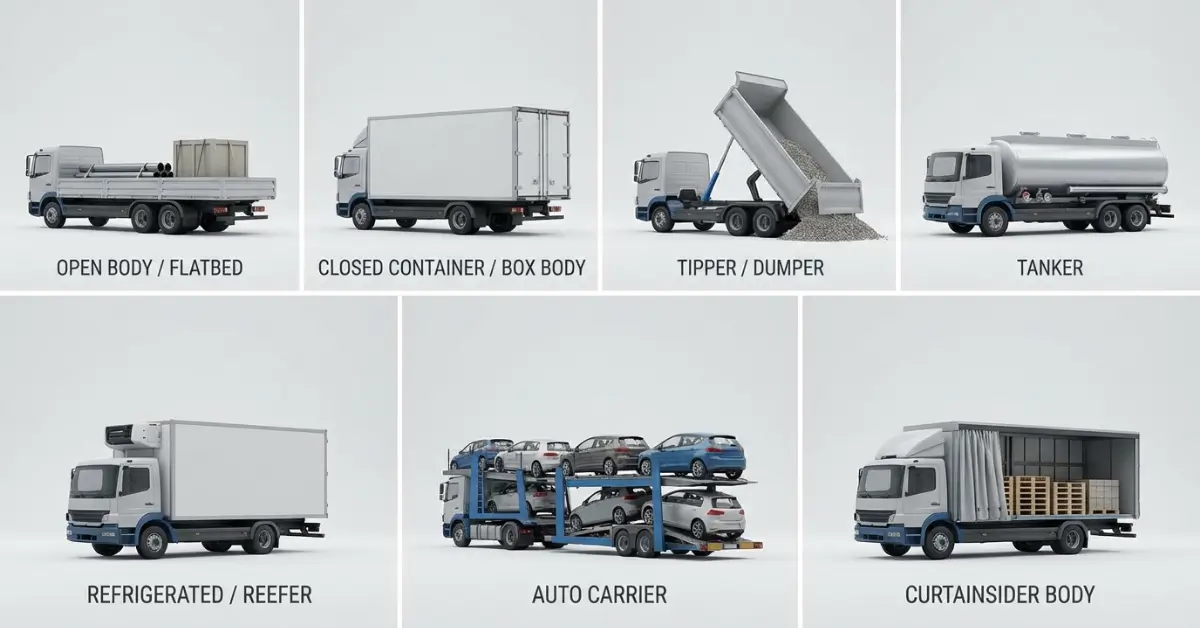
Open Body / Flatbed
For cargo that doesn't need weather protection and needs side or top loading such as steel pipes, construction rods, large machinery, or marble slabs. Fast loading, easy crane access.
Closed Container / Box Body
For cargo that needs protection: electronics, pharmaceuticals, FMCG, household goods during shifting. Standard for all 32ft SXL/MXL container movements.
Tipper / Dumper
Hydraulic rear discharge. Built for sand, gravel, construction debris, mine material. The tipper's rear door raises and the load falls out by gravity. Simple and brutal, which is exactly why it works.
Tanker
Liquid cargo like petroleum products, chemicals, milk, and water. Requires hazardous goods certification for some materials. The cylindrical body is structural. Tankers are specialist vehicles with a specific regulatory regime.
Refrigerated / Reefer
Insulated container with an active cooling unit. Dairy, meat, frozen food, some pharmaceuticals. The cooling unit runs off the truck's engine or a separate diesel generator. Operating cost is significantly higher than a standard box truck. But cold chain compliance is non-negotiable in regulated sectors.
Auto Carrier Truck Body
Multi-deck vehicle for transporting passenger cars and two-wheelers from factories or ports to dealerships. A growing body type as India's passenger vehicle market expands.
Curtainsider Body Truck
A box body with retractable fabric sides instead of fixed panels. Allows forklift side-loading without opening rear doors. Common in retail supply chains, where loading dock time is money.
How to Pick the Right Truck in 2026 : 5 Questions to Ask First
1: How Much Payload Will YOU Carry?
This is the gateway question. Get the weight wrong and every other decision is built on sand. Weigh your cargo before booking. Not after.
2: What Distance Will YOUR Truck Cover in a Aay?
Under 150 km: CNG or electric SCVs/LCVs can work. 150–400 km: diesel LCVs and ICVs are the economic choice. Over 400 km: HCV diesel for volume economics.
3: What Type of Goods?
Reefer body. Fragile/high-value? Closed container. Construction material? Tipper or open flatbed. Mixed retail stock? Curtainsider or closed container.
4: YOUR Transportation Route?
Mumbai city: SCVs and narrow LCVs. NH express: ICVs and HCVs. Mining zones and construction sites: tippers with reinforced chassis. Hill routes: lower GVW trucks with better power-to-weight ratio.
5: Buying or Booking?
If buying, run the EMI calculation math against projected utilisation before you commit. If booking, match the truck type to the load, not to the cheapest rate per trip.
Indian Permits and Legal Limits in 2026 for Trucks
The Motor Vehicles Act and CMVR (Central Motor Vehicle Rule) set limits on what trucks can legally carry, how tall they can be, and where they can operate. Ignoring this is how businesses get expensive.
National Permit Requirement
Required for interstate operation. A truck with only a State Permit cannot legally cross state lines for commercial freight. The distinction matters enormously for fleet buyers.
GVW Limits on Bridges and Highways
Many older bridges have posted weight limits. Overloaded vehicles crossing these face challan and can be impounded. The post-2019 amendments to the Motor Vehicles Act substantially increased overloading penalties.
Width and Height Limits
Maximum width 2.5 metres, maximum height 4.5 metres for standard trucks. Oversized loads require ODC (Over Dimensional Cargo) permits, which involve route surveys, escort vehicles, and state transport authority approvals.