
News Details
Supreme Court Hikes Truck Entry Fee in Delhi: New Rates from April 1
Summary
Entering Delhi with a truck? Get ready to pay more from April. Supreme Court hikes entry fee to push freight to peripheral expressways. Ring roads called "complete failure."
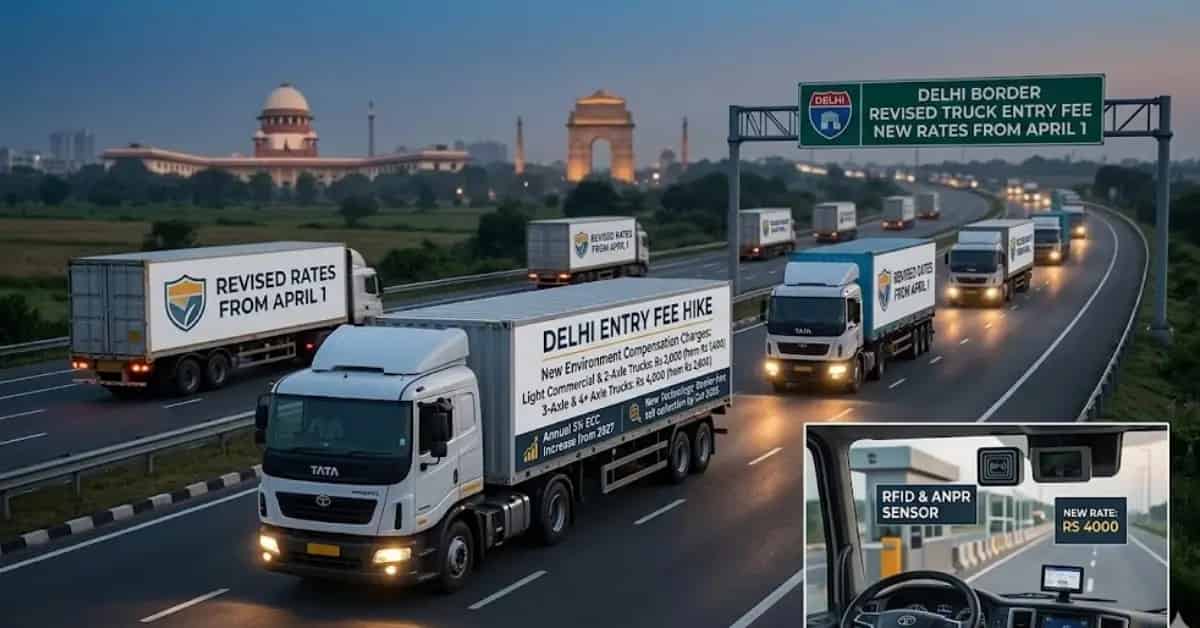


The Supreme Court has approved higher Environment Compensation Charges for trucks and commercial vehicles entering Delhi. The revised rates will take effect from April 1, 2026. The move aims to restore the deterrent effect of the charge and discourage heavy vehicles from passing through the national capital.
New Charges for Different Vehicle Categories
Small commercial vehicles and two-axle trucks will now pay Rs 2,000 instead of Rs 1,400. Three-axle trucks and vehicles with four or more axles will pay Rs 4,000, up from Rs 2,600. The bench comprising Chief Justice Surya Kant and Justices Joymalya Bagchi and Vipul M. Pancholi approved the proposal from the (CAQM) Commission for Air Quality Management.
Annual 5% Road Tax Increase Starting from 2027
The court also approved a 5% annual increase in ECC rates starting April 1, 2027. This aligns with the average annual rise in toll rates on national highways. The bench described the increase as reasonable and consistent with the original intent when the charge was introduced in 2015.
Ring Roads Called a "Complete Failure"
During discussions on Delhi's traffic, Chief Justice Surya Kant made strong remarks. He said the "concept of ring roads has become a complete failure. Big flop." He noted that he argued against ring roads in 2002 but was not heard properly. Additional Solicitor General Aishwarya Bhati responded that the court can now rectify it.
Why Were Rates Hiked Now
ECC rates had remained unchanged since 2015. Toll charges on the Eastern and Western Peripheral Expressways have been periodically increased during this period. The cost difference between travelling through Delhi and using the expressways had reduced significantly. This made it economically viable for freight vehicles to continue passing through the capital. The situation contributed to traffic congestion and increased emissions of particulate matter and nitrogen oxides in Delhi.
Court's Original Intent from 2015
The Environment Compensation Charge was first introduced by the Supreme Court in October 2015 in the MC Mehta vs Union of India case. The court had noted that although alternative routes existed, many commercial vehicles entered Delhi to avoid paying higher tolls on peripheral highways. This added to pollution levels in the city. The funds collected were meant to augment public transport and improve road infrastructure, particularly for cyclists and pedestrians.
CAQM's Assessment and Recommendation
CAQM told the court that current ECC rates had lost their deterrent value due to inflation, rising vehicle operating costs, and higher toll charges on alternative routes. A comparative assessment showed the difference between using peripheral expressways and travelling through Delhi was no longer significant enough to discourage transit traffic.
The commission recommended revising rates to restore deterrence value and create a stronger economic incentive for non-destination freight traffic to bypass Delhi.
Technology Upgrades at Toll Points
To improve compliance and reduce congestion, CAQM also proposed technological measures. It is recommended that the Municipal Corporation of Delhi install a barrier-free Multi-Lane Free Flow toll collection system by October 2026. The system will integrate RFID and Automatic Number Plate Recognition technology at all 126 toll collection points. Such systems allow seamless toll and ECC collection without requiring vehicles to stop, reducing congestion at Delhi's border entry points.
Also Read : NHAI Signs MoU with Truck Aggregators for Driver Safety, Highway Alerts