
Blog Details
12 Tyre Truck Load Capacity in India 2026: Tonnes, CFT & Brass
Summary
What a four-axle 12 wheeler can legally carry in tonnes, cubic feet and brass and the simple arithmetic that gets you to the number.
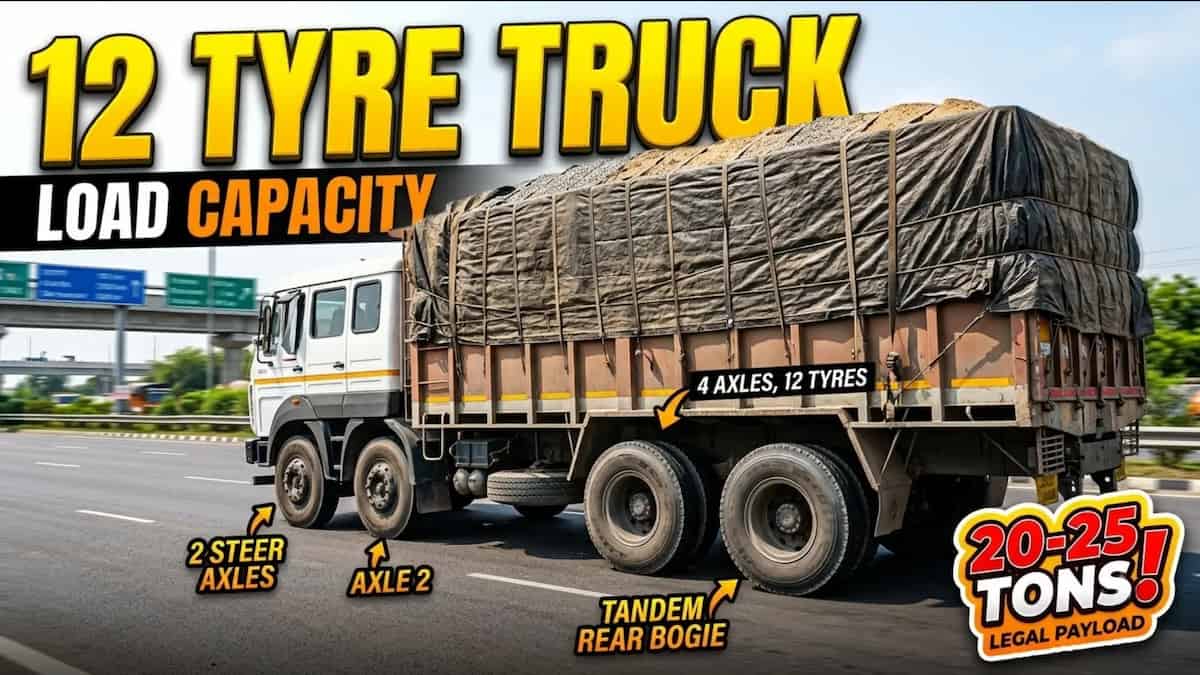


A 12 tyre truck (also called a 12 chakka or 12 wheeler ) carries 20 to 25 tonnes of legal payload in India. Every 12 tyre truck has the same gross vehicle weight (GVW) of 35 tonnes. Subtract the unladen weight — the truck plus its fitted body, usually 11,000 to 14,000 kg — and what is left is yours to load. In volume, that is roughly 450 to 500 cubic feet, or about 5 brass of sand.
Popular 12 tyre trucks include Eicher Pro 6035 and Tata Signa 3523.TK, priced at ₹38.50 lakh and ₹49.23 lakh respectively.
Two Types of 12 Tyre Truck in India 2026
Count the tyres from the front and the layout is always the same. Two on the front steering axle. Two on the second axle. Eight on the twin rear bogie, four per axle. Four axles, twelve tyres on the road.
Two different trucks wear those twelve tyres, and the difference matters when you buy.
8x2 Haulage 12 Wheeler
The second axle carries weight but is not driven. On most models it is a lift axle, so you can raise it when you are running empty and save tyre wear and toll. This is the standard long-distance goods truck: the Tata Signa 3525.T, the Ashok Leyland 3520 and the Tata LPT 3521 are all 8x2.
8x4 Tipper and Mining Build
Two steering axles up front, both rear axles driven. You lose nothing in capacity but gain grip on loose ground, which is why tippers and transit mixers use it.
Both are registered at the same 35,000 kg, so load capacity does not change between them.
One thing that trips up new owners: the lift axle is not just a tyre-saving trick. Raise it while the truck is loaded and the weight it was meant to carry shifts onto the bogie behind it. The truck is still under 35 tonnes overall, but that rear bogie is now over its own limit — and that is the figure a weighbridge records.
12 Tyre Truck Load Capacity in Tons
Three numbers decide what you can load, and two of them are already printed on your registration certificate.
- Gross vehicle weight is the ceiling — the heaviest the loaded truck may be on a public road. For every 12 tyre truck sold in India it is 35,000 kg.
- Unladen weight is the truck as it stands empty, with its body fitted, a full tank and the spare wheel on board.
- Payload is simply the first minus the second.
Do this with your own RC book
Open the registration certificate. Find the field marked Gross Vehicle Weight and the one marked Unladen Weight. Subtract the second from the first. That figure, to the kilogram, is your legal load — and it is the same subtraction an RTO officer does at a checkpoint.
GVW 35,000 kg − unladen weight 12,400 kg = 22,600 kg legal payload
No generic number online beats this one, because no two bodies weigh the same. A steel tipper body is heavier than a flatbed. A container body is heavier again. Your RC already accounts for all of it.
Why the published figures are all different
The payload an OEM prints is for the bare chassis, before any body goes on. That is why brochure figures look generous.
|
Model |
GVW |
Rated payload (bare chassis) |
Realistic load once a body is fitted |
|
Tata Signa 3523.TK |
35,000 kg |
26,000 kg |
around 23 tonnes |
|
Eicher Pro 6035 |
35,000 kg |
25,000 kg |
around 22 tonnes |
|
BharatBenz 3528C |
35,000 kg |
20,600 kg |
around 18 tonnes |
The last column assumes a standard steel fixed-side open body of roughly 2.5 tonnes. Ask your body builder for the exact weight — it goes on the body-builder's certificate, and it is what the RTO uses to set the unladen weight on your RC.
So when a broker quotes you "26 tonne capacity", check which number he is quoting. It is almost always the chassis figure, and you will be two to three tonnes short of it on the road.
12 Tyre Truck Load Capacity in Cubic Meter, CFT and Brass
If you are moving sand, stone or gravel, tonnes are not how you buy or sell. You buy in brass. One brass is 100 cubic feet, or 2.83 cubic metres, and what it weighs depends entirely on the material.
Here is the same 22-tonne legal load, converted.
|
Material |
Weight of 1 brass |
Fits in one legal load |
Volume |
|
River sand |
4.7 tonnes |
4.7 brass (470 cft) |
13.3 m³ |
|
M sand |
4.95 tonnes |
4.4 brass (440 cft) |
12.6 m³ |
|
20 mm aggregate |
4.4 tonnes |
5.0 brass (500 cft) |
14.2 m³ |
|
10 mm aggregate |
4.6 tonnes |
4.8 brass (480 cft) |
13.6 m³ |
For anything else, divide your payload by the weight of one piece. At 22 tonnes you get roughly 6,300 to 7,300 clay bricks, depending on whether they weigh 3 kg or 3.5 kg each, or 440 cement bags of 50 kg.
Fill the body and you will be three times over the limit
This is the part that costs people money. A 32 ft open body measures roughly 32 × 7.5 × 6 feet, which is about 1,440 cubic feet of space. Load river sand all the way to the top rails and you have 14.4 brass on board — close to 68 tonnes on a truck rated for 22.
Sand and stone run out of weight long before they run out of room. On a correctly loaded 12 wheeler, sand sits at roughly a third of the body height. If your load looks level with the rails, it is not a full load. It is a challan.
12 Tyre Truck Dimensions in Length, Width and Cargo Space
The chassis is the same. The body is what you choose, and 12 wheelers are sold with bodies from 22 to 32 feet.
|
Body length |
Metres |
Cargo volume (open body) |
Common on |
|
22 ft |
6.7 m |
about 990 cft |
Tata Signa 3525.T, Tata LPT 3521 |
|
24 ft |
7.3 m |
about 1,080 cft |
Ashok Leyland 3520, most haulage builds |
|
26 ft |
7.9 m |
about 1,170 cft |
Ashok Leyland 3520, Eicher Pro 6035 |
|
28 ft |
8.5 m |
about 1,260 cft |
Tata Signa 3525.T, Ashok Leyland 3520 |
|
30 ft |
9.1 m |
about 1,350 cft |
Ashok Leyland 3520 |
|
32 ft |
9.8 m |
about 1,440 cft |
Tata Signa 3525.T, Tata LPT 3521 |
Volumes assume a standard 7.5 ft wide open body with 6 ft sides. A closed container body is taller inside, so it holds more air but weighs more empty, and that comes straight out of your payload.
Width and height are fixed by law, not by choice. Rule 93 of the Central Motor Vehicles Rules caps a goods vehicle at 2.6 metres wide and 3.8 metres tall overall. Every standard body is built to sit inside that.
The length limit is the one worth knowing. A rigid multi-axle truck may not exceed 12 metres overall — cab, body and all. A 32 ft body puts you near that ceiling, which is why you will not find a 36 or 40 ft rigid 12 wheeler. Past 32 feet, the market moves to trailers.
For how this size sits against every other truck on Indian roads, see our guide to truck dimensions in feet in India. If you are specifically after a closed box, our breakdown of container truck size in India covers the internal measurements.
Best 12 Wheeler Trucks in India
Every one of these is registered at 35,000 kg, so the choice comes down to engine, body options and price.
|
Model |
Power |
Torque |
Rated payload |
Body lengths |
Price (ex-showroom) |
Best for |
|
240 HP |
900 Nm |
25,000 kg |
26–31 ft |
₹38.50–45.50 lakh |
Lowest entry price in the class |
|
|
220 HP |
850 Nm |
26,000 kg |
varies by build |
from ₹49.23 lakh |
The highest rated payload here |
|
|
281 HP |
1100 Nm |
20,600 kg |
varies by build |
₹50.13 lakh |
Ghat sections and hill routes |
|
|
200 HP |
850 Nm |
8,600 |
22, 24, 28, 32 ft |
₹34.40 lakh onwards |
Budget haulage on flat routes |
|
|
200 HP |
700 Nm |
12,000 |
24, 26, 28, 30, 32 ft |
₹42.50 lakh |
The widest choice of body lengths |
One line on body type before you sign anything. An open fixed-side body is the lightest and gives you the most payload. A tipper or hyva body costs you two to three tonnes of that payload in steel and hydraulics, which is the trade for self-unloading. A closed container sits in between on weight and is the only sensible choice for cargo that must stay dry.
Where the 35,000 kg Comes From, and What Breaking It Costs
The figure is not a Tata or Ashok Leyland decision. It is built up axle by axle from a central government notification — MoRTH's S.O. 3467(E), dated 16 July 2018, which raised India's safe axle weights by roughly a fifth.
Add up what each axle on a 12 wheeler is allowed to carry:
|
Axle |
Tyres |
Safe weight |
|
Front steering axle |
2 |
7,500 kg |
|
Second axle |
2 |
7,500 kg |
|
Rear tandem bogie |
8 |
21,000 kg |
|
Total |
12 |
36,000 kg |
Manufacturers register the vehicle a notch below that, at 35,000 kg, which leaves a small margin. Trucks on pneumatic suspension are allowed an extra tonne per axle. No rigid vehicle, whatever its axle count, may exceed 49 tonnes.
Two things people miss. The limit applies per axle as well as in total, so a truck under 35 tonnes overall can still be overloaded if the weight is sitting on the wrong axles. And the GVW that matters in a challan is the one on your RC, not the one in the brochure.
What an Overloaded Truck Costs
Under the Motor Vehicles Act, the first tonne over the truck's load limit is ₹20,000. Every tonne after that is ₹2,000 more, with no upper cap. The vehicle is held at the weighbridge until the excess is offloaded, so you also pay for the detention, the second truck and the delay.
At five tonnes over, that is ₹28,000 before you count the day you lost. Keep the weighbridge slip from every trip — our guide on how to read a weight slip for a truck shows which figure on it the RTO actually checks.
Is a 12 Tyre Truck the Right Size for Your Load?
Tyre count is really axle count, and axle count is what sets the ceiling.
|
Truck |
Axles |
GVW |
Typical legal payload |
|
6 tyre |
2 |
18,500 kg |
9–12 tonnes |
|
10 tyre |
3 |
28,500 kg |
16–19 tonnes |
|
12 tyre |
4 |
35,000 kg |
20–25 tonnes |
|
14 tyre |
5 |
43,500 kg |
26–30 tonnes |
|
22 tyre (truck-trailer) |
6+ |
up to 55,000 kg |
30–40 tonnes |
Payload figures are indicative. Your own RC gives the exact one.
Run these three checks before you commit:
-
Is your regular load between 20 and 25 tonnes? Below 19, a 10 wheeler burns less diesel and costs less in tyres for the same job. Above 26, you need a 14 tyre or a trailer, and no amount of careful loading changes that.
-
Is your cargo heavy for its size? Sand, stone, cement, steel, tiles and fertiliser all hit the weight limit with the body half empty. Light bulky goods do the opposite — you will fill 1,400 cubic feet and still be ten tonnes under, which means you are paying for capacity you cannot use.
-
Can your pickup and delivery points handle a 12-metre vehicle? Narrow mandi lanes, basement loading bays and village approach roads are where this size stops working, whatever the payload says.
Before You Book or Buy a 12 Wheeler Truck
-
Do the GVW minus unladen weight subtraction yourself, off the RC, before the first trip
-
Ask the seller or broker whether the capacity quoted is chassis payload or loaded payload
-
Match the body length to your usual cargo, not to the biggest number on offer
-
Confirm the lift axle stays down whenever the truck is loaded
-
Weigh the empty truck once at a public weighbridge and keep that slip in the cabin
-
Budget for a tipper body costing you payload, if self-unloading matters more than tonnage
If you are still deciding between sizes, our 22 ft truck capacity guide covers the step below, and the difference between trucks and trailers explains when it stops making sense to buy a rigid at all.