Blog Details
Why Is Horn OK Please Written on Trucks?
Summary
Ever wondered why Indian trucks display Horn OK Please? Discover its meaning, history, popular origin theories and connection with Indian trucking culture.
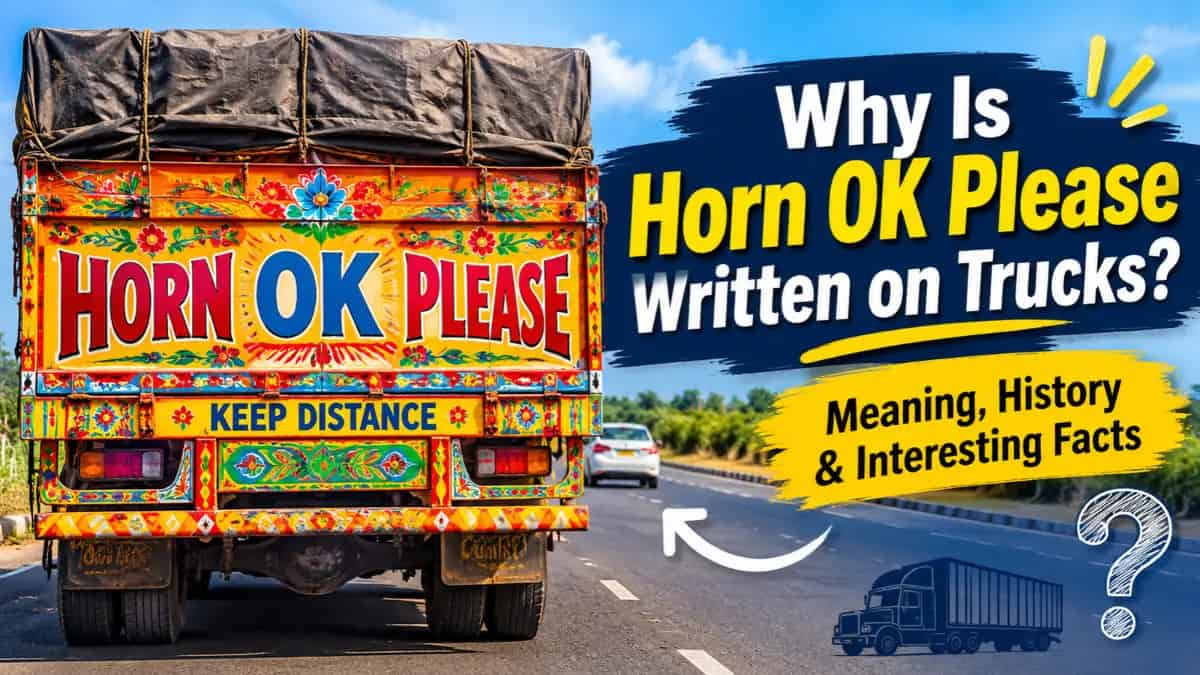


If you travel on Indian highways, you have probably seen the words "Horn OK Please" painted in large, colourful letters on the back of trucks. From small pickup vehicles to heavy commercial trucks, this message has become one of the most familiar sights on Indian roads.
But have you ever wondered why Horn OK Please is written on trucks? Does it have a special meaning, or is it simply a traditional message used by truck drivers?
The phrase is generally associated with asking vehicles approaching from behind to sound their horn before overtaking. However, its exact origin is still debated. Some popular theories connect it to World War II fuel shortages, while others suggest that an old detergent brand played a role in making the phrase popular.
Let's understand the Horn OK Please meaning, why Indian trucks display this message and how it became an important part of Indian trucking culture.
What Does Horn OK Please Mean?
Horn OK Please is a traditional message written on the back of Indian trucks to encourage approaching drivers to sound their horn before overtaking.
The message is associated with communication between truck drivers and vehicles travelling behind them. Since large trucks have blind spots and limited rear visibility, an approaching vehicle making its presence known can help the truck driver remain aware of nearby traffic.
The phrase is commonly understood in the following way:
-
Horn: Sound your horn to alert the truck driver.
-
OK: A middle word whose original meaning is uncertain.
-
Please: A polite request to approaching motorists.
Although the phrase does not follow conventional English sentence structure, it has become widely recognised across India.
It is also important to understand that sounding a horn does not automatically mean it is safe to overtake. Drivers should always check road conditions, visibility and oncoming traffic before passing a truck.
Why Is Horn OK Please Written on Indian Trucks?
There are several explanations for why Horn OK Please appears on Indian trucks. Its association with overtaking and communication on older roads is one of the most widely discussed explanations.
Here are the main reasons behind its popularity.
1. To Alert Truck Drivers Before Overtaking
Large commercial vehicles have bigger blind spots compared with most passenger cars. A driver sitting inside a truck may not always notice a smaller vehicle approaching from behind.
Traditionally, sounding the horn was a way for approaching motorists to alert the truck driver before overtaking.
This message became particularly familiar on roads where trucks and other vehicles shared narrow lanes and overtaking required extra attention.
However, modern drivers should not depend only on horns. Indicators, mirrors and safe overtaking practices are equally important.
2. A Tradition from Older Indian Highways
Earlier, many Indian roads had single carriageways with limited space for overtaking. Drivers had to carefully judge the distance from oncoming traffic before passing a slow-moving truck.
One popular historical explanation suggests that the word OK was once associated with a signal from the truck driver indicating that overtaking was safe.
According to this account, a light was placed above the word OK. When the road ahead was clear, the truck driver could switch it on to indicate that the following vehicle could overtake.
Although this story is not conclusively documented, it reflects the driving conditions on older Indian roads.
3. Part of Indian Truck Decoration
Indian trucks are well known for their colourful artwork, decorative lettering and traditional messages.
Truck owners often customise the rear and sides of their vehicles with different slogans, religious symbols and paintings. Horn OK Please became one of the most recognisable messages in this tradition.
Even today, many commercial vehicles carry this phrase as part of their traditional appearance.
What Does OK Stand for in Horn OK Please?
The word OK is the most interesting part of the phrase because its exact origin has never been conclusively established.
Over the years, several explanations have become popular. Two frequently discussed theories connect the word to an old detergent brand and the fuel shortages during World War II.
1. The World War II and On Kerosene Theory
One popular theory traces the phrase back to World War II.
According to this explanation, diesel shortages during the war reportedly led some trucks to use kerosene as an alternative fuel.
Since kerosene was considered more volatile, a warning was supposedly painted on the back of vehicles:
"Horn Please, On Kerosene."
The message was intended to alert approaching motorists to the fuel being used. Over time, the words "On Kerosene" were supposedly shortened to OK, creating the familiar phrase Horn OK Please.
This explanation has been repeated in several articles, including a historical discussion published by Mahindra Truck and Bus.
However, there is no conclusive historical evidence establishing this as the actual origin. It should therefore be understood as a popular theory rather than a confirmed fact.
2. The OK Detergent Advertising Theory
Another popular explanation connects the phrase with an old detergent brand called OK, manufactured by Tata Oil Mills Company (TOMCO).
According to this theory, the detergent brand used a lotus symbol in its advertising. The OK branding was reportedly painted in the middle of the rear panels of trucks, where the words Horn and Please were already familiar.
Over time, the branding supposedly became part of the traditional truck message.
This theory is interesting because commercial vehicles were an effective way to display advertisements across different towns and highways.
However, the exact connection between the detergent advertisement and the widespread use of Horn OK Please remains uncertain.
3. The Overtaking Signal Theory
A third explanation suggests that Horn, OK and Please were used as a communication system between two drivers.
According to this theory, the following vehicle would sound its horn to indicate an intention to overtake. The truck driver could then communicate whether the road ahead was clear.
Some versions of the story also mention a light fitted above the word OK.
While this explanation is often associated with older Indian roads, there is no definitive evidence proving that this was the original meaning of the phrase.
So, what does OK actually mean?
There is no universally accepted answer. The kerosene, detergent advertising and overtaking signal explanations are all popular theories, but the precise origin remains uncertain.
Why Do Indian Trucks Have Different Messages Written on Their Backs?
Horn OK Please is not the only phrase found on Indian trucks. Commercial vehicles often carry different messages that reflect road safety, religious beliefs, personal expressions and traditional truck artwork.
Some commonly seen messages include:
|
Message |
What it generally communicates |
|
Horn OK Please |
Traditional reminder to alert the driver before overtaking |
|
Sound Horn |
Requests approaching drivers to use their horn |
|
Use Dipper at Night |
Reminds drivers to use dipped headlights |
|
Buri Nazar Wale Tera Muh Kala |
Traditional expression against the evil eye |
|
Maa Ka Aashirwad |
Expression of religious faith and blessings |
|
Keep Distance |
Reminder to maintain a safe distance |
These messages make Indian trucks visually distinctive. They also reflect the culture of drivers and vehicle owners who spend long periods travelling between cities, industrial areas and transport hubs.
For a better understanding of the commercial vehicles operating on Indian roads, you can also explore our guide to truck dimensions in India.
Is Horn OK Please Mandatory on Indian Trucks?
No. Horn OK Please is not a nationally mandatory message that every truck in India must display.
It is a traditional slogan rather than a compulsory vehicle identification or safety marking.
In April 2015, the Maharashtra transport department announced a restriction on displaying Horn OK Please on commercial vehicles. The decision was linked to concerns that the message could encourage unnecessary honking and contribute to noise pollution.
However, this was a state-level development and should not be confused with a nationwide requirement.
Truck owners and operators must follow the applicable motor vehicle regulations and safety requirements. Traditional messages do not replace legally required vehicle markings.
Is Horn OK Please Still Relevant on Modern Indian Trucks?
Yes, the phrase is still recognised on Indian roads, although its original practical purpose is less important in today's driving environment.
Modern commercial vehicles have improved safety features and better visibility systems. Highway infrastructure has also developed significantly, with wider roads and dedicated lanes on many routes.
Some features that help improve truck safety include:
-
Rear-view mirrors: Help drivers monitor vehicles approaching from behind.
-
Reverse cameras: Provide additional visibility while reversing.
-
Turn indicators: Communicate turning and lane-changing intentions.
-
Blind-spot monitoring: Helps detect vehicles in nearby blind areas on certain equipped models.
-
Improved braking systems: Support better vehicle control and stopping performance.
These features help drivers manage traffic more effectively, but they do not remove the need for careful driving.
Maintaining a safe following distance, checking mirrors, and overtaking only when the road is clear remain important precautions.
For more information about road safety and commercial vehicle responsibilities, read our guide to the hit-and-run law in India.
Why Is Truck Art So Popular in India?
Truck art is an important part of India's road transport culture. Many truck owners decorate their vehicles with colourful paintings, traditional patterns, religious symbols and personalised messages.
Unlike plain commercial vehicle designs, Indian trucks often feature artwork that makes each vehicle look different.
Some popular elements of Indian truck art include:
-
Bright colours and hand-painted lettering.
-
Religious pictures and symbols.
-
Flowers, birds and decorative patterns.
-
Traditional slogans and local expressions.
-
Personal messages and names.
For many truck owners, these decorations represent personal identity, faith and pride in their vehicles.
Horn OK Please has become one of the most recognisable parts of this artistic tradition, making it more than just a message on the back of a truck.
Conclusion
Horn OK Please is one of the most familiar phrases associated with Indian trucks and highway journeys. While its exact origin remains uncertain, the message is traditionally connected with alerting truck drivers before overtaking.
The different theories surrounding the word OK, including the World War II kerosene explanation and the detergent advertising theory, have made the phrase even more interesting.
Today, Horn OK Please represents more than a driving message. It is part of Indian trucking culture, traditional vehicle artwork and the identity of commercial vehicles travelling across the country.