Blog Details
17 Feet Truck Dimensions in India: Size, Payload & Top Models in 2026
Summary
The 17-footer earns its keep quietly. Here's everything you need to know before you book one.
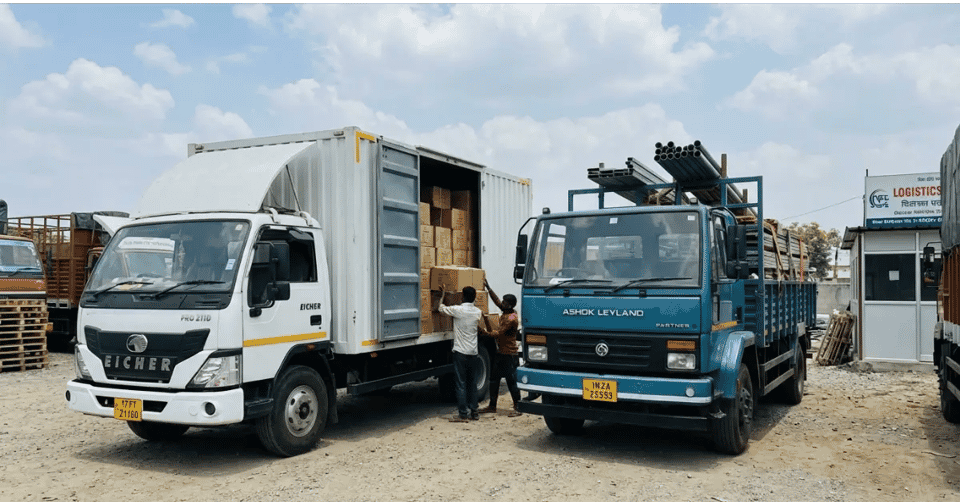


Most people booking a 17 ft truck assume they're getting something just a little bigger than a 14-footer. They're not. A 17 ft truck sits in a different league for payload and cargo volume. And confusing the two sizes on a sensitive consignment can mean two trips instead of one. Here's a complete breakdown of the dimensions, load capacity, top models, and use cases for the 17 ft truck in India.
Dimensions of a 17 Feet Truck in India
The standard cargo body dimensions of a 17 ft truck in India are:
17 ft × 6 ft × 7 ft (L × W × H)
In metres, that translates to approximately 5.18 m × 1.83 m × 2.13 m.
Internal cargo volume: 17 × 6 × 7 = 714 cubic feet (CFT)
That's enough to comfortably fit the contents of a 2.5 BHK apartment — furniture, appliances, and packed cartons included in a single trip.
Note that the "17 ft" refers to the cargo body length, not the overall vehicle length. Chassis and cab configurations vary by OEM (original equipment manufacturer), so the truck's total bumper-to-bumper length will be longer.
But here's what most shippers miss: the 6 ft internal width is a real constraint. Standard pallet width in India is around 1.1 m (3.6 ft), meaning you can fit two pallets side-by-side with room to spare. But trying to load wide industrial equipment without measuring first is a common and expensive mistake.
For a full side-by-side comparison across all truck sizes, see our guide on truck dimensions in feet in India.
17 Feet Truck Load Capacity
The 17 ft segment is primarily served by 6-tyre (single axle) trucks in India, which means one set of rear axle wheels rather than a tandem. Here's what that means for payload:
Typical payload range: 4.5 tonnes to 7.5 tonnes, depending on the model and GVW
GVW range: 7,490 kg to 11,990 kg
Multi-axle (MXL) variant: Not standard at this size. The 17 ft body is generally mounted on a single-axle (SXL) chassis
GVW (Gross Vehicle Weight) is the total permissible weight of the loaded truck. Your cargo, the driver, fuel, and the vehicle itself combined. If your cargo weighs 6 tonnes and the truck's GVW is 7,490 kg, you're very close to the legal limit before accounting for the truck's kerb weight. Always check payload, not GVW, when planning your load.
The most common overloading mistake at this size? Stacking light-but-bulky cargo like mattresses or packaged goods all the way to the roof and assuming weight is fine. Volume fills up before weight does on these trucks. A fully packed 714 CFT container can still be well under the weight limit, or vice versa with dense materials like tiles.
Best 17 Feet Truck to Buy in 2026
|
Model |
Power (HP) |
Payload (kg) |
Price (Ex-Showroom) |
Best For |
|
160 HP |
7,500 |
₹23.92 Lakh |
Regional logistics, FMCG runs |
|
|
160 HP |
~7,000 |
₹24.16 Lakh |
Long-haul, fuel-efficient ops |
|
|
~130 HP |
~3,600 |
₹16.49 Lakh |
Urban & semi-urban delivery |
|
|
140 HP |
4,050 |
₹22.00 Lakh |
City routes, budget-conscious ops |
The Eicher Pro 2110 series is the market leader in the 17 ft segment, trusted by fleet operators across the country for its fuel coaching technology, 7-speed gearbox, and 7,500 kg payload. Which is the highest in class at this body size. If fuel cost per km is your primary concern, this is the truck to shortlist first.
2 Body Options to Choose From
Both body types are widely available on 17 ft chassis in India.
Open body (flatbed/platform) works best when:
-
Your cargo is irregularly shaped — steel bars, pipes, scaffolding, construction materials
-
You need to crane-load or forklift from the side
-
Height clearance is not an issue on your route
Closed container (box truck) makes more sense when:
-
You're moving packaged FMCG, electronics, textiles, or pharmaceuticals
-
The route involves overnight transit or monsoon-season runs
-
Your consignee requires sealed delivery documentation
The simple rule: if rain or dust can damage the goods, book the closed container. If cargo is self-weatherproof or oversized, go open body.
Real Use Cases of 17 Ft Trucks in India
Retail supply chain and FMCG distribution:
Replenishing district-level distributor stock on 300–500 km runs. The 714 CFT volume handles mixed-SKU loads cleanly without the cost overhead of a larger truck.
Household shifting (2.5 BHK):
The 17 ft closed container is the standard booking for a 2–3 bedroom move between cities. Fits furniture, appliances, cartons, and a few oddly-shaped items without needing a second vehicle.
E-commerce hub-to-spoke:
Loads from a regional fulfilment centre to district delivery hubs. The closed body protects high-value parcels; the 5–7 tonne payload handles dense carton loads efficiently.
Textile and apparel logistics:
Bulk bale movements from manufacturing clusters (Surat, Tiruppur, Ludhiana) to wholesale markets. Open body works for baled fabric; closed container for finished garments.
Pharma regional distribution:
Temperature-sensitive medicines don't need a reefer on short runs, but do need a closed container. The 17 ft size is common for state-level pharma distributor runs.
Light building materials:
Tiles, sanitary ware, plywood, and pre-painted sheets — goods that are heavy enough to need a proper truck but low enough in volume to not require a 20 ft body.
3 Questiones To Counter Before YOU Buy
Run through these three questions before booking:
1. What is your cargo weight?
If the total load is under 4 tonnes, a 14 ft truck will be more cost-effective. If it's over 8 tonnes, you need at least a 19 ft truck.
2. What is your cargo volume?
If your consignment fills more than ~700 CFT, you've outgrown the 17 ft body — step up to an 18 or 19 ft truck.
3. What is your route?
The 17 ft is best on state highways under 600 km. For longer runs of 800+ km, a larger truck with bigger fuel tank options (like the Eicher Pro 2110 with the 425L tank variant) makes better financial sense.
If your cargo is heavier or bulkier than this size handles, check out our 16 feet truck dimensions guide for lighter loads or our 18–19 ft guides for larger consignments.
Legal Limits and Permits You Need to Know
Under the Central Motor Vehicles Rules (CMVR) and the Motor Vehicles Act, 1988 (as amended), the following limits apply to trucks in this category:
-
Maximum width: 2.5 metres (8.2 ft). Standard 17 ft trucks are within this
-
Maximum height: 4.5 metres from ground (overall vehicle height)
-
Maximum GVW for single-axle trucks: As per the MoRTH 2018 revision, permissible GVW limits depend on the axle configuration and tyre type; for most 6-tyre single-axle trucks in this segment, the limit ranges from 7.5 to 12 tonnes
-
Special permits: Not required for standard cargo at this size; ODC (Over Dimensional Cargo) permits are only needed if cargo overhangs the body or exceeds legal height/width
The overloading penalty under the Motor Vehicles (Amendment) Act, 2019 starts at ₹20,000 for the first offence and increases for repeat violations and weight-in-motion cameras at state border checkposts make enforcement real, not theoretical.
Before You Book This Truck
-
Confirm whether you need open body or closed container. This affects both price and transit safety
-
Check the actual payload of the specific model being offered, not just the body size; a 17 ft Ashok Leyland Partner carries significantly less than a 17 ft Eicher Pro 2110
-
Measure your cargo's volume in CFT before booking. 714 CFT fills faster than most shippers expect
-
Ask for the GVW and kerb weight certificates if you're crossing state borders with a heavy consignment
-
For monsoon-season moves or electronics, always insist on a closed container body
Use the TruckOnWheels platform to compare live rates and verified truck listings for your specific route