Blog Details
20 Feet Vehicle Capacity: Payload, Truck Models, GVW, Cargo Length
Summary
The complete guide to what a 20 Feet vehicle can actually carry and how to avoid paying more for a truck than you need.


The 20 feet vehicle is one of the most searched truck sizes in India right now. And for good reason. It sits right in the sweet spot between a small Eicher 17 ft and a heavy 32 feeter. But here's what most people miss: the same "20 feet" label can mean very different things depending on axle configuration and body type.
What Are the Exact Dimensions of a 20 Feet Vehicle in India?
A standard 20 feet vehicle in India typically measures approximately 20 ft (L) × 7.5 ft (W) × 8 ft (H). Some variants, especially open platform trucks, run slightly narrower at 7 ft width.
(Click here to learn more about truck dimensions in feet in India)
The internal cargo volume works out to roughly 33 cubic meters (around 980–1,100 CFT), which is substantial. To put it in context, that's enough space to comfortably fit the contents of a 4 BHK apartment.
What changes with different variants is the weight capacity and that's where most shippers go wrong.
20 Feet Vehicle Load Capacity: Single Axle vs. Multi Axle
This is the number that really matters for your logistics decision:
20 Ft Single Axle (6 Tyre):
-
Load capacity: 6 to 7.5 tons
-
Best for: lighter cargo, urban to inter-city runs, e-commerce, FMCG
20 Ft Multi Axle (10 Tyre):
-
Load capacity: up to 16 tons
-
Best for: heavy industrial goods, factory-to-warehouse bulk movement, longer routes
If your shipment is heavy but not bulky, the multi-axle 20 feeter often beats a larger single-axle truck on cost per ton. That's a number worth paying attention to.
Best 20 Feet Trucks in India Right Now
Here are the top vehicles available with a 20-foot body option, ranked by what they're best at:
|
Model |
Power |
Payload |
Price (ex-Delhi) |
Best For |
|
180 HP |
11,100 kg |
₹26.28 Lakh |
Best overall + resale |
|
|
180 HP |
~10,000 kg |
₹24.23 Lakh |
City-highway mix |
|
|
160 HP |
10,572 kg |
₹21.46 Lakh |
Best payload/price |
|
|
170 HP |
9,750 kg |
₹22.22 Lakh |
Long-haul uptime |
|
|
150 HP |
10,800 kg |
₹27.50 Lakh |
Leyland fleet operators |
|
|
155 HP |
10,341 kg |
₹27.49 Lakh |
First-time buyers |
Open Platform Vs Closed Container : Which One Do You Need?
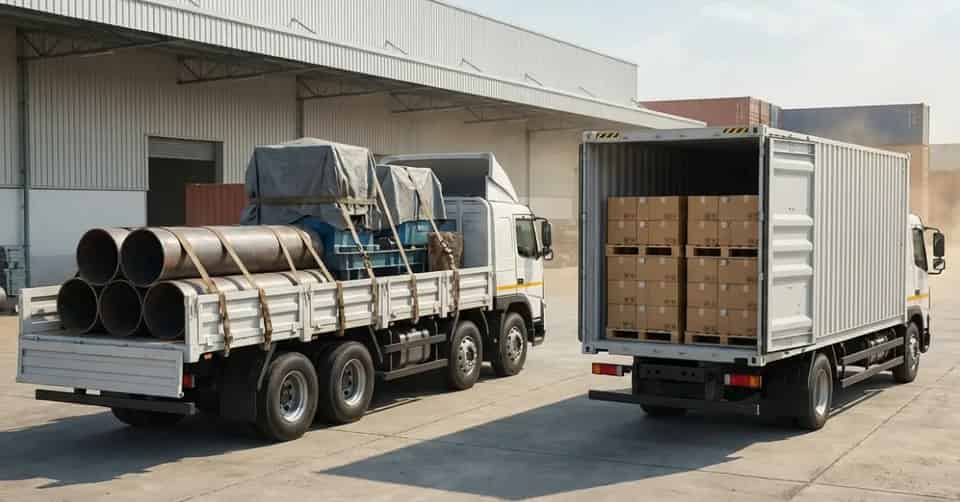
The 20 feet size comes in two primary body types, and choosing the wrong one is an expensive mistake.
Closed Container (Box Truck)
Fully enclosed body with weather protection. Ideal for electronics, pharmaceuticals, FMCG, textiles, and any goods that cannot be exposed to dust or rain. If your cargo has high value or needs security against pilferage, this is the right choice.
Open Platform (Flatbed)
No sides, no roof. Designed specifically for over-dimensional cargo (ODC). Think large machinery, steel structures, construction equipment, or industrial goods that can't be loaded through a rear door. Open platform 20 feeters can carry between 6 MT and 10 MT comfortably, with heavy-duty variants handling more with the right axle setup.
The Catch Nobody Tells You About
A 20 feet vehicle in India is excellent for medium-distance runs. Typically 250 to 500 km. For routes longer than that, industry experience shows that a 32 feeter often becomes more cost-effective per ton-kilometre, even if you're not filling it completely. If you're running Delhi to Mumbai regularly with 7-ton loads, it's worth doing that math before defaulting to a 20 feeter every time.
On the flip side, for last-mile urban delivery, a 20-ft closed container is often easier to manoeuvre than a 32 feeter and runs into fewer access issues at delivery points in congested areas.
What Industries Use the 20 Feet Vehicle Most?
Based on typical usage patterns across Indian logistics:
-
Factories moving inventory to regional warehouses: the 20 feeter handles one pallet stack cycle cleanly
-
Electronics and appliance distributors: the closed body protects high-value cargo
-
Pharmaceutical companies: temperature-sensitive goods benefit from the enclosed, secure body
-
FMCG and retail: ideal for replenishing regional distribution centres
-
Construction and heavy industry: open platform variants for pipes, machinery, and steel
Is a 20 Feet Truck Right for YOUR Shipment?
Ask yourself three quick questions before booking:
-
Does your cargo weigh between 4 and 10 tons? If yes, a single-axle 20 feeter fits your load without overpaying for a larger vehicle.
-
Is your route under 500 km? The 20 feeter is most cost-efficient in this range.
-
Does your cargo need weather protection? Go closed container. Oversized or irregularly shaped load? Go open platform.
If all three answers point to yes, you've found your truck. If your load is heavier than 10 tons, look at the multi-axle 20 feeter or step up to a 22 feeter.
Book the Right Truck Without the Guesswork
At TruckOnWheels, you can calculate 20 feet truck vehicle EMI before you commit. Whether you need a single-axle container for your next FMCG dispatch or an open platform 20 feeter for industrial machinery, we'll help you plan your budget accordingly.
The right truck doesn't just carry your goods. It protects your margins.